·amura·
38
compás int •
compass int
the Fall’s zigzags
its way through hills, creating in-
tense rapids that roar from the belly of this beast.
It is a strange sight to admire; an effort by nature
to create one of the most marvelous sights in the
world by means of a small fissure in the land.
David Livingstone, a consummate Scotsman,
motivated by faith and desire to put a stop to
the slave trade, explored the Kalahari and upper
Zambezi deserts between 1842 and 1856. In 1855
he became the first white man to admire what
he would later name “Victoria Falls”, in honor of
Queen Victoria. He promptly returned to England,
yet returned many times thereafter, accompanied
by missionaries, and on his third and last trip, in
1866, he ventured once more northwards in search
of the Nile spring.
Unfortunately, it was his violent and stubborn
temper that, in 1869, prompted his missionaries
to abandon him, for which he disappeared for two
years. Henry Stanly, a journalist at the time, did
not believe him dead. He proceeded to search for
Dr. Livingstone, until one day, in 1871, at the edge
of Lake Tanganyika, he found him, and thus uttered
the now celebrated phrase: “Mr. Livingstone I
Zambesi, formando unos sorprendentes y fuertes rá-
pidos que rugen en el fondo de esa profunda garganta.
Es un extraño paisaje, un insólito esfuerzo de la
naturaleza para convertir esa falla natural dentro de
la roca basáltica en una de las maravillas del mundo.
El escocés David Livingstone, motivado por su fe
y su deseo de acabar con el tráfico de esclavos, exploró el
desierto del Kalahari y el Zambezi superior entre 1842
y 1856. En 1855 se convirtió en el primer hombre
blanco en contemplar las cataratas que bautizó en
honor a la reina Victoria y volvió a Inglaterra. Regresó
varias veces a África, acompañado por misionarios y
en su tercero y último viaje, en 1866, se aventuró más
al norte en busca del manantial del Nilo.
En 1869, su temperamento terco y violento
provocó que sus ayudantes lo abandonaran, y
desapareció 2 años. El periodista Henry Stanley no lo
creyó muerto y partió en su búsqueda hasta que
un día de 1871, en la orilla del lago Tanganyika, lo
encontró, inmortalizando estas palabras “Dr. Livings-
tone, I presume”. Enfermo y desfalleciente, no quiso
regresar a Inglaterra. David Livingstone había
recorrido solo esas regiones desconocidas, descu-
briendo ríos, lagos y tribus en su eterna búsqueda
1
2
3
4
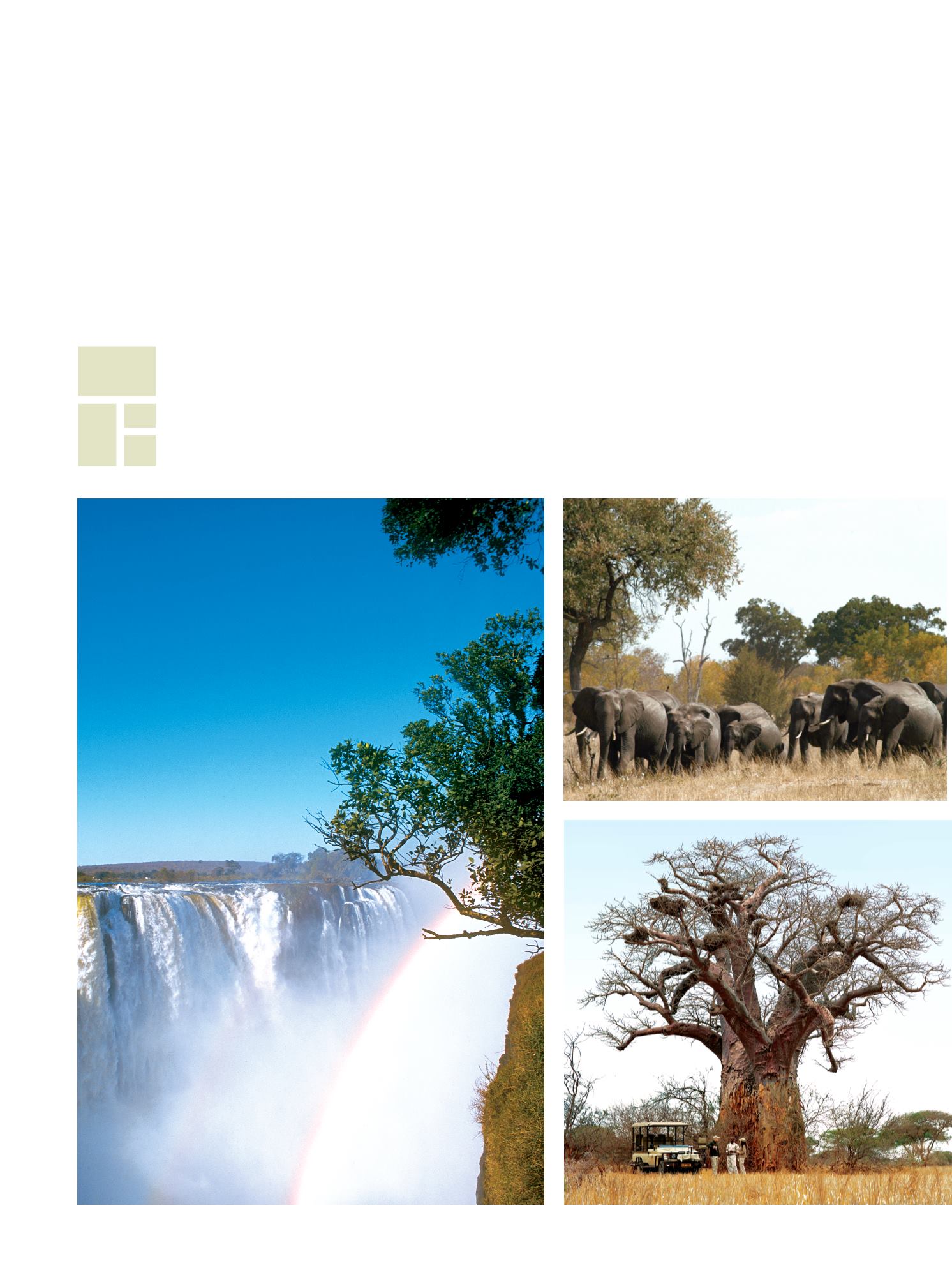
1. Cataratas de
Victoria, Zimbabue. /
Victoria Falls,
Zimbawe.
2. Cataratas de
Victoria, Zambia. /
Victoria Falls,
Zambia.
3.Desierto del
Kalahari, Zimbabue./
Kalahari Desert,
Zimbawe.
4. Baobab, el árbol
más representativo
de África del Sur. /
Baobab, the most
representative tree
in South Africa.


