Granada y Sevilla son las dos ciudades españo-
las que mayor y mejor colección de ejemplos tienen
de la arquitectura mudéjar. Sevilla se considera una
de las ciudades más bellas del país, por su armónica
combinación de lo ancestral y lo contemporáneo.
Si bien Córdoba fue durante tres siglos el centro
político para los árabes, Sevilla lo fue para los al-
mohades (dinastía marroquí que dominó el sur de
la península ibérica de 1147 a 1269) desde la mitad
del siglo XII. Fernando III entró a Sevilla, capital de
Al-Ándalus, en 1248.
La belleza arquitectónica que habían construido los
invasores en Sevilla, muestra deslumbrante de la cultura
que les distinguía, no pasó desapercibida para los espa-
ñoles. Sin embargo, como en otros casos similares, los
vencedores al principio se negaban a asimilar este arte.
Por entendible orgullo, preferían preservar la propia
arquitectura, la europea y cristiana, que consistía sólo
en líneas sobrias y dimensiones monumentales. Pero
poco a poco se relaja tal rigidez y los españoles termi-
nan por rendirse ante la belleza de los edificios erigi-
dos por los musulmanes.
Granada and Sevilla are the two Spanish cities
which have the largest and best collection of Moor-
ish architecture exaamples. Seville is considered
one of the most beautiful cities of the country, for
its harmonious combination of the ancient and the
contemporary.While Cordobawas for three centuries
the political center for the Arabs, it was Sevilla to the
Almohads (Moroccan dynasty who dominated the
south of the Iberian Peninsula in 1147-1269) from
the middle of the twelfth century. Fernando III en-
tered Sevilla, capital of Al-Andalus, in 1248.
The architectural beauty that the invaders
built in Seville, is a dazzling display of the culture
that distinguished them.It was not unacknowl-
edged by the Spanish. However, as in similar cases,
the victors refused at first to assimilate the art.
Because of understandable pride, theypreferred to
preserve the European and Christian architecture,
which consisted of sober lines and monumental
proportions. Gradually the Spanish relaxed this ri-
gidity and eventually surrender to the beauty of the
buildings erected by the Muslims.
4
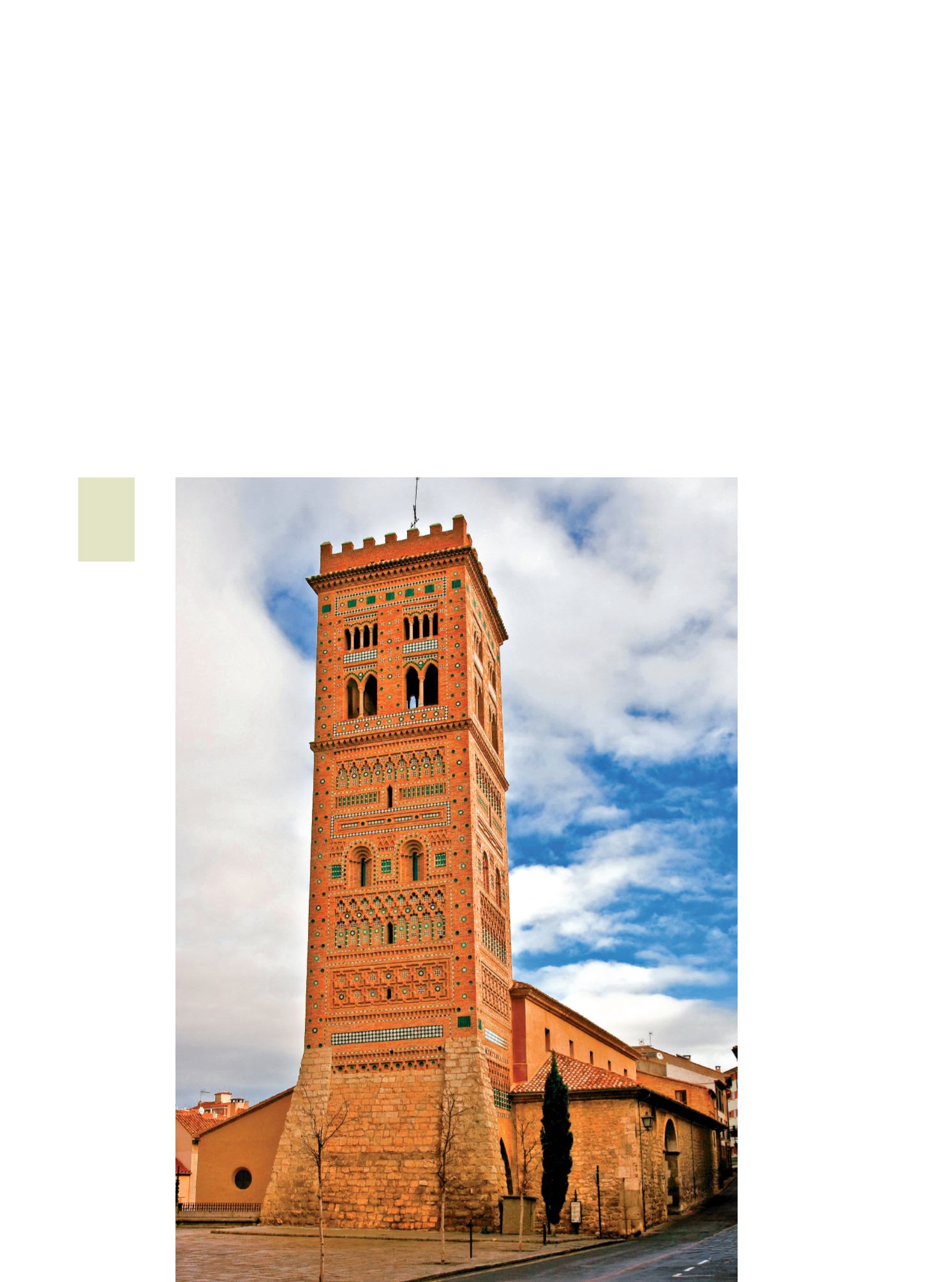
4. Torre mudéjar de la
Iglesia de San Martín
en Teruel, Aragón,
España. /
Mudejar
towerintheChurch
ofSanMartín.Teruel,
Aragón,Spain.
·amura·
148
los conquistadores •
the conquerors


