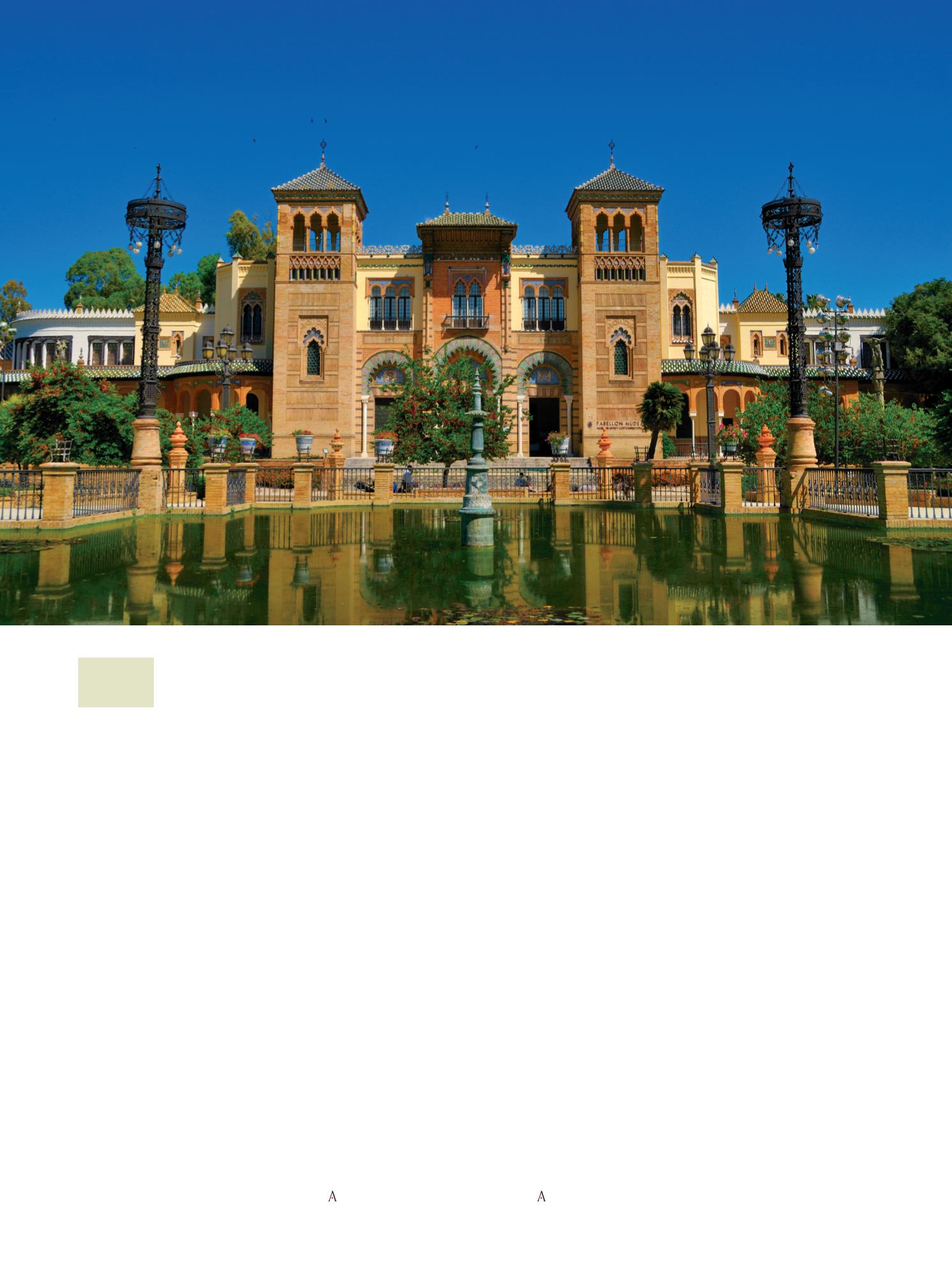
7
7. PabellónMudéjar.
Museo de Artes
y Costumbres
Populares en Sevilla,
España. /
Mudéjar
Pavillion.Museumof
ArtsandFolkwaysin
Sevilla,Spain.
cuando un terremoto afectó no sólo a éste sino a múl-
tiples mezquitas convertidas en templos cristianos.
Hace pocas décadas tuvo su más reciente restauración.
Este templo, además de sus detalles arquitectó-
nicos, guarda imágenes devocionales que por sí solas
valen la visita al interior: San Cayetano, Santa Ana, el
Cristo de la Exaltación, la Virgen de las Lágrimas, la
del Rosario, la del Carmen y Santa Lucía. Su admirable
puerta gótica, que también data del siglo XVI, antes
estuvo en la iglesia de Santa Lucía.
La torre de la iglesia de San Marcos, otro excelen-
te destino a visitar, se tiene por el mejor campanario
mudéjar de Sevilla. Tan marcada similitud tiene con la
Giralda almohade, que varios expertos sospechan que
es un alminar traído de algún otro sitio. No es genera-
lizada esta creencia, sino la de que se construyó en la
primera mitad del siglo XIV.
El Real Alcázar de Sevilla responde fielmente a ese
deseo que tuvo la monarquía de la época por construir-
se palacios de gran lujo que acentuaran su posición y su
poder, especialmente. Es un conjunto (para ser exactos:
Reales Alcázares de Sevilla) construido durante el rei-
nado de tres monarcas: Alfonso X, Alfonso XI y Pedro I.
Estos dos últimos se entregaron al mencionado propó-
sito de ostentación, como se deriva de las construccio-
nes que algunos estudiosos atribuyen a ellos.
El Alcázar de Sevilla nuestra la participación de
artistas granadinos, toledanos y sevillanos, ejemplo
de la fusión de tendencias musulmanas interpretadas
por mudéjares de varias procedencias. Esta suma cul-
tural seguiría dándose incluso en México, como mues-
tra la arquitectura del siglo XVI que se conserva en los
valles de México y de Puebla.
quake affected not only this building but many Christian
churches converted intomosques. Itwent through itsmost
recent restaurationa fewdecades ago.
This temple, along with its architectural details,
guard devotional images which alone, are worth a
visit inside. San Cayetano, Santa Ana, the Exaltation
of Christ, Our Lady of Tears, of the Rosary, Our lady of
Carmen and Saint Lucia . The amazing Gothic door, also
dates from the sixteenth century, it once stood in the
church of Santa Lucia.
The tower of the San Marcos church is another great
place to visit. It is the best Mudejar bell tower of Seville.
There is such marked similarity with the Almohad
Giralda, that experts suspect it is a minaret brought
from elsewhere. This belief is not widespread, but it is
firmly belived that it that was built in the first half of
the fourteenth century.
The Real Alcázar de Sevilla faithfully responds y to
the desire that the monarchy had at the time, to build
luxury palaces that especially, accentuated their po-
sition and power. It is a compound (to be exact: Royal
Alcazar Palaces in plural) built during the reigns of
three monarchs: Alfonso X, XI and Pedro Alfonso I.
These last two were famous for the said purpose of
ostentation, as it is derived from the constructions
that some scholars attribute to these kings.
The Alcázar of Sevilla shows the participation of
artists from Granada, Toledo and Seville.It is an ex-
ample of the fusion of Muslim trends interpreted by
various Mudejar sources. This cultural sum would be
retained even in Mexico, as shown in the XVI century
architecture that is preserved in the valleys of Mexico
and Puebla.
·amura·
los conquistadores •
the conquerors
150


