·amura·
130
herencia cultural •
culture and heritage
The Dur
ū
z
ī
community has been isolated and
for centuries their faith have been transmitted ex-
clusively in the interior of families which have no
probability of accepting converse.
Passing on with the Omeyas, a dynasty which
developed during 661 y 750, beginning in Damas-
cus and extending throughout the picturesque vil-
lage of Besharre, which grant an easy access to the
famous and impressive Lebanese cedars.
Under this dynasty architecture flourished, be-
ing the authors of one of the greatest mosques,
such as the Mohammad Al-Amin, one of the sym-
bols inside Beirut city, its brilliant brown exterior
captivated me, owning a perfect contrast with the
intense blue Lebanese sky vault.
Omeyas were also the creators of the foundation
in Muslim civilization that derived in the develop-
ment of theological and juridical sciences.
The Alauis ethnic also exists, called like this due
to Ali, cousin and son-in-law of the prophet Maho-
ma, this religious current is considered a heterodox
branch of the Chii Islam, do to the fact is believed
that its descendants are the legitimate successors
of Mahoma, however, some of their beliefs are in
conflict with those of Islam.
The Alauitas correspond to approximately a 10%
of the population in Lebanon, since themid 70´
s these
minority has occupied themainpositions of power.
Muslim considere this ethnic heretic, since in-
side their beliefs we can find, to mention an exam-
ple, reincarnation, the celebration of Christmas and
the consecration of wine, amongst others.
The community is divided between the initiated
and the profane, with exclusion of women, since it
is believed women do not have souls.
One of the principal beliefs of the Alaui which I
found most surprising was the thought of all human
beings as stars of light who should reincarnate seven
times before returning to the sky, if they are sinners
they shall reincarnate as Christians until their com-
plete expiation, they amongst them, it is also believed
that the unfaithful shall reincarnate as animals. These
beliefs arebased in their holybook “Kitab–AlMajmu”.
La comunidad Drusa se aisló y desde hace si-
glos la fe solo se transmite exclusivamente en
el interior de las familias sin probabilidad de acep-
tar conversos.
Continuaré con los Omeyas, dinastía que se desa-
rrolló entre los años 661 y 750, asentándose en Da-
masco y extendiéndose al pintoresco pueblo de Bes-
harre, de fácil acceso a los famosos e impresionantes
Cedros de Líbano.
Bajo esta dinastía floreció la arquitectura,
siendo los creadores de las grandes mezquitas
como la de Mohammad Al-Amin, uno de los símbo-
los de la ciudad de Beirut, me cautivó su brillante
exterior marrón que contrasta con el intenso azul
del cielo libanés.
Los Omeyas también fueron los creadores de los
cimientos de la civilización musulmana que derivó en
el desarrollo de las ciencias jurídicas y teológicas.
Existe también una etnia llamada los Alauís, lla-
mados así por Alí, primo y yerno del profeta Mahoma,
esta corriente religiosa es considerada una rama muy
heterodoxa del Islam Chií, debido a que creen que sus
descendientes son sucesores legítimos de Mahoma,
sin embargo, algunas de sus creencias chocan con la
del Islam.
Los alauitas corresponden aproximadamente al
10% de la población del Líbano, desde los años 70 han
ocupado los principales centros del poder.
Los musulmanes consideran a esta etnia como he-
rejes, ya que dentro de sus creencias se encuentran, por
mencionar algunos ejemplos, la reencarnación, la celebra-
ción de la Navidad, la consagración del vino, entre otras.
La comunidad se divide en iniciados y profanos,
con exclusión de las mujeres, ya que no creen que las
mujeres tengan alma.
Una de las creencias de los alauís que más me
sorprendió, es que creen que todas las personas son
estrellas en el mundo de la luz y que deben reencar-
nar siete veces antes de volver a las estrellas y si son
pecadores reencarnarán como cristianos hasta su
expiación completa, creen que los infieles reencarna-
rán en animales. Estas creencias se basan en su libro
“Kitab – Al Majmu”.
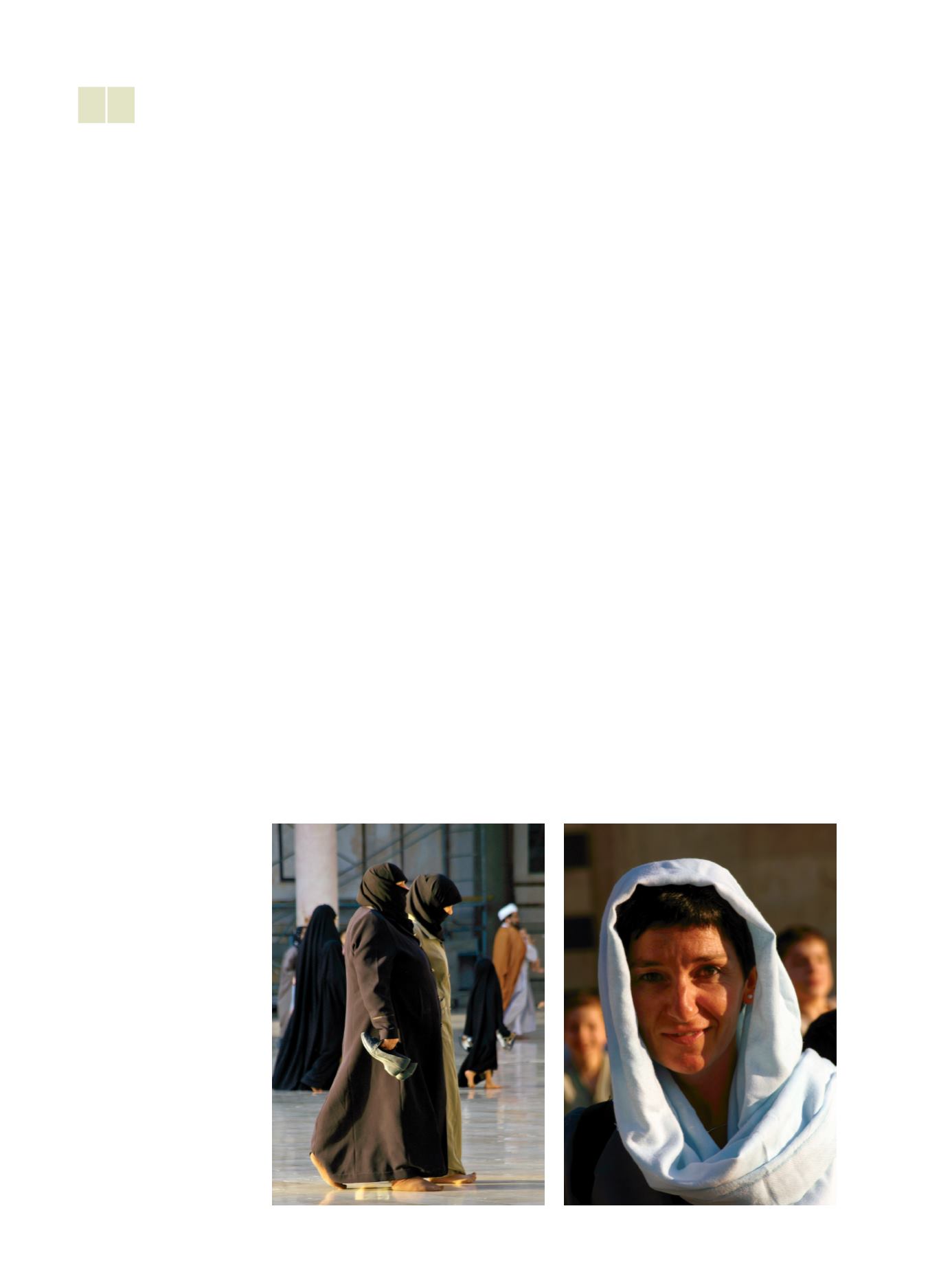
3 y 4. Mujeres
musulmanas.
/
Muslimwomen.
3.
4.


