·amura·
134
herencia cultural •
culture and heritage
La iglesia ortodoxa de AntioquÍa
El origen de la Santa Iglesia Oriental Ortodoxa,
Católica y Apostólica, comúnmente llamada ‘Iglesia
Ortodoxa’, se encuentra en los principios del cristia-
nismo mismo. Más que cualquier otra, ha conservado
las antiguas tradiciones cristianas de las tierras don-
de la religión de Jesús fue primeramente predicada.
Depende del Patriarca greco-ortodoxo de AntioquÍa y
de todo el Oriente ortodoxo, que actualmente es S. B.
Ignacio IV Hazim.
Los católicos del rito greco melquita católico
El término melquita fue aplicado a los cristianos
que rechazaron el Concilio de Calcedonia (año 451),
que había condenado el monofisismo. Se constitu-
yeron como iglesia independiente en el entorno de
las sedes de AntioquÍa (sirios ortodoxos o jacobitas)
y de Alejandría (coptos), a los cristianos fieles al
concilio en el siglo VI. Al rechazar el Concilio, rehu-
saban también el dominio bizantino y subrayaban el
rasgo cultural y lingüístico propio (siriaco y copto).
Los calcedonianos recibieron de ellos el nombre de
melquitas, es decir imperiales (del siriaco malko,
(rey, emperador), o seguidores del emperador bi-
zantino, símbolo de la ortodoxia de Calcedonia.
Los católicos greco melquitas adoptaron el rito bi-
zantino, primero en siríaco, posteriormente en griego
y finalmente, en gran parte, en árabe. Actualmente, el
término melquita designa específicamente a la rama
católica de esta iglesia, fruto de una escisión en torno
a una elección patriarcal del año 1724.
La iglesia greco melquita católica tiene cerca de
2 millones de fieles. Su patriarca es S. B. Gregorio
III Lutfi Laham, que ostenta el título de Patriarca
de Antioquía y Todo el Oriente, de Alejandría y de
Jerusalén. Las iglesias melquita católica y greco or-
todoxa, tienen la misma liturgia. Sólo que los mel-
quitas católicos reconocen la autoridad del Papa,
mientras que los ortodoxos, no.
The Orthodox Church of Antioch
The origin of the Holy Eastern Orthodox Catho-
lic and Apostolic Church, commonly called ‘Ortho-
dox Church’, is found in the principles of Christi-
anity itself. More than any other, it has preserved
the ancient Christian traditions of the land where
the religion of Jesus was first preached. It is depen-
dent on the Greek Orthodox Patriarch of Antioch
and All the East Orthodox, currently S. B. Ignatius
IV Hazim.
The Melkite Greek Catholic rite
Melkite is a termwas applied to Christianswho re-
jected the Council of Chalcedon ( year 451 ) , who had
condemned Monophysitism. They were established
as an independent church in the vicinity of the head-
quarters of Antioch ( Syrian Orthodox or Jacobite ) and
Alexandria ( Coptic ) , Christians faithful to the coun-
cil during the sixth century. By rejecting the Council,
they also refused Byzantine rule and emphasized the
cultural and linguistic aspect of the religion ( Syriac
andCoptic ). The Chalcedonian received fromthemthe
name of Melkite, imperials (malko Syriac, (king, em-
peror), or followers of the Byzantine Emperor, symbol
of the orthodoxy in Chalcedon.
Melkite Greek Catholics adopted the Byzan-
tine rite, first in Syriac, Greek and then finally
mainly in Arabic. Currently, the term refers spe-
cifically to the Melkite Catholic branch of this
church, the result of a spin around a patriarchal
election of 1724 .
Melkite Greek Catholic Church has about 2 mil-
lion member . Their patriarch is S. B. Lutfi Laham
Gregory III , who holds the title of Patriarch of An-
tioch and All the East , of Alexandria and Jerusa-
lem. Churches Orthodox Greek Catholic Melkite ,
have the same liturgy. Only the Melkite Catholics
recognize the Pope’s authority, while the Ortho-
dox don’t.
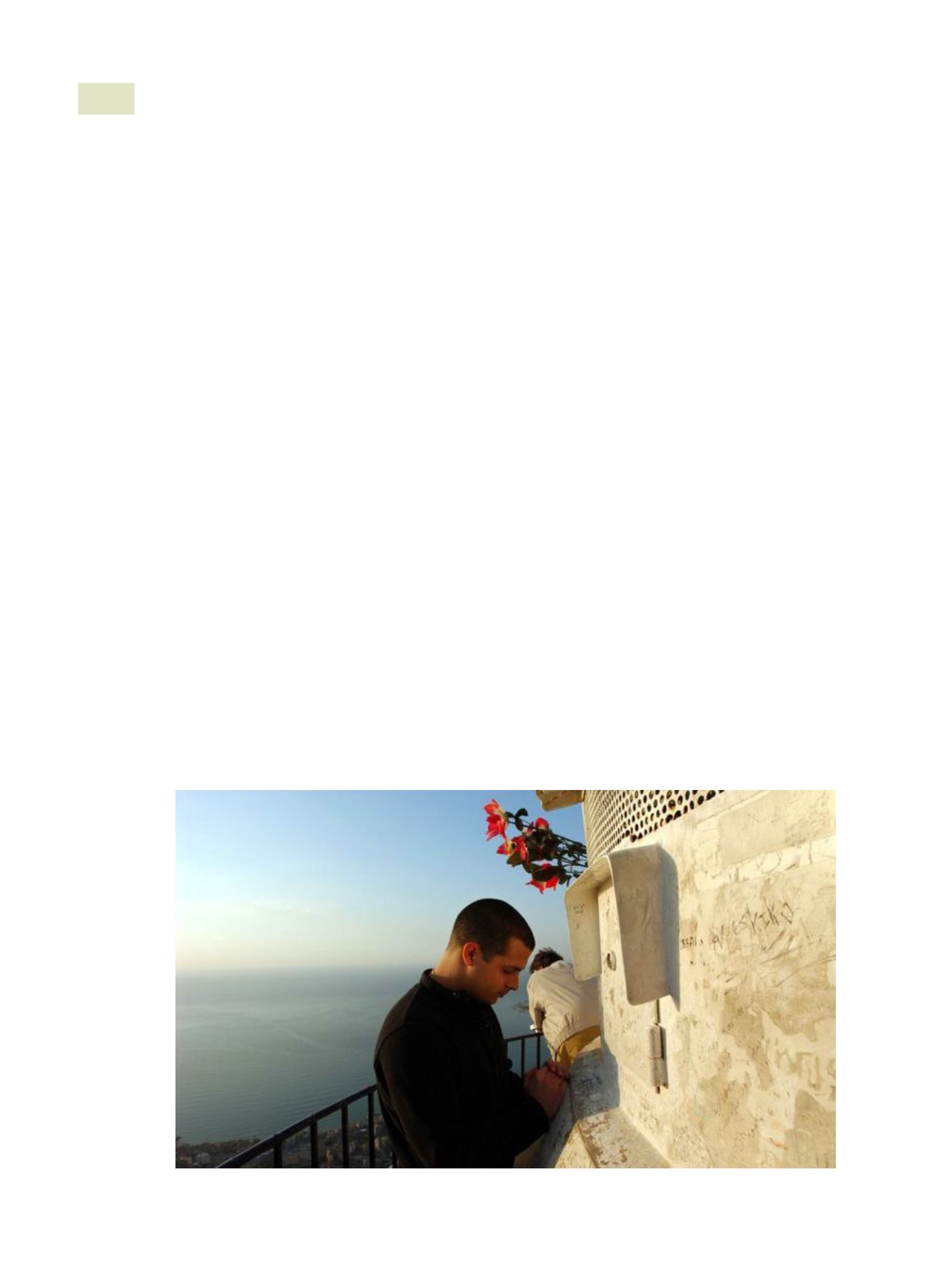
10. Un cristiano
reza a la Señora del
Líbano.
/ Christian
praying to Lady
of Lebanon.
10


