·amura·
137
herencia cultural •
culture and heritage
When I die Umar , Ali was elected as caliph. But he
was said to be a conspirator in the death of his prede-
cessor and his right was challenged by Muawiyah,
governor of Syria andmember of the Umayyad family,
thereby a cruel war between the two fractions begun.
Both agreed that the battlefield was to be Siffin (in
the middle Euphrates in Syria ) to resolve disputes be-
tween the people of Ali Ibn Abi Talib , the fourth caliph
of Islam , and followers of the Syrian governor, Muawi-
yabinAbiSufyan,theMuslimssplitintothreecommu-
nities: the Sunni, the Shia and the Alawite whose con-
flict framed Al- Fitna Al Kubra and great civil war, with
the verdict of a neutral judge. Followers of Ali came
intoanothergroupof disagreementswiththe rulingof
theKharijites andkilledAli during the year 661, trying
invain to also killMuawiya and the judge.
The followers of Ali Hassan bet on his son who
rejected the position, and then by Hussain, who
promote an insurrection against the Umayyads. His
deathbydecapitationtookplace inthe cityofKarbala
(Iraq) in 680 , his body was buried in the same place
and the head was left to the Caliph in Damascus.
The shocking death of Hussain convulsed much
of the Muslims and brought them the decision to
seek the honest and reverent basic roots of Islam.
Hussain ‘s sacrifice is the foundation of Shi’ism,
which alludes marches every year with flagellate,
and its allegory in battle against illegality.
Al morir Umar I, Alí fue elegido califa. Pero se le se-
ñaló como conspirador en la muerte de su antecesor, y
su derecho fue cuestionado por Muawiya, gobernante
de Siria e integrante de la familia de los omeyas, enta-
blándose con ello una cruel guerra entre las dos faccio-
nes. Ambos aceptaron que el campo de batalla fuese
Siffín (en el Eufrates medio, en Siria) para dirimir las di-
ferencias entre la gente de Alí Ibn Abi Talib, cuarto califa
del Isla, y los seguidores del gobernador sirio Muawiya
ben Abi Sufián. Los musulmanes se escindieron en tres
comunidades, la sunita, la chiita y la alauita, conflicto
enmarcado como Al-Fitna Al Kubra, o gran guerra civil,
con el veredicto de un juez neutral, pero de las huestes
de Alí surgió otro grupo en desacuerdo con el fallo, el
de los jariyíes y asesinaron a Alí en 661, tratando inútil-
mente de matar también a Muawiya y al juez.
Los seguidores de Alí apostaron por su hijo Hassán
quien rechazó el cargo, y después por Hussain, quien
promovería una insurrección contra los omeyas. Su
muerte por decapitación en la ciudad de Karbala (Irak),
en el 680, siendo enterrado su cuerpo en el mismo sitio
y la cabeza dada al califa en Damasco.
La escandalosa muerte de Hussain convulsionó a
gran parte de los musulmanes y les trajo la decisión de
buscar un poder honesto y reverente con las bases del
Islam. El sacrificio de Hussain es el cimiento del chiis-
mo, que lo alude cada año con marchas de flagelados,
siendo su alegoría en la lid contra la ilegalidad.
Los ismaelitas
Los ismaelitas o septimanos admiten a siete ima-
nes. El sentido del legado de Ja’afar al Sádik fue el
punto de desunión entre imanes y septimanos. En
la mitad del siglo VII, los adeptos del imán Ismael, a
quien los imanes rehusaron por uno de menor edad, se
dividieron al decir que el imán poseía una luz interna
que lo hace infalible y le otorga condición divina.
The Ismaili
The Ismailis or septimans support seven mag-
nets. Thesenseof the legacyof Ja’afar al Sadikwas the
point of disunity between magnets and septimans.
In the seventh century, followers of the magnet Ish-
mael, who was refused by a magnet of younger age,
divided by saying that themagnet had an inner light
that grants him infallible divine status.
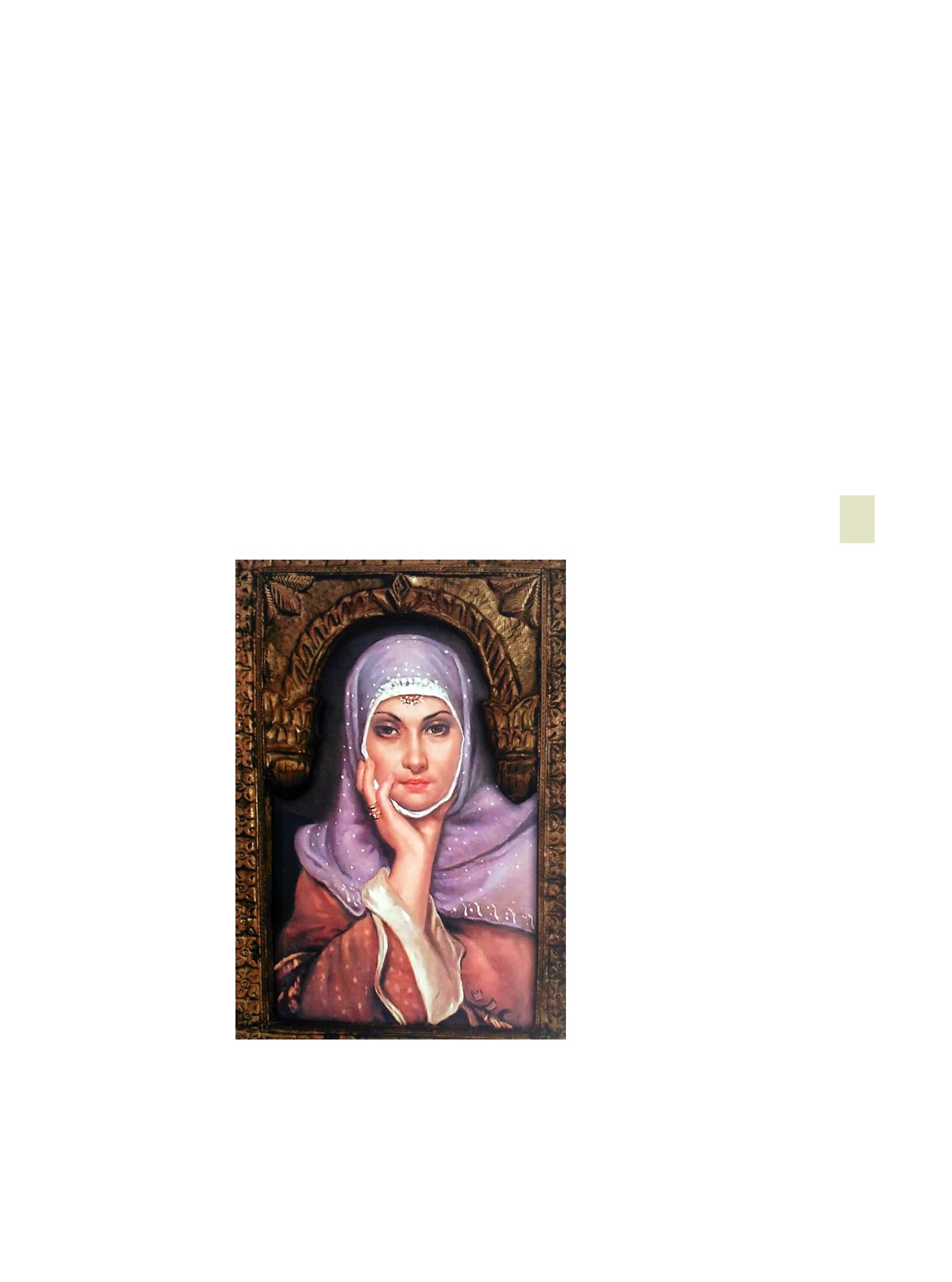
17. Pintura de una
mujer musulmana.
/
Picture of a
muslimwoman.
17


