·amura·
136
herencia cultural •
culture and heritage
La mayoría de sabios de Ahl as-Sunna, al igual que
los eruditos chiitas, consideran que no son una mahdab
o escuela jurídica más. La mad
ā
hib, son las corrientes de
interpretación de la jurisprudencia islámica. La discordia
entre ellos y el cuerpo superior musulmán es de creen-
cia, no de jurisprudencia; para ellos, al que sigue al Imam
se le aceptan actos de adoración; si no, la fe es parcial y la
adoración, dudosa. Para un sunita es herético.
El 90% de los musulmanes del mundo son suni-
tas y todos creen en la autenticidad de Al Qur’án (El
Corán); su texto se salvaguarda de toda adición u omi-
sión. El Corán debe ser creído en armonía con lo escri-
to en árabe, desconfiando de traducciones no acepta-
das por sus autoridades pues generalmente cambian
su sentido. Cada palabra fue dada por Alláh (Dios) a
través del Arcángel Gabriel. El Corán es eterno, es la
Verdad, el germen de los creyentes, de su fe, ritos y
reglas de comportamiento.
Los sunitas creen en Alláh como único Dios. No
hay intermediarios con él. Alláh tiene control sobre lo
bueno o lo malo. Todos los seres dependen de Alláh y
necesitan su favor y misericordia.
Most scholars of Ahl as - Sunna , as Shiite schol-
ars , believe that there amahdab law school ormore.
The mad
ā
hib , are the current interpretation of Is-
lamic jurisprudence. The discord between themand
the upper Muslim core is one of belief, not of law, for
them, those who worship the Imam has accepted
acts of worship , otherwise it is partial faith and
doubtful worship. For a Sunni this is heretical .
90% of the world’s Muslims are Sunni and they
all believe in the authenticity of Al Qur’an (The
Koran) , its text safeguard any addition or omis-
sion. The Koran must be believed in harmony with
what is written in Arabic, distrusting translations
not accepted by the authorities, since it generally
changes their meaning. Each word was given by Al-
lah (God) through the Archangel Gabriel. The Koran
is eternal , it is the Truth, the seed of the believers,
faith, rites and rules of behavior.
Sunnis believe in Allah as the only God. There
are no middlemen with him. Allah has control over
what is good or bad. All beings depend on Allah and
need of his favor and mercy.
Shia Muslims
The word derives from the word Shi’ism ch
ī’
at ‘ Al
ī
,
which refers to the side of Ali, cousin and son in law of
the Prophet. When Muhammad died (632 d . C.), no one
foresaw who would apply for a succession. They chose
themethod of voting on candidates, choosing between
the main characters. Some were in favor of Ali , assum-
ing thathewas theonly real heir and for being themost
attachedtoMuhammad,othernotabledenyingthepos-
sibility of being the caliph or successor to Muhammad,
likedAbuBakr al- Siddiq , father of the Prophet, naming
himself Khalifat Rasul Allah (successor of the messen-
ger of theGod), a termderived fromthe titleof caliph.
AnotherchoicewasUmarI,thesecondcaliphdur-
ing the year 634. Before he died, Abu Bakr appointed
him his heir and the men mentioned complied to
these orders. The third was Uthman ibn Affan, also
sonofMohammed, who emerged fromthefirst group
to convert; by the time of the death of Caliph Umar I
in 644, elected for six high personages , he was cho-
sen fromamong the companions of Muhammad.
Los musulmanes chiitas
El vocablo chiismo deriva de la voz ch
ī’
at ‘Al
ī
, que
se refiere al bando de Alí, primo y yerno del Profeta. Al
morir Mahoma (632 d. C.), nadie previó quien o como
se haría la sucesión. Se optó por el método de la vo-
tación, escogiendo candidatos entre los personajes
principales. Algunos se inclinaron por Alí, al suponer
que era el único heredero auténtico y por haber sido
el más apegado a Mahoma, negando a otros notables
la posibilidad de ser el califa o sucesor de Mahoma, ta-
les como Abu Bakr al-Siddiq, suegro del Profeta, auto-
nombrándose Khalifat Rasul Alláh (sucesor del envia-
do de Dios), vocablo del que deriva el título de califa.
Otros elegido fue Umar I, segundo califa en el
634. Antes de fallecer, Abu Bakr lo designó su he-
redero y los notables acataron dicha transmisión.
El tercero fue Utmán ibn Affan, también yerno de
Mahoma, surgido del primer grupo converso y califa
a la muerte de Umar I, en 644, elegido por seis altos
personajes, que lo escogieron de entre los camara-
das de Mahoma.
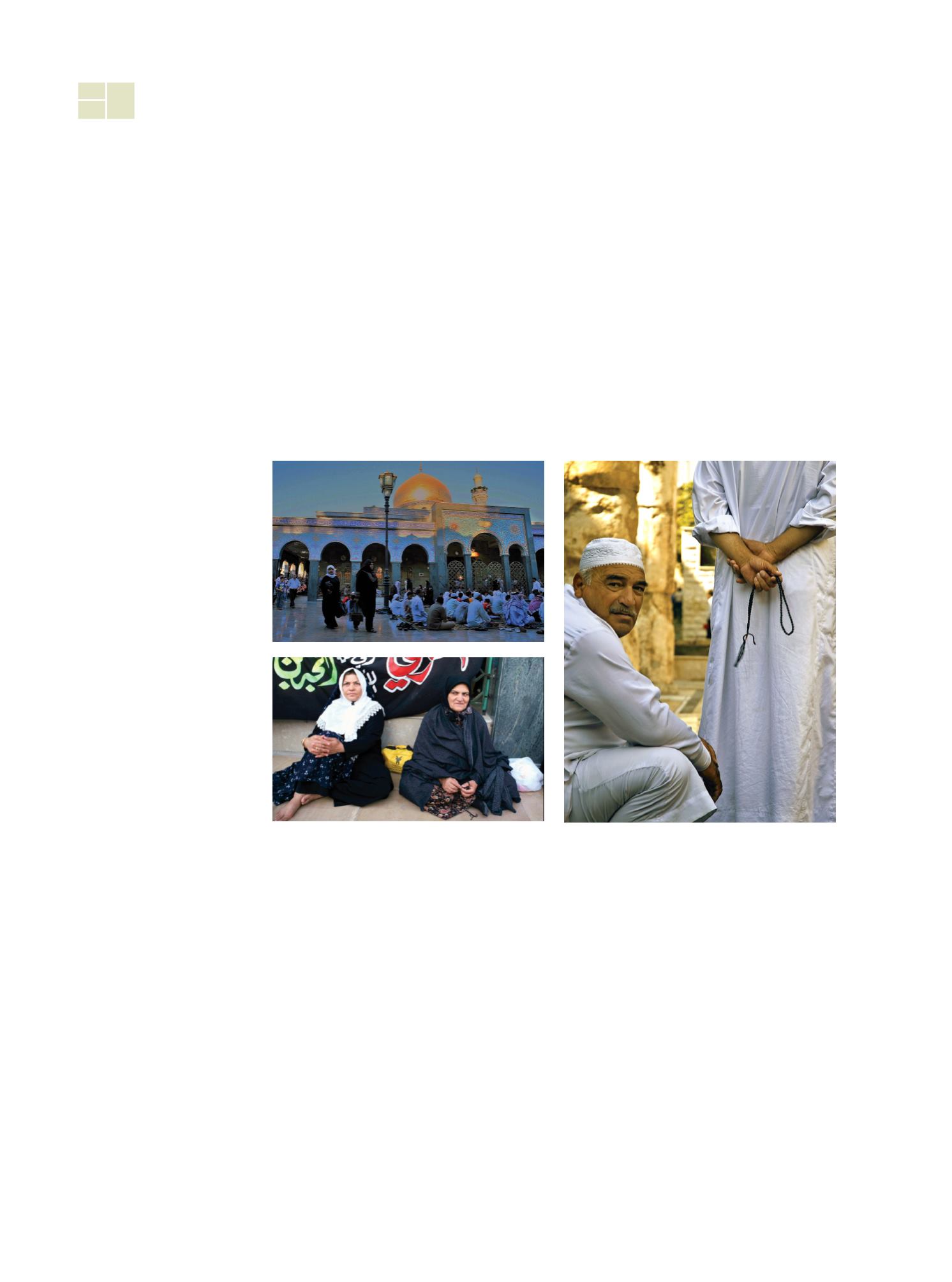
14. Mezquita de
culto chiita.
/
Mosque of
shiite faith.
15. Mujeres chiitas.
/
Shiites women.
16. Hombres chiitas
preparados para
el momento de la
oración.
/ Shiitemen
ready to pray time.
14
15
16


