·amura·
149
especies •
species
A
sí lo indica el propio nombre de este árbol, que
procede de Oriente Medio. Desgraciadamente,
en la actualidad, casi ha desaparecido de las
montañas libanesas debido a la presión a la que fue-
ron sometidos sus bosques desde hace milenios por
su apreciada madera. No obstante, se mantiene ex-
tendido aún por la Anatolia meridional, incluso se pue-
den encontrar todavía ejemplares en estado silvestre
con una edad estimada de 2.000 o 3.000 años.
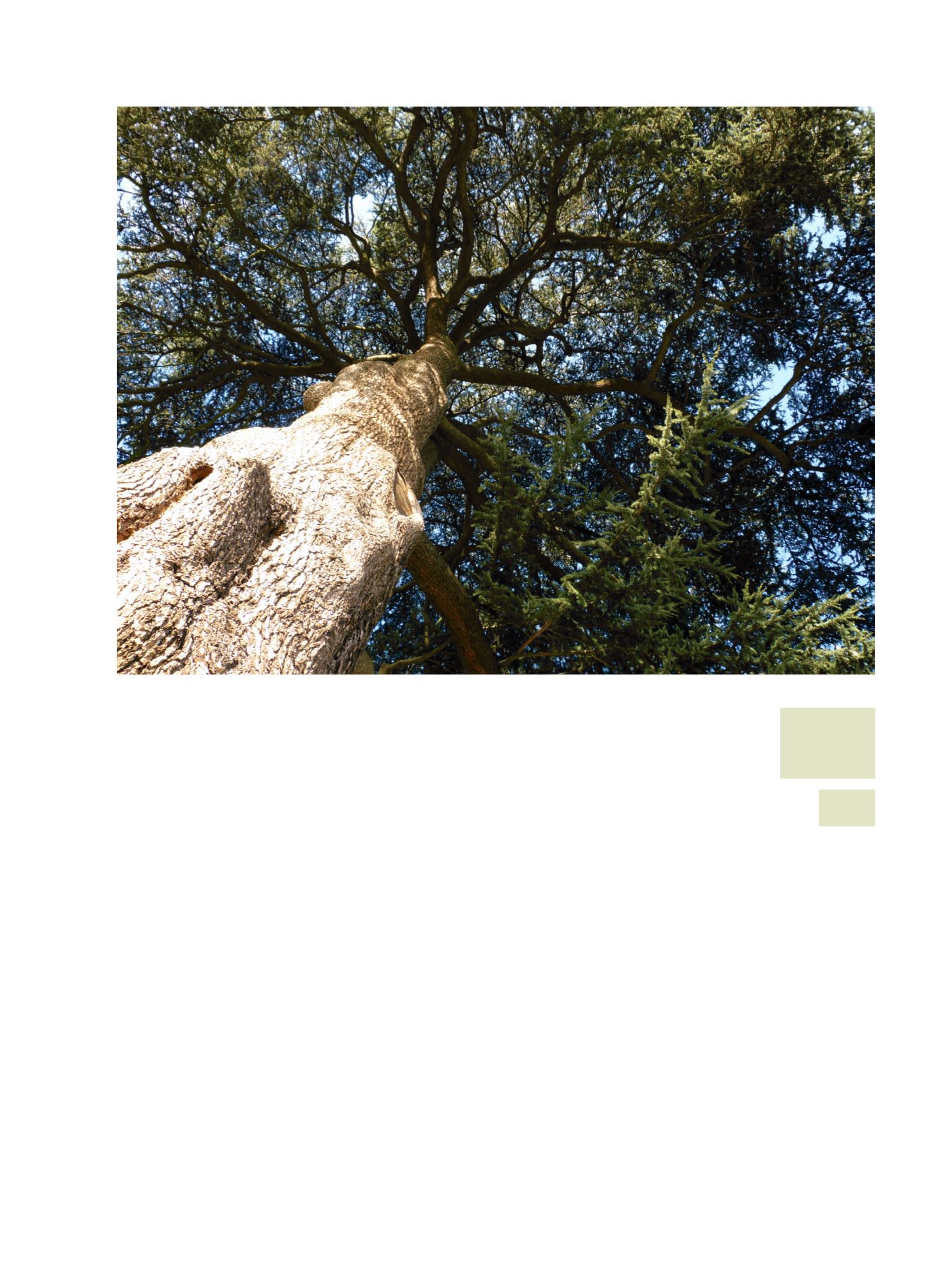
El cedro del Líbano (Cedrus libani) es el cedro por
antonomasia. Las hojas son verdes y pequeñas. Tie-
ne el tronco más grueso y erecto, puede alcanzar los
cuarenta metros de altura. En los ejemplares adultos
presentan su porte característico en estratos horizon-
tales, abandonado la forma cónica de la juventud. Se
usa mucho en jardinería como árbol decorativo.
Es un árbol de alta montaña, propio de un país tan
arriscado como es Líbano. Su hábitat se sitúa entre los
1.200 y 2.000 metros de altura, por tanto, soporta in-
viernos fríos (temperaturas de hasta 30
º
C bajo cero) y
precipitaciones poco abundantes. El árbol se debe plan-
tar en lugares soleados y en terrenos que drenen; aun-
que sean secos, deben de tener agua en profundidad.
Los cedros son coníferas de ramas largas, extendi-
das horizontalmente, y hojas aciculares, persistentes,
reunidas en fascículos sobre braquiblastos. En su copa
brotan piñas ovales, erectas, de escamas muy apreta-
das, con semillas triangulares. Las flores masculinas
duran todo el verano en forma de conos verdes de cin-
co centímetros y esparcen su polen a fines de otoño.
T
his is indicated by the very name of this tree,
which comes from the Middle East. Unfortu-
nately, at present, it has almost disappeared
from the Lebanese mountains due to the pressure
their forests were subjected there formillennia since
their wood is highly prized. However, it’s population
has remain extended in southernAnatolia, including
several subjects which can still be found in the wild
with an estimated age of 2,000 or 3,000 years.
The cedar of Lebanon (Cedrus libani) is the quint-
essential cedar. The leaves are green and small. It has
a thicker and erect trunk, which can reach up to forty
meters high. In the adult specimens a demeanor is
presented along characteristic horizontal layers,
abandoning the conic shape of their youth. It is very
much used as an ornamental decoration in gardens.
Itisahighmountaintreetypicalofacountrywith
many mountains as Lebanon. Its habitat is located
between 1,200 and 2,000 meters, thus supporting
cold winters (temperatures up to 30
º
C below zero)
and small precipitation. The tree should be planted
in full sun and in soils that are capable of draining,
all though they are dry, water must have depth.
The cedars are coniferous trees with long branch-
es that extendedhorizontally, andneedle-like leaves,
persistent, united in fascicles on short shoots. In the
spring cup a pineapple-looking oval can be found
with very tight scales of triangular seeds. Male flow-
ers last all summer in the form of two-inch green
cones and spread their pollen during late fall.
1.Los cedros del
Líbano en invierno,
bajo la nieve se
encuentran entre los
10 y los 20 m. /
Thecedarsof
Lebanoninwinter,
undersnoware
amongthe
10to20m.
2. Cedro, iconodel
Líbano/
Cedar,icon
ofLebanon .
1
2


