



 39 / 132

comQgT iOt • iOt comQBTT
El ataque de Pearl Harbor en 1941, desató la acción de
Estados Unidos en la II GM, en tanto que Japón avanzaba
por el Océano Pacífico y Asia, siendo la campaña de Filipi-
nasun factor claveydecisivopara sudominio geopolítico.
Luego de varios ataques japoneses en Luzón durante di-
ciembre de 1941, alrededor de 26 tanques Ha-Go ocupa-
ron la ciudad de Carmen, avanzando haciaManila.
Con Bataán y Manila como objetivos principales, la
ciudad fue incomunicada y sufrió numerosos bombar-
deos aéreos por parte del ejército japonés, destruyendo
a las inexpertas divisiones filipinas aun con apoyo de
Estados Unidos. Para enero de 1942, los japoneses en-
traron a Manila y en abril del mismo año, Radio Manila
comunicó la ocupación de Bataán, con lo que Filipinas
pasaba a formar parte del Imperio Japonés, permane-
ciendo bajo su dominio hasta 1945, cuando Estados
Unidos irrumpió para recuperar el archipiélago. Sin em-
bargo, la influencia de Japón ya era un componente en la
consciencia de Filipinas y para 1946, la Commonwealth
Americana fue disuelta y las islas obtuvieron al fin su so-
beranía e independencia, constituyéndose como un país
con un camino de reconstrucción -tanto de su territorio
como de su identidad-, muy arduo por delante.Por otra
parte, los procesos de urbanización en Manila han sido
muy acelerados, incluso violentos. No solo Intramuros
emergió rápidamente, sino que los proyectos para levan-
tar la ciudad después de la II GM, establecieron el preám-
bulo de una metrópolis con grandes carencias en sus
sectores más poblados, lo cual se ha acentuado durante
las últimas décadas. En los 90, Manila se convirtió en la
ciudad que conocemos hoy, con fuertes inversiones para
sus admirables rascacielos por un lado, pero con barrios
cada vezmás pobres por otro.
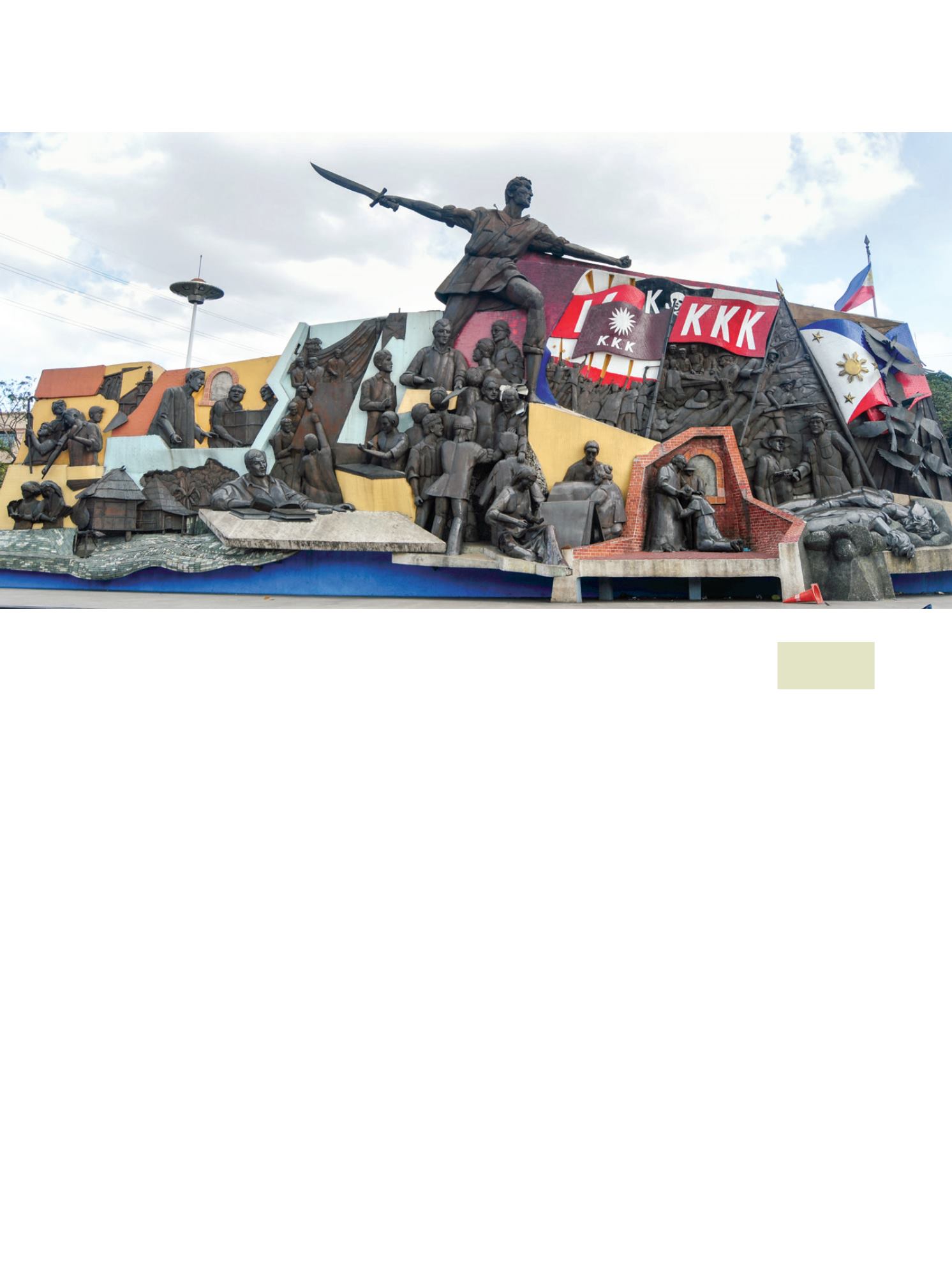
7.Monumentoa la
sociedadKatipunan
ysufundadorAndrés
BonifacioenManila,
Filipinas./
Monument
tosocietyKatipunan
andit´
sfounder
AndresBonifacioat
Manila,Philippines.
7
The attack on Pearl Harbor in 1941 strained the
United States into the war, as Japan made its way
through the Pacific Ocean and Asia. The Philippines
became then a key and decisive geopolitical point.
After numerous Japanese attacks on Luzon during
the winter of 1941, around 26 Ha-Go tanks occupied
the city of Carmen on their way to Manila.
With Bataan and Manila in their sights, the
city was cutoff and suffered from multiple aer-
ial bombardments courtesy of the Japanese Air
force. The air strikes wiped out the American-
backed, but poorly trained, Filipino troops. By
January, 1942, the Japanese had entered Manila,
and in April of that same year, Radio Manila an-
nounced the occupation of Bataan, effectively
making the Philippines part of the Japanese Em-
pire. It would remain this way part of its domin-
ion until 1945, when the United States launched
an attack to recapture the archipelago. Never-
theless, Japan’s influence had permeated the
Filipino conscience, and by 1946, the American
Commonwealth was disbanded and the islands
achieved sovereignty and independence. It had
a long and difficult road ahead, as a country
that was beginning to rebuild itself. Manila’s
urbanization process rapidly advanced, though.
Perhaps violently so. Not only was Intramuros
rebuilt quickly, but the projects that were pro-
posed to reconstruct the city after WWII laid
the foundations for a modern metropolis. In the
90s, Manila became the city that is today, heav-
ily funded and boasting admirable skyscrapers
alongside its poorer neighborhoods.
·amura·
37