



 40 / 132

·amura·
38
comQgT iOt • iOt comQBTT
Cuna de democracia
para Asia y el mundo
Al viajar a Manila notaremos el cariño del pueblo
por su héroe nacional, José Rizal, con frecuentes
monumentos que se integran al escenario urbano
y colonial. Nacido en 1861, José Rizal es autor de
dos novelas:
Noli me tángere
y
El filibusterismo
,
mismas que inspiraron el movimiento de indepen-
dencia en Filipinas.
En su obra, Rizal denuncia los abusos de la coloniza-
ción española, razón por la que sus textos fueron prohi-
bidos en su propio país. Era un hombre de letras, médico,
universitario y activista, defensor de los derechos filipi-
nos, que se reveló contra las imposiciones del catolicismo
y la corona española, estableciendo vínculos con socieda-
des secretas que le ayudaron a difundir su obra y valores,
tal es el caso de la Liga Filipina, fundada por el mismo Rizal
en Hong Kong en 1892.
Su participación con estas sociedades lo hicieron
sospechoso de involucrarse en una rebelión por par-
te de los Katipunan, la cual, si bien tiene un origen en
la misma Liga Filipina cuando ésta fuera desactivada
tras una detención y deportación secreta contra Ri-
zal, no era liderada por él en esos momentos. Esta
acusación provocó que el ya celebrado Rizal fuera
enviado a Manila en 1896, donde fue fusilado, pro-
vocando la pasión trascendente de un pueblo que
jamás olvidaría la lucha del auténtico precursor de
la independencia filipina. Sin embargo, Rizal no es el
único ejemplo de lucha y democracia que ha marcado
la historia de Manila y del archipiélago.
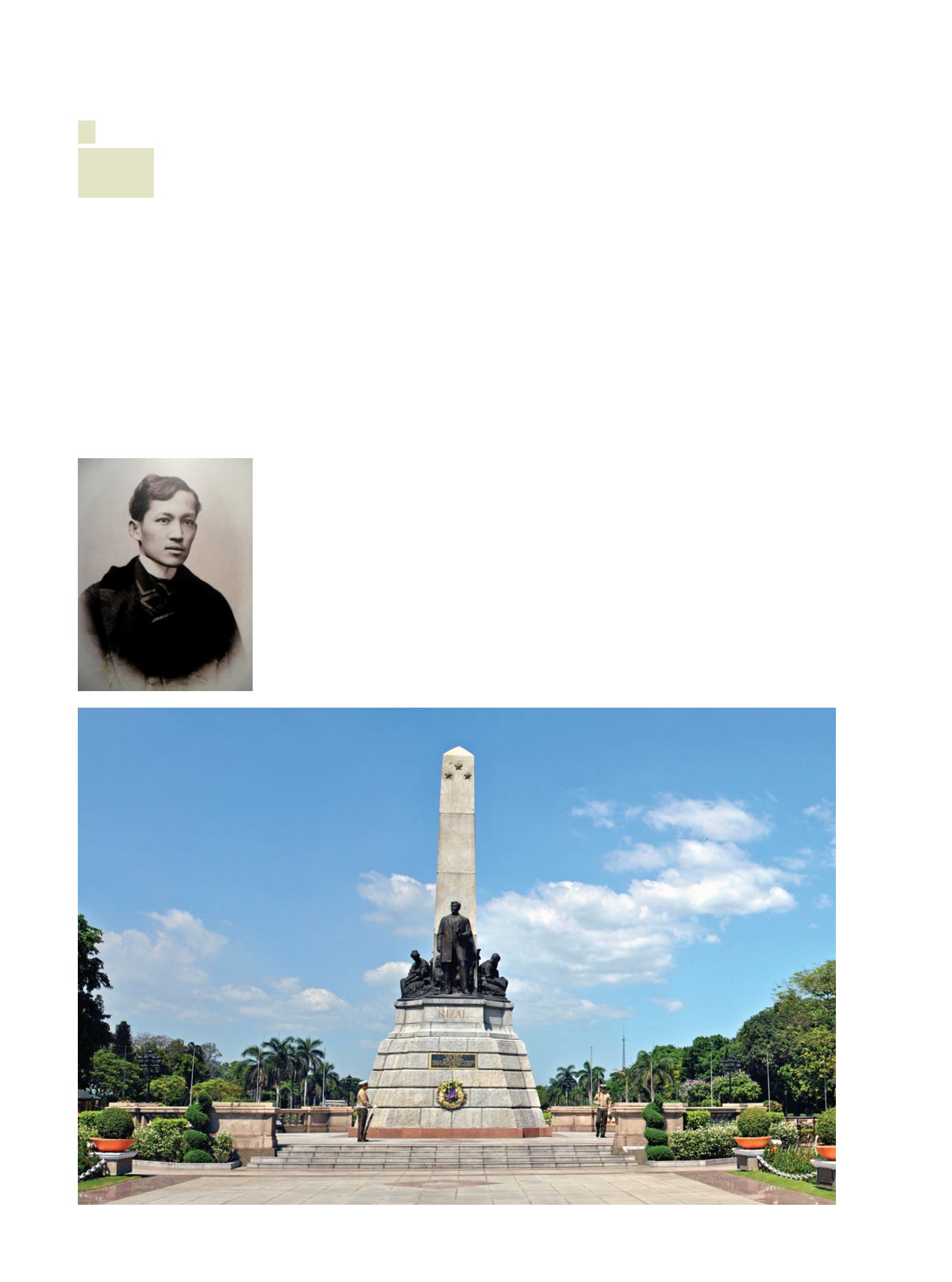
8.
JoséRizal/
Jose
Rizal
9.
Monumentoa
JoséRizalenParque
Luneta./
Rizal
Monumentatthe
LunetaPark.
8
Cradle forademocracy
inAsia and theworld
When travelling through Manila, one will notice
the affection its people have for their national hero,
Jose Rizal. Monuments of him are frequently found
around the city, and form part of the colonial and
urban landscape. Born in 1861, Rizal is the author of
two novels: Noli me tangere, and The Filibustering
(also known as The Reign of Greed).
In these works, Rizal denounces the abuse of the
Spanish Crown, reasonwhy his texts were suppressed
in his own country. A man of letters, doctor, scholar,
and activist, a defender of Filipino rights, who revolt-
ed at against the Catholic authorities, and the Spanish
Crown, Rizal also established links with secrets so-
cieties that helped him to publish and distribute his
works. One of these societies was the Filipino League,
founded by Rizal himself inHongKong, in 1892.
His involvement in these societies made the
authorities suspect of him of forming part of a
Katipunan rebellion, which, although planned
by members of the Filipino League after the ar-
rest and deportation of Rizal, was not led by him.
In spite of this, the charge was enough to have
Rizal sent to Manila in 1896, and he was prompt-
ly executed by a firing squad. This event enrage
the population, and they would never forget
one of the authors of the Filipino independence.
Nevertheless, Rizal was not the only example of
a person fighting for democracy in the Manila
and the rest of the archipelago.
9
Foto /
Photo
: DEORITZ / Brian Song / Cebu / Skf / Rgos / VLS / At / Manila Ocean Park / Nztravel / Rhoy Cobilla