cinematografía •
cinematography
Hoy la capital del estado federal de Maharash-
tra se alista para los festejos fílmicos que tendrán
lugar en el 2016, los cuales celebrarán el 120 ani-
versario de proyecciones en la india, al recordar
cuando en 1896 Auguste y Louis Lumière llevaron
lo que se llamó –en su tiempo– el más portentoso
avance de la época: el Cinematógrafo y presenta-
ran en un salón del hotel Watson de Bombay seis
cortometrajes ante una audiencia inglesa que los
clasificó como fabulosos. Así, al tiempo en que ini-
ciaba una era de transformaciones políticas y revo-
luciones sociales en la India, el cine hindi apareció
en escena con la película silente sobre la leyenda
del Rajah Harishchandra, su esposa Taramati y su
hijo; que gracias a su bien lograda narrativa, que
describe pasajes de los libros sagrados del hinduis-
mo, presentada en el cine Coronation de Bombay,
convirtiéndose en uno de los primeros éxitos co-
merciales. En los años siguientes se lanzaron otras
películas mudas, hoy consideradas obras maestras;
una de las más representativas es la primera cola-
boración indoeuropea de 1929,
The Trow of Dice
, del
realizador alemán Franz Osten.
Posteriormente, el auge de estos filmes llegó a locali-
dades como Madras (la actual Chennai), en donde se creó
una industria propia en cuyas producciones solo se habla
el idioma tamil y actualmente se conoce como Tollywood;
en la década de 1950 rebasó sus fronteras, cuando altos
rangos del Ejército Rojo intercambiaban armas por los clá-
sicos carretes de celuloide de 35mmde filmes indios.
At present, Maharashtra, capital city of the
federal state, is getting ready for the film festivals
that will be celebrated in 2016, to commemorate
the 120 anniversary of projections in India, by
remembering when, in 1896, Auguste and Louis
Lumière attained what was called, in its time, the
most amazing advance of that age, the cinematog-
rapher; presenting 6 short movies before an Eng-
lish public who classified them as fabulous in a Ho-
tel Watson hall of Bombay. This way, at the same
time, while an era of political transformations and
social revolutions was staring in India, Hindi cin-
ema entered the stage with a silent movie about
the legend of Rajah Harishchandra, his wife Tara-
mati and their son. Thanks to a well accomplished
narrative, shown in the Bombay’s Coronation The-
ater, it pictures passages from the sacred Hindu
book, becoming one of the first commercial hits. In
the following years, other silent movies were pre-
miered, today considered masterpieces; one of the
most representative being the first Indo-European
collaboration in 1929, A Throw of Dice, by the Ger-
man filmmaker Franz Osten.
Later on, the boom of these films arrived at
places like Madras (nowadays Chennai), where it
was created an industry on its own, spoken only
in Tamil, currently known as Tollywood. In the
50s, it went beyond its borders when Red Army
top officials exchanged arms for typical 35mm
Indian celluloid rolls.
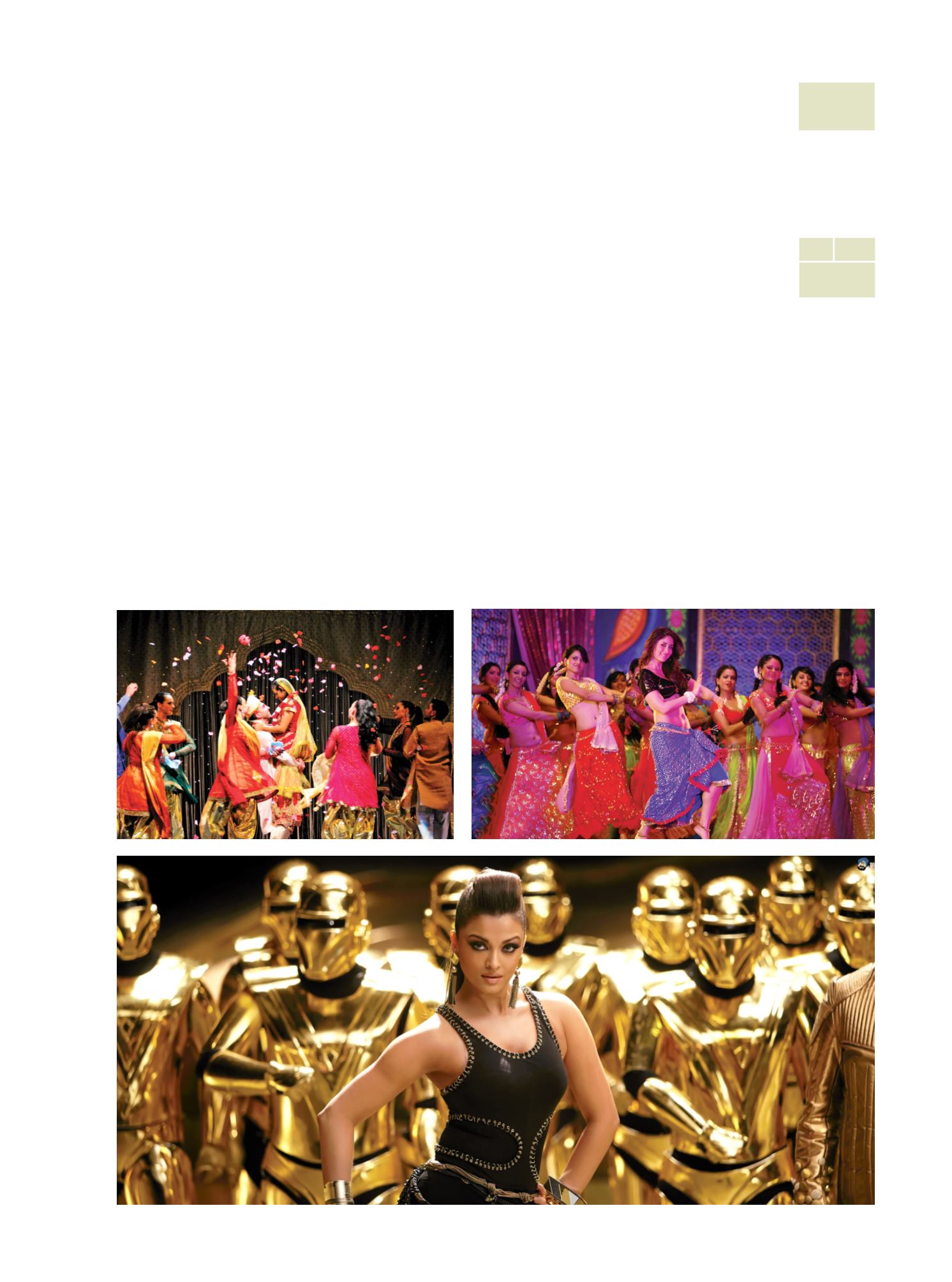
1.Escenadelfilm
romántico indio
GoliyonKiRaasleela
RamLeela./
Scene
fromtheindian
romanticfilm
GoliyonKiRamLeela
Raasleela.
2.En2016se
festejarán120años
deproyeccionesen la
India./
In2016they
willcelebrate120
yearsofprojections
inIndia.
3.Bollywoodsupera
a la industriafílmica
deEstadosUnidosy
China,siendoelprimer
productoranivel
mundial./
Bollywood
filmindustry
outperformstheUS
andChina,being
thefirstworldwide
producer.
4.
Robot
,unade
lascintasmás
importantesde la
industriadelcine
indio./
Robot
,oneof
themostimportant
featuresoftheIndian
filmindustry.
2
3
4
·amura·
97
1


