compás int • int compass
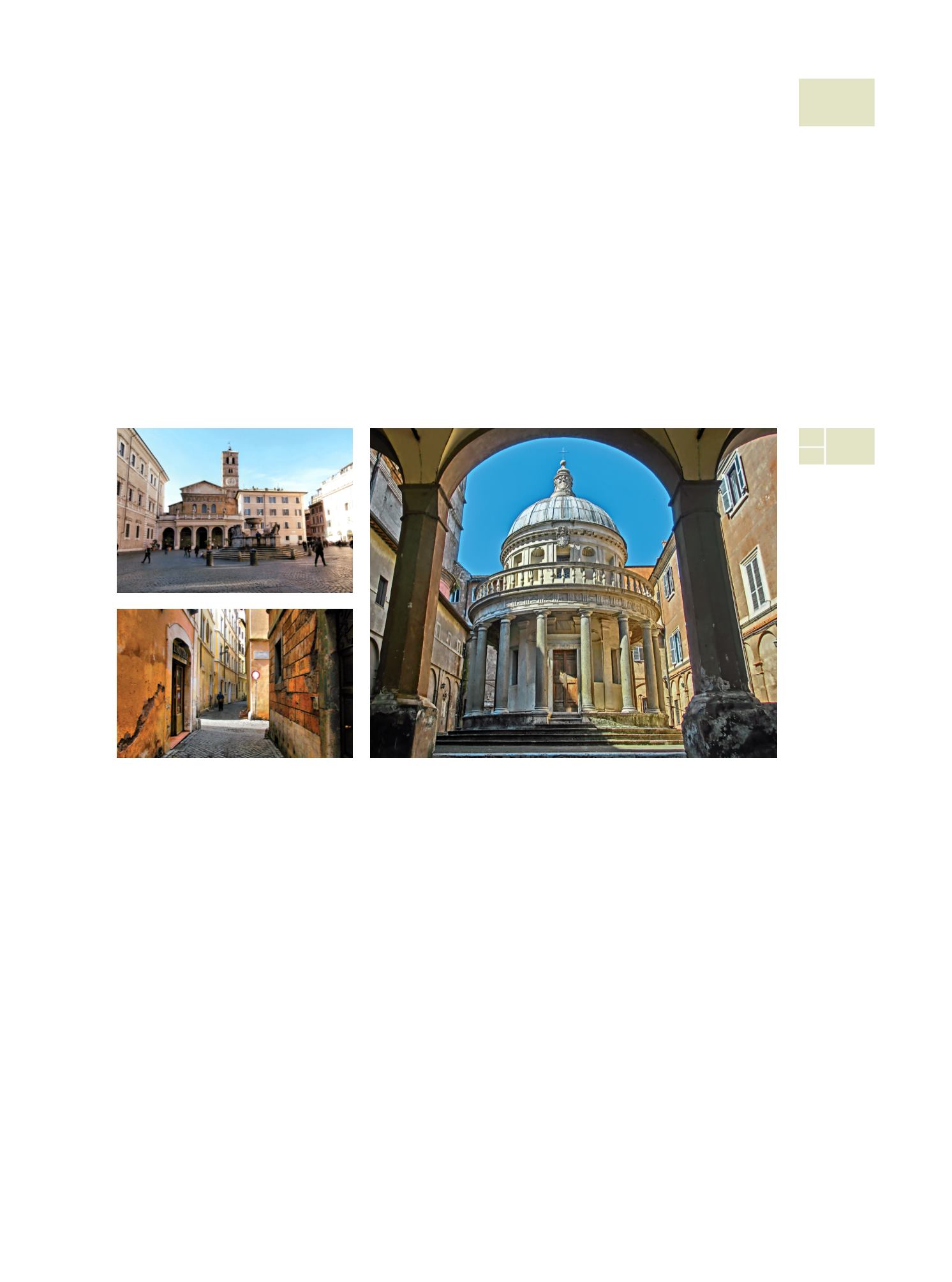
35.LaPlazadeSanta
MaríaenTrastevere
es,sinduda,elcentro
neurálgicodeeste
pintorescobarriode
Roma.Sufuente,
restauradaporCarlo
Fontanaen1692,
datade laépocade
losromanos.
/The
PlazadeSantaMaria
inTrastevereisun-
doubtedlytheheart
ofthispicturesque
neighborhoodof
Rome.Itssource,
restoredbyCarloFon-
tanain1692,dates
fromthetimeofthe
Romans.
36.ElTempletedeSan
Pietro inMontorio,se
mandóconstruirpor
losReyesCatólicos
deEspañaen1503
paraenaltecerel lugar
donde latradicióncris-
tianafija laCrucifixión
delprimerPapa./
TheTempleofSan
PietroinMontorio,
wasorderedbuiltby
theCatholicKings
ofSpainin1503
toheightenthe
placewhereChristian
traditionsetsthe
Crucifixionofthe
firstPope.
37. ElcampodiFiori
esunmercadotípico
romano. /
Thedi
Fiorifieldisatypical
Romanmarket.It
containsallkinds
ofvegetablesand
agriculturalproducts.
Initsvicinityare
severalrestaurants.
59
·amura·
Trastevere
Es el barrio bohemio de Roma. Su nombre significa “atrás
del río” (tras tevere) porque está ubicado cruzando el río
Tíber, a la altura de Campo di Fiori. Esta plaza está llena
de vida y ofrece a los visitantes una gran variedad de
bares y
trattorias
. Sus estrechas y enredadas callejuelas
entre los edificios color ocre hacen que el paseo por este
barrio sea muy agradable.
Un paseo por:
-Piazza Santa Maria in Trastevere. Fue diseñada por el
arquitectoCarloFontanaen1692.Aquíselocalizalafamosa
iglesia de Santa Maria in Trastevere, la cual está decorada
con pequeñosmosaicos en toda su ábside y fachada.
-San Francesco a Ripa. En esta iglesia vivió san Fran-
cesco de Asís cuando era un hospicio. Aquí se encuentran
todavía la almohada de piedra y el crucifijo de este santo.
La iglesia también alberga la famosa escultura de Éxtasis
de Bernini.
-San Pietro in Montorio. En el patio de este convento
demonjes franciscanos españoles se encuentra il Tempie-
to de Bramante, que fue construido en la cima del Monto-
rio (monte de oro) donde san Pedro fue crucificado.
Trastevere
ItisthebohemiandistrictofRome.Itsnamemeans“be-
hind the river” (tras tevere) because it is located across
theTiber river, by theCampodi Fiori. Thisplaza is full of
life and offers visitors a great selectionof bars and trat-
torias. Its narrow and complex alleyways between the
ocher colored buildings make of the walking through
thisdistrict anutmost pleasingexperience.
Awalkthrough:
-PiazzaSantaMariainTrastevere.Itwasdesignedby
the architect Carlo Fontana in 1692. Here is situated the
famous church Santa Maria in Trastevere, and is deco-
ratedwithsmallmosaicsover all itsapseand facade.
-SanFrancescoaRipa.InthischurchlivedSanFran-
cesco d’Assisi when it was a hospice. Here the stone
pillow and crucifix of this saint can still be found. The
church also shelters the famous Ecstasy sculpture of
Bernini.
-SanPietro inMontorio. In thepatioof this convent
of Spanish Franciscan monks one can find il Tempieto
deBramante,thatwasbuiltoverthetopoftheMontorio
(mountainof gold)whereSt. Peterwas crucified.
Awalk through:
-Via Condotti. In this street are the most renowned
shops in the world of fashion. Here tourists and Italians
alikegathertotakeastrollintheeveningorgoshopping.
-Pincian. The Pincian is a balcony with line of sight
to the city in the gardens of Villa Borghese. It can be
reached from the top of the staircase of Piazza di Spag-
na, from the Piazza del Popolo or via the park of Villa
Borghese. Fromhere it ispossible toget oneof themost
spectacular views of theEternal Cityand its buildings.
- Piazza del Popolo. It is one of the largest plat-
forms of Rome. It is located at the end of Via del Cor-
so, in the part opposite to Piazza Venezia. The cur-
rent design is a work of Giuseppe Valadier to receive
and guide the pilgrims on their arrival to Rome in
the XIX century. It has an oval shape and is the join-
ing point of 3 streets: Via del Babuino, Via del Corso
and Via di Ripetta.
Unpaseopor:
-Via Condotti. En esta calle se encuentran las tiendas de
mayorrenombredelmundodelamoda.Aquíturistaseitalia-
nossedancitaparadarunpaseoporlatardeoirdecompras.
-Pincio. El Pincio es un balcón con vista a la ciudad
en los jardines de Villa Borghese. Se puede llegar des-
de la cima de la escalinata de Piazza di Spagna, desde
Piazza del Popolo o por el parque de Villa Borghese.
Desde aquí se puede apreciar una de las más espec-
taculares vistas de la Ciudad Eterna y de sus edificios.
- Piazza del Popolo. Es una de las explanadas
más grandes de Roma. Está ubicada al final de Via
del Corso, en la parte opuesta a Piazza Venezia. El
diseño actual es obra de Giuseppe Valadier para re-
cibir y guiar a los peregrinos que llegaban a Roma
durante el siglo XIX. Tiene una forma oval y es el
punto de unión de tres calles: Via del Babuino, Via
del Corso y Via di Ripetta.
34. El mirador del
Pincio, brinda una
vista espectacular de
la piaza del Popolo y
el Vaticano al fondo.
/Theviewpointof
thePincio,offersa
spectacularviewof
thepiazadelPopolo
andtheVatican.
35
37
36
34


