·amura·
51
Las tendencias artísticas y arquitectónicas han
ido cambiando, pero siempre han mantenido y reto-
mado las raíces clásicas que los caracterizaron y con
las cuales se dieron a conocer al mundo durante el
esplendor del Imperio romano. Es por esto que Mus-
solini, durante su gobierno, propone retomar todos
estos elementos clásicos por medio del arte y la ar-
quitectura, para regresarle a Italia y en particular a los
romanos, su identidad como nación.
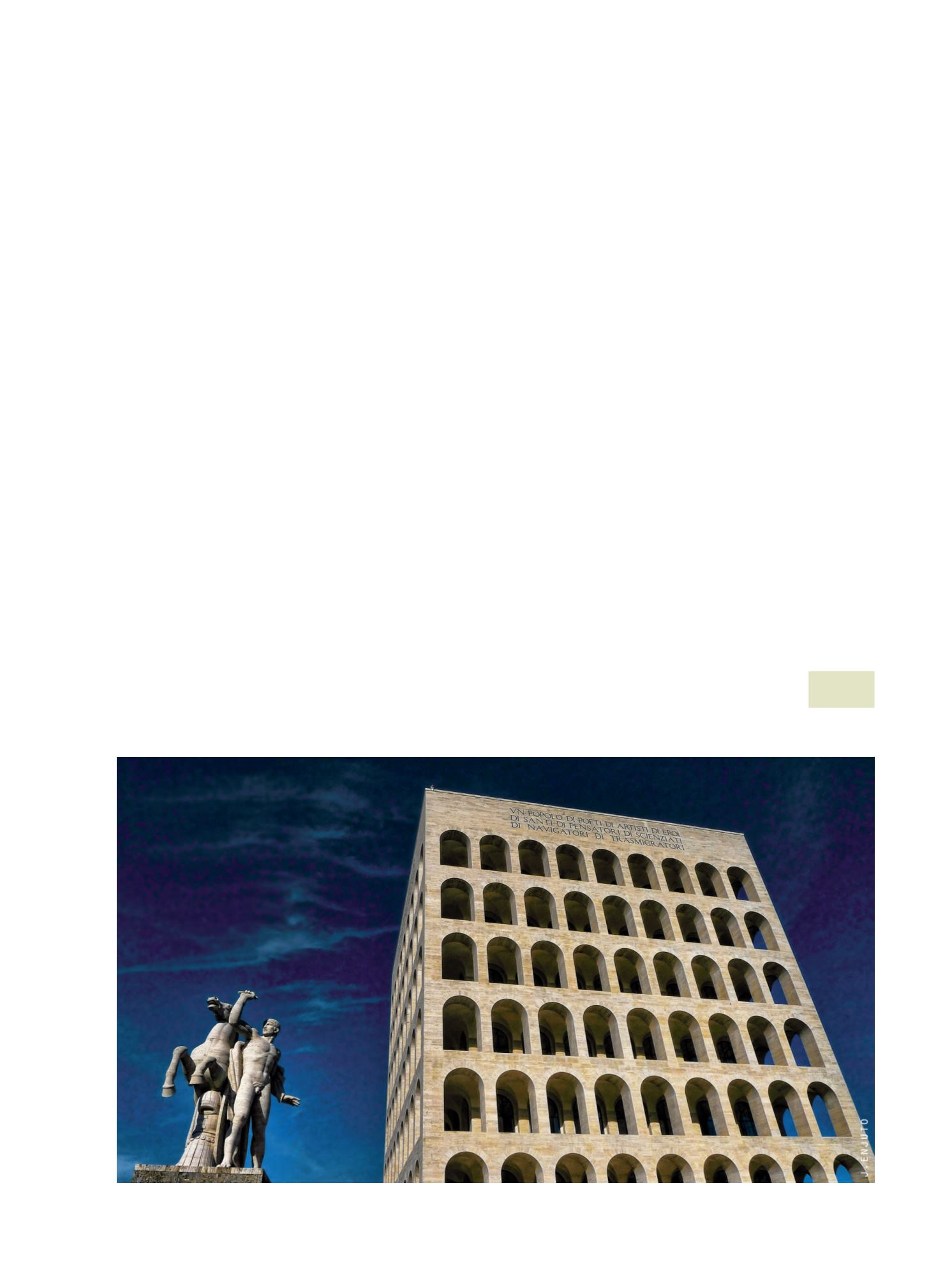
En los años treinta crea una ciudad satélite a Roma
para llevar a cabo la Exposición Universal de Roma (EUR)
en conmemoración de los 20 años del fascismo. Para
esta feria se construyeron diferentes edificios cuya
forma recordaba a alguna edificación romana, pero
dándole una forma lineal, más estilizada y menos or-
namentada, como, por ejemplo, el Coliseo Cuadrado.
El
Duce
veía la expresión artística como un medio
de propaganda política, ya que por medio de ésta po-
día llegar a muchos más lugares dando a la gente de
qué hablar. Es por esto que impulsó y motivó a pinto-
res, escritores, escultores y arquitectos a formar un
movimiento puramente italiano: el futurismo.
Este movimiento de jóvenes artistas como Filippo
T. Marinetti, Umberto Boccioni, Gino Severini, Giaco-
mo Balla y Antonio Sant’Elia reinterpreta el clasicismo
y rompe las barreras estáticas de la pintura y escultu-
ra, para darle una dinámica y vida a las nuevas obras.
En el futurismo se analiza con minuciosidad el cuerpo
humano y su desplazamiento en el espacio. En este
detallado ejercicio de análisis, el cuerpo y sus movi-
mientos son descompuestos hasta que se vuelven
mecánicos y sistematizados. Una persona ya no era
vista como tal, sino como parte de un sistema y ese
sistema era el fascismo.
Roma es un museo viviente porque la historia de
esta ciudad se vive y visita en la cotidianidad de un
recorrido a casa, al trabajo o en un día de paseo con la
familia y amigos.
The artistic andarchitectural tendencieshave been
changing, but have always kept and taken back to the
classical roots that distinguished themandwithwhich
they were known throughout the world during the
days of splendor of the Roman Empire. It is because of
this that Mussolini, during his government, proposes
to retake all these classical elements by means of the
art and the architecture, inorder togive Italy and to the
Romans inparticular, their identityas anationback.
In the thirties he creates a satellite city to Rome
to hold the Rome Universal Exposition World Fair
(EUR) to commemorate the 20th anniversary of Fas-
cism. For this fair, different buildings were built
that would evoke some Roman building, but provid-
ing it with a lineal form, more stylish and less orna-
mented as for example the Square Colosseum.
The Duce saw the artistic expression as a vehicle
for political propaganda, as for means of it he could
reach to many more places giving people some-
thing to talk about. It’s because of this that he urged
and motivated painters, sculptors and architects to
form a purely Italian movement: the Futurism.
This movement of young artists like Filippo T.
Marinetti, Umberto Boccioni, Gino Severini, Gia-
como Balla, and Antonio Sant’Elia reinterprets the
classicism and breaks the aesthetic barriers of the
painting and sculpture, to provide dynamism and
life to the new works. In the Futurism the human
body and its movement through space are thor-
oughly analyzed. In this detailed analysis exercise,
the body and its movements get deconstructed un-
til they become mechanical and systematized. A
person was no longer seen as such, but as a part of a
system and that systemwas the Fascism.
Rome is a living museum because the history of
this city is lived and seen every day on the way back
home, on the way to work, or on a strolling day with
family and friends.
compás int • int compass
19. Actualmente el
Coliseo Cuadrado es
sede de la marca de
alta costura Fendi.o
/ Nowadays, the
Square Colosseum
is the headquarters
of luxury fashion
label Fendi.
19


