



 100 / 134

·amura·
96
Diseño •
Design
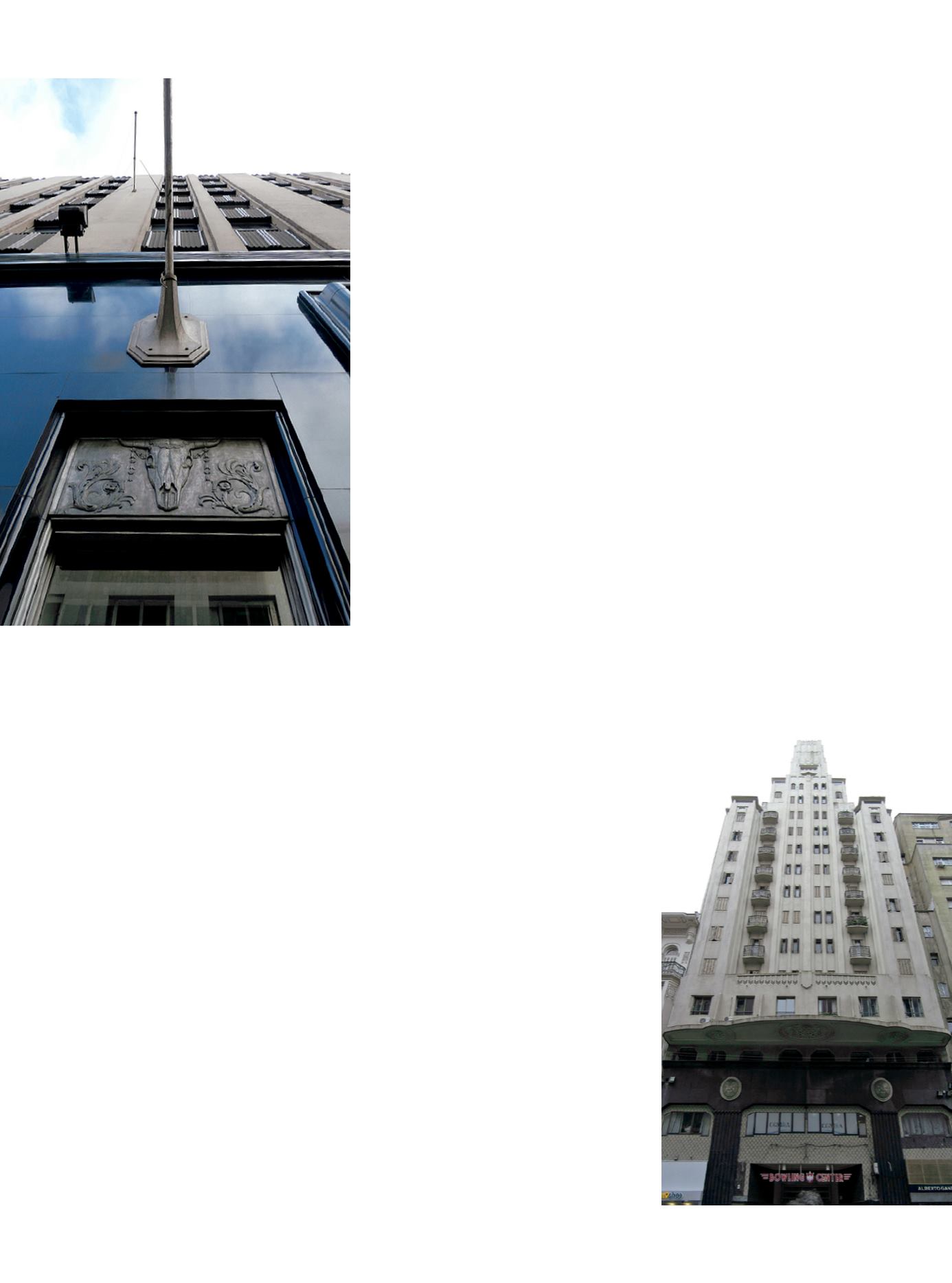
Edificio Artigas
Este es un edificio a menudo comparado con los ras-
cacielos de la ciudad de Nueva York: no está extre-
madamente adornado, pero sí está organizado simé-
tricamente con vidrio y aluminio; además posee un
aspecto cuadrado clásico. Se encuentra en la esquina
de Rincón y Treinta y Tres, pero tiene sólo una entrada.
Su nombre se debe al héroe nacional uruguayo José
Gervasio Artigas.
Palacio Díaz
Este es otro ejemplo de arquitectura que alude a los
edificios de Nueva York. Es un edificio alto, de apro-
ximadamente 65 m, con 18 pisos y un diseño vertical
con detalles metálicos que acentúan la jerarquización
de la estructura. La planta baja se extiende hasta el
octavo piso, donde el edificio comienza a reducirse;
esto hace alusión al Empire State Building. Fue cons-
truido en 1929 y concebido por Gonzalo Vázquez Ba-
rrière y Rafael Ruano.
Palacio Tapie
Actualmente es conocido como el edificio de San-
tiago de Chile. Fue creado por Francisco Vázquez
Echeveste y construido en 1933. Su diseño curvo se
basa en su ubicación en la esquina de la calle San-
tiago de Chile, en el barrio Cordón, al este del centro
de Montevideo. La torre que se eleva en la parte su-
perior contribuye a la geometría redonda del edifi-
cio y proporciona un elemento de sofisticación.
This is a building often compared to the sky-
scrapers of New York City: never too exuber-
antly adorned, but symmetrically organized
with glass work and aluminum, plus a classical
squared look. It stands in the corner of Rincón
and Treinta y Tres, but has only one entrance. It
was named after Uruguayan national hero José
Gervasio Artigas.
This is another example of architecture that alludes
to the buildings of New York. It is a tall building, ap-
proximately 65m, with 18 floors, a vertical design
and metallic details that accentuate the hierar-
chization of the structure. The lower floor extends
upwards to the eighth floor, where the building
begins to narrow, reminiscent of the Empire State
Building. It was built in 1929 and conceived by Gon-
zalo Vázquez Barrière and Rafael Ruano.
It is currently known as the Santiago de Chile
building. It was created by Francisco Vázquez Ech-
eveste and built in 1933. Its curved design is based
on its location on the corner of Santiago de Chile
Street, in the Cordón neighborhood, east of Down-
town Montevideo. The tower that rises on top con-
tributes to the round geometry of the building and
provides an element of sophistication.
It was named Art Deco in the 60s as
a derivative of the
1925 Exposition
Internationale des Arts decoratifs et
industriels modernes
in Paris.
A este movimiento se le dio el nombre
de Art Déco en los años 60 como un
derivado de
la Exposition Internationale
des Arts decoratifs et industriels
modernes
de 1925 en París.