


 41 / 134

Montevideo: el inicio
Montevideo: The Beginning
Para detener el avance de los portugueses, que estu-
vieron muy cerca de apoderarse de la Bahía de Monte-
video, el Gobernador y Capitán General del Río de la Pla-
ta, Don Bruno Mauricio de Zabala, comenzó a erigir los
cimientos de una ciudad amurallada y artillada, con un
grupo de 110 soldados y 1,000 indígenas armados con
una batería de 10 cañones: el Fuerte de San José.
Así comenzó el levantamiento de la Ciudadela, que
tardó 40 años en ser construida (1742 -1782) y cuyas
edificaciones principales fueron el cuartel, la iglesia, el
mercado, y la casa de gobierno. Los primeros habitantes
de San Felipe y Santiago de Montevideo (antiguo nombre
de la ciudad) provinieron de las Islas Canarias y Galicia. El
trazo arquitectónico fue realizado por Pedro Millán, res-
petando los capítulos de legislación urbana de las Leyes
de Indias, por lo que las manzanas fueron delineadas en
ángulos rectos.
La Ciudadela tenía al centro una plaza de armas, y es-
taba totalmente amurallada, con torres en cada esquina,
y a sus pies el foso que podía rellenarse a voluntad des-
de el mar, por lo que era solamente accesible a través de
un puente levadizo. Fue edificada para servir como base
naval de la Marina Real española en el Río de la Plata; cu-
yas naves de guerra patrullaban las costas americanas del
Atlántico Sur. 150 años más tarde, comenzó a destruirse
lamuralla y a construirse la ciudad abierta deMontevideo.
To cut off the Portuguese’s advance—who were close
to seizing the Bay of Montevideo—the Governor and
CaptainGeneral of Riode la Plata, DonBrunoMauricio
de Zabala, started to build the foundations of a new
walled city, reinforced with artillery, a group of 110
soldiers, and 1,000natives armedwith a battery of 10
guns: San Jose Fort.
That’s how the construction of the citadel be-
gan, which lasted 40 years (1742-1782); its main
buildings were the headquarters, the church, the
market, and the courthouse. The first inhabitants
of San Felipe and Santiago de Montevideo (former
name of the city) arrived from the Canary Islands
and Galicia. The architectural plan was designed by
Pedro Millán, abiding by the chapters of urban leg-
islation in the Laws of the Indies; this is why blocks
were delineated in straight angles.
The citadel had anArms Square at the center, and it
was completelywalled, with towers at each corner, and
at the bottomwas themoat that couldbe refilled atwill
fromthesea, reasonwhy itwasonlyaccessible through
a drawbridge. It was built to serve as the naval base of
theSpanishRoyalNavyinRiodelaPlata;theirwarships
patrolled the coasts of the American continent in the
South Atlantic. 150 years later, the wall was destroyed
and theopencityofMontevideowas born.
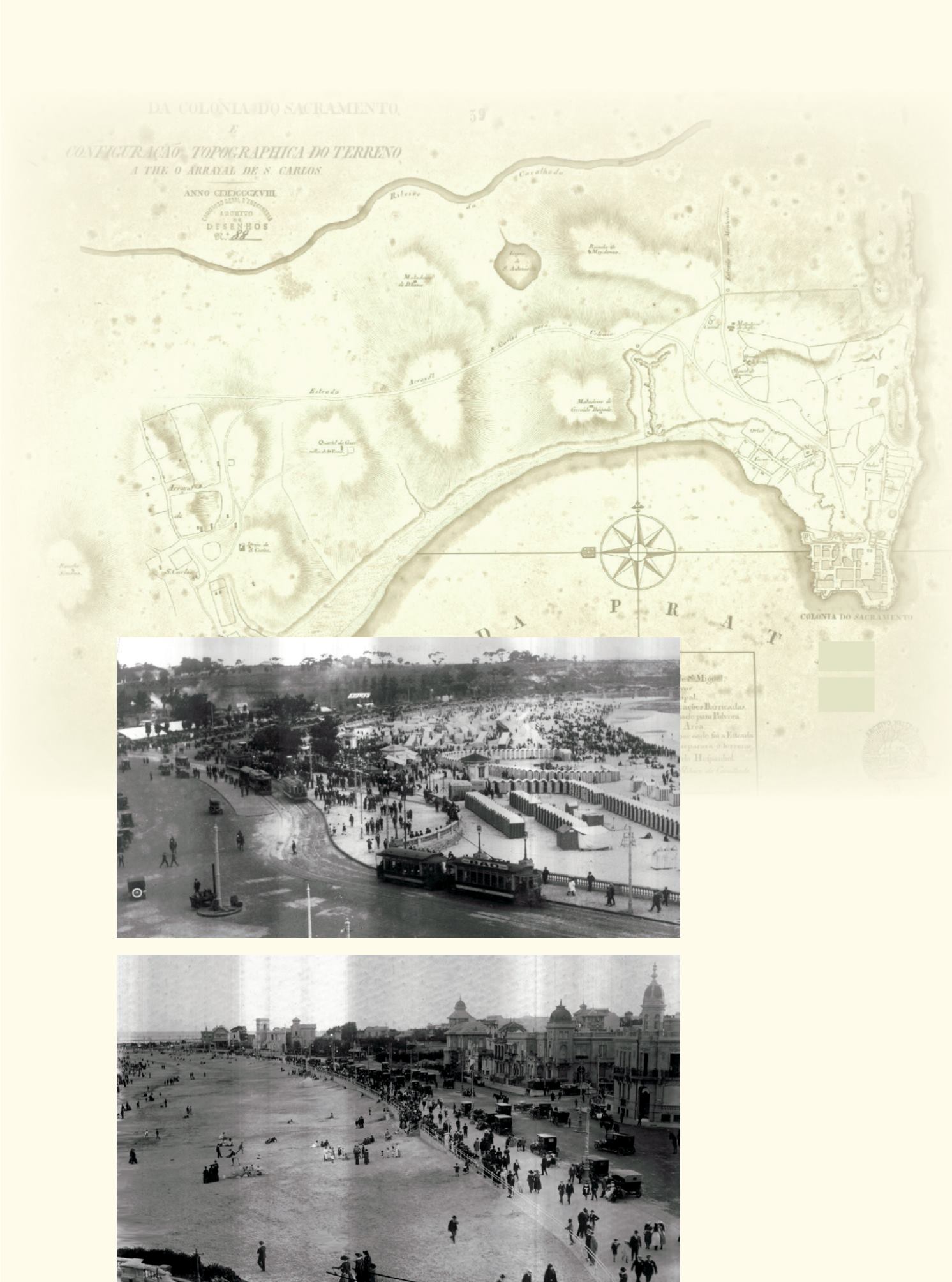
4y5 Imágenes
históricasde laciudad
deMontevideo./
Historicalpictures
ofthecityof
Montevideo.
·amura·
37
compás int • int compass
4
5