·amura·
47
compás int • int compass
Un parpadeo por Valencia
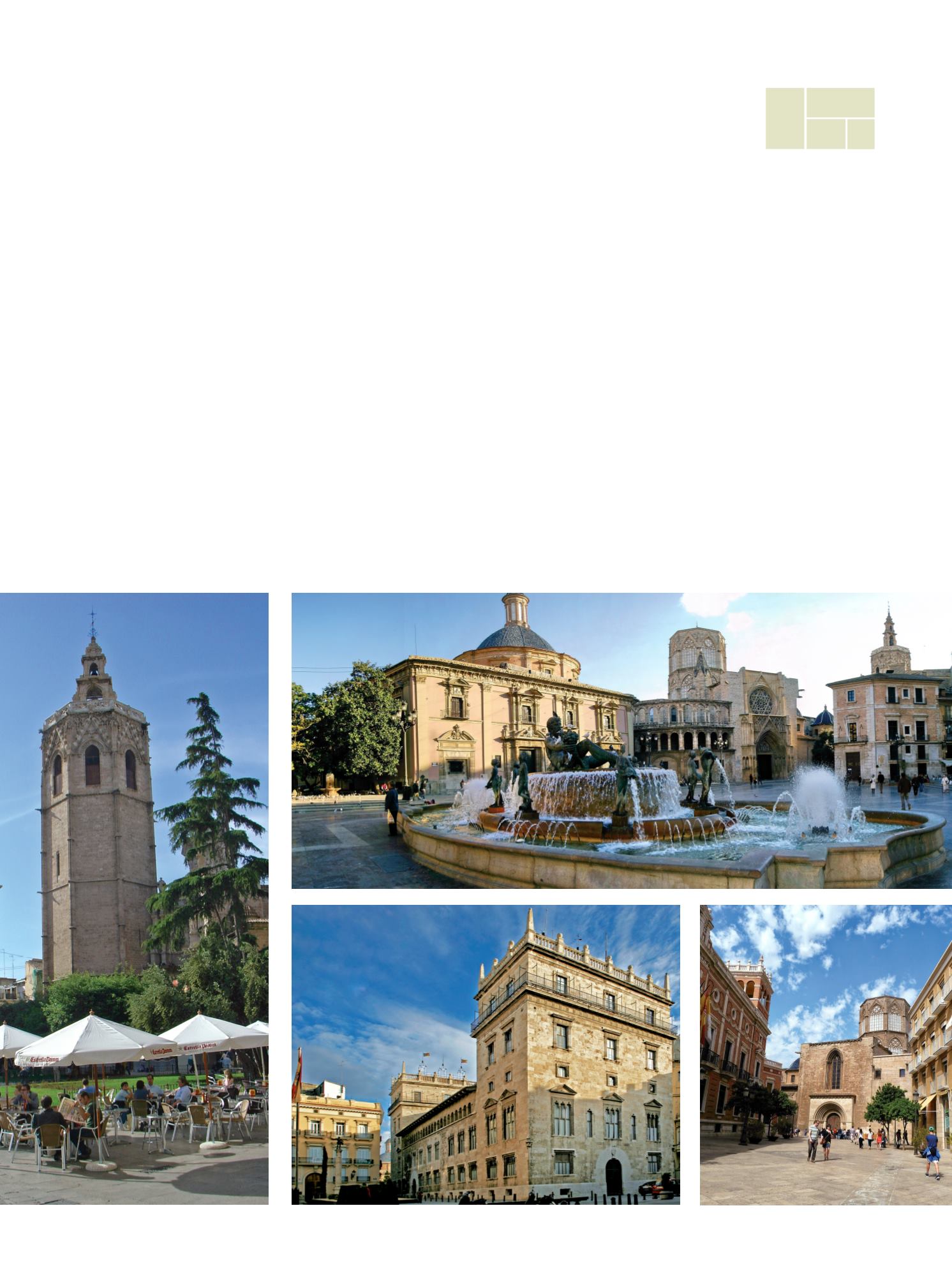
El barrio de la Seu, antiguamente Plaça de la Seu,
uno de los centros neurálgicos de Valencia, toda-
vía conserva la huella del urbanismo romano en
las calles que llegan hasta ella. Ahí, en el corazón del
Centro Histórico, se encuentran la Catedral y la plaza
de la Virgen, donde tradicionalmente se han concen-
trado las instituciones y estamentos de poder, lo que
la convierte en uno de los referentes históricos de la
ciudad. Muy cerca está el Palau de la Generalitá; este
edificio, que hoy alberga la sede del gobierno autóno-
mo valenciano, fue erigido en el siglo XIV, como sede
de la diputación general y su torre es uno de los sím-
bolos representativos de la imagen tradicional de la
ciudad. La zona también presume su historia de no-
bleza y burguesía, cuando en el Siglo XV en el Palau
de Les Corts, mejor conocido como Palacio de Borgia,
hoy convertido en el Parlamento Valenciano residió la
noble familia.
En la plaza de la Limosna o Plaça de l’Almonia,
considerada la más antigua de la población, bajo la
cual fueron hallados los restos de la ciudad que ahí se
asentó tanto en época de la Roma republicana como
en la imperial. Hoy el espacio lo ocupan los restos ar-
quelógicos en un complejo museístico. Otro testigo
silente del pasado es la bella Cripta Arqueológica de
la Cárcel de San Vicente Mártir, una capilla funeraria
debajo de lo que fuera la casa del Chantre hasta la des-
amortización de 1835.
A blink for Valencia
The Barrio of the Seu, knownbefore as Plaça de la Seu,
one of the neural centers of Valencia, still keeps the
trace of the roman urbanism in the streets that ar-
rive to it. There, in the heart of the Historical Down-
town, you can find the Cathedral and the Plaza of
the Virgin, where traditionally the institutions
and power estates have concentrated, which turn it
into one of the historical references of the city. Very
close you can find the Palau de la Generalitá; this
building, that today houses the Seat of the Valen-
cian Autonomous Government, was built in the XIV
century to Seat the General Council and its tower is
one of the representative symbols of the traditional
image of the city. The area also brags its noble and
bourgeoisie history, when on the XV century in the
Palau de les Corts, better known as the Borgia Pal-
ace, today converted into the Valencian Parliament,
lived the noble family.
In the plaza of Alms, or Plaça de l’Almonia, con-
sidered the oldest in town, under which the re-
mains of the city that was there during the era of
the Republican as well as the Imperial Rome. Today,
that space is occupied by the Archaeological rests
within a museum complex. Another silent witness
of the past is the beautiful Archaeological Crypt of
the jail of Saint Vincent Martyr, a funereal chapel
under what used to be the house of the Chantre un-
til its seizure in 1835.
23
24
25
26
23. Torre del
Miguelete. /
Torre
delMiguelete.
24. Plaza de la
Vírgen en Valencia
y sus alrededores.
/
PlazadelaVirgen
inValenciaand
surroundingareas.
25. Palau de la
Generalitá. /
Palau
delaGeneralitá.
26. Plaza de la
Limosna. /
Plaza
ofAlms.


