·amura·
116
los conquistadores •
the conquerors
Para una sociedad burguesa y elitista, la fortuna
no bastaba. Los viajes a Europa con el banquero An-
drew Mellon, quien más tarde fundaría la Galería Na-
cional de Arte en Washigton, D.C., y el gusto por el arte
le permitieron la entrada a un mundo aristocrático.
Don Andrew Carnegie reconocería a Henry como el
Rey del coque, por lo que lo invitó a una sociedad que
llevó a Frick a dirigir una de las más importantes em-
presas acereras del orbe. Enemistado con los sindica-
tos, sobrevivió a un atentado a manos del anarquista
lituano Alexander Berkmann en 1895.
La vida familiar también se trastocó con la devas-
tadora enfermedad de Marta, su hija predilecta. A los
dos años ingirió un alfiler sin que nadie se percatara.
Dos años después, invadida por infecciones y con se-
veras hemorragias internas, un ennegrecido objeto
asomó por el costado derecho de la pequeña. Por ese
tiempo también murió el cuarto de sus hijos.
María Dolores Jiménez-Blanco señala: […] conoció
a muchos otros artistas y coleccionistas. Frick des-
cubrió un mundo nuevo. El arte le producía el placer
que le había faltado por todo lo que había sufrido. A
diferencia de otros coleccionistas Henry Clay Frick co-
menzó su acervo por el gusto de decorar su modesto
hogar. Paulatinamente, refinamiento, suerte, buen
gusto y ojo avisado, acabarían por integrar en plena
Quinta Avenida, entre las elegantes calles 70 y 71,
donde se levanta una sobria y deslumbrante casona
de 5 millones de dólares que perteneciera a la familia
Vanderbilt, una de las mejores colecciones de arte en
Occidente.
ufacture of that metal. Before turning 30, Frick was
already a millionaire.
For a bourgeois and elitist society, wealth was
not enough. His travels to Europe with the banker
AndrewMellon, who later founded the National Gal-
lery of Art in Washington, DC, and his taste for art
allowed him to entry an aristocratic world.
Mr. Andrew Carnegie would recognize Henry as
the King of coke, so he invited him to a society that
led Frick to lead one of the largest steel companies
in the world. At odds with the unions, he survived
an attack by the hands of Lithuanian anarchist Al-
exander Berkmann in 1895.
Family life was also disrupted by the devastat-
ing disease of Martha, his favorite daughter. At age
two she swallowed a pin without anyone noticing.
Two years later, overrun by severe infections and in-
ternal bleeding, a black object appeared at the child’s
right side. By this time his fourth child also died.
Maria Dolores Jimenez-Blanco points out: […]
he met a lot of other artists and collectors. Frick
discovered a new world. Art produced him the plea-
sure he lacked for all he had suffered. Unlike other
collectors Henry Clay Frick began its collection for
the sake of decorating his modest home. Gradually,
refinement, good luck, good taste and an educated
eye, would eventually fully integrate, right in Fifth
Avenue between the elegant 70th and 71st streets,
where a $5million stunning sober mansion that be-
longed to the Vanderbilt family stands, one of the
finest Western collections of art.
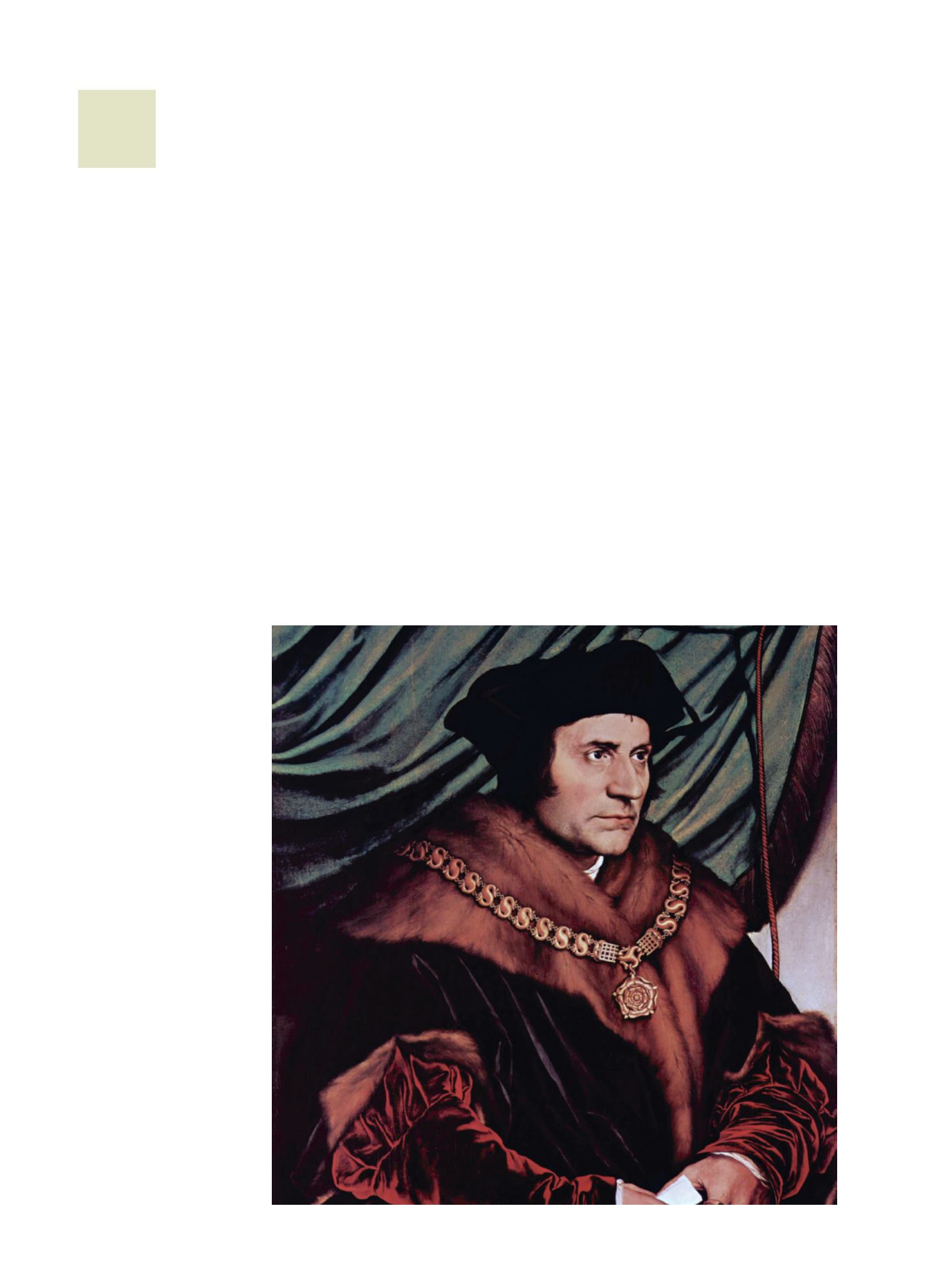
1. Hans Holbien
The Younger
(1497/98-1543)
Sir Thomas More,
1527
Óleo sobre lienzo/
Oil on canvas.
29 inch x 23 inch.
The Frick Collec-
tion, New York.
1


