conservancy •
conservación
Había llegado. La mañana de la sabana era intensa,
como un sol agazapado en la llanura. Después de un vue-
lo de ensueño sobre el cielo keniata, nos dirigimos, en un
camión, hacia el campamento ubicado dentro del Másai
Mara, cruzando la llanura que nos regalo la presencia de
algunos elefantes. Al acercarnos, un hombre murmuró
unas palabras. Era alto, esbelto y con una túnica roja cru-
zada, la cual le descubría unhombro; inmediatamente fui
cautivado por aquel dueño de una tranquilidad absoluta
y una mirada generosa. Supe, más tarde y por mí inago-
table curiosidad, que esa intrigante persona pertenecía
a la tribu Másai, por cierto, una de las más antiguas y re-
presentativas de África; un pueblo nómade y guerrero
del cuál subsisten alrededor de un millón de personas
distribuidas entre Tanzania y Kenia. Cultura orgullosa y
llena de valor, exactamente eso, era lo que había notado
en los ojos del primer Másai del camión.
El calor empezó lentamente a trepar hacia mi frente.
Agudicé la vista y noté, a lo lejos, el campamento. Puedo
decir que la ansiedad, y no el calor, me hizo saltar del ca-
mión, y es que la idea del safari me perseguía desde hace
años. Para mi suerte, Juan nos recibió servicialmente. Él,
era el dueño del campamento; un español de barba tupi-
da y mirada alegre que residía en Kenia hacia 5 años. Fui-
mos a reconocer el lugar, me enseñó algunas instalaciones
y presentó a sus ayudantes de trato amable, yo para ese
entonces estaba bastante preocupado por mi estómago y
un buen baño. El lugar era completamente acogedor. Des-
cansé enuna tienda elevada a unos cincometros del suelo,
con telas extendidas elegantemente como puertas y con
todas las comodidades necesarias. Al caer la tarde, otros
viajeros, el dueño, algunosMásai y yo, nos reunimos como
una familia alrededor de una gran mesa blanca adornada
conmanteles de lino para un banquetemagnífico.
Juan como gran anfitrión nos abrazó con intri-
gantes historias, y explicó otras tantas curiosidades
y costumbres del lugar. Por mi parte, me demoré
I had arrived. Morning in the savanna is intense,
the sun crouching on the prarie. After what felt a
oniric flight over the Kenyan sky, we headed our-
selves by bus, to the camp located inside Masai Mara.
We crossed the pastures that gifted us with the pres-
ence of some elephants. As we came closer a man
mumbled a fewwords. Hewas tall, lean andwore a red
tunic that rested on one of his shoulders; I was imme-
diately captivatedby theowner of suchabsolute tran-
quility andgenerous gaze. I knew later, ledbymy tire-
less curiosity, that this intriguing character belonged
to the Maasai tribe, which by the way, is one of the
most ancestral and representative of Africa; a warrior
nomad tribe, ofwhichalmost amillionaredistributed
between Kenya and Tanzania. A culture full of pride
and courage, that was exactly what I had noticed in
the eyes of the first Maasai I saw in that bus.
The heat slowly began climbing up to my fore-
head. I sharpened my view and noticed, far away,
the camp site. I can say the apprehension, not the
heat, made me jump out of the bus. The idea of a sa-
fari had chased me for years. Luckley, Juan received
us in an attentive manner.He was the owner of that
camp; a happy looking, heavy bearded Spaniard
that had lived in Kenya for 5 years. We went scout-
ing, he showed me some of the facilities and intro-
duced me to his helpers. I ,was more concerned for
my appetite and a good bath. The place was cozy. I
rested in a tent, elevated 5meters above the ground,
with extended textiles elegantly placed as doors
and equipped with all the necessary commodi-
ties. As night fell, other travellers, the owner, a few
Maasai and I gathered as a family around the huge
white table adorned with linen for a banquet.
Juan, being a great host, hugged us all into his
intriguing stories and explained other costumes and
curiosities of the place. Onmypart, I tookmy time and
3.
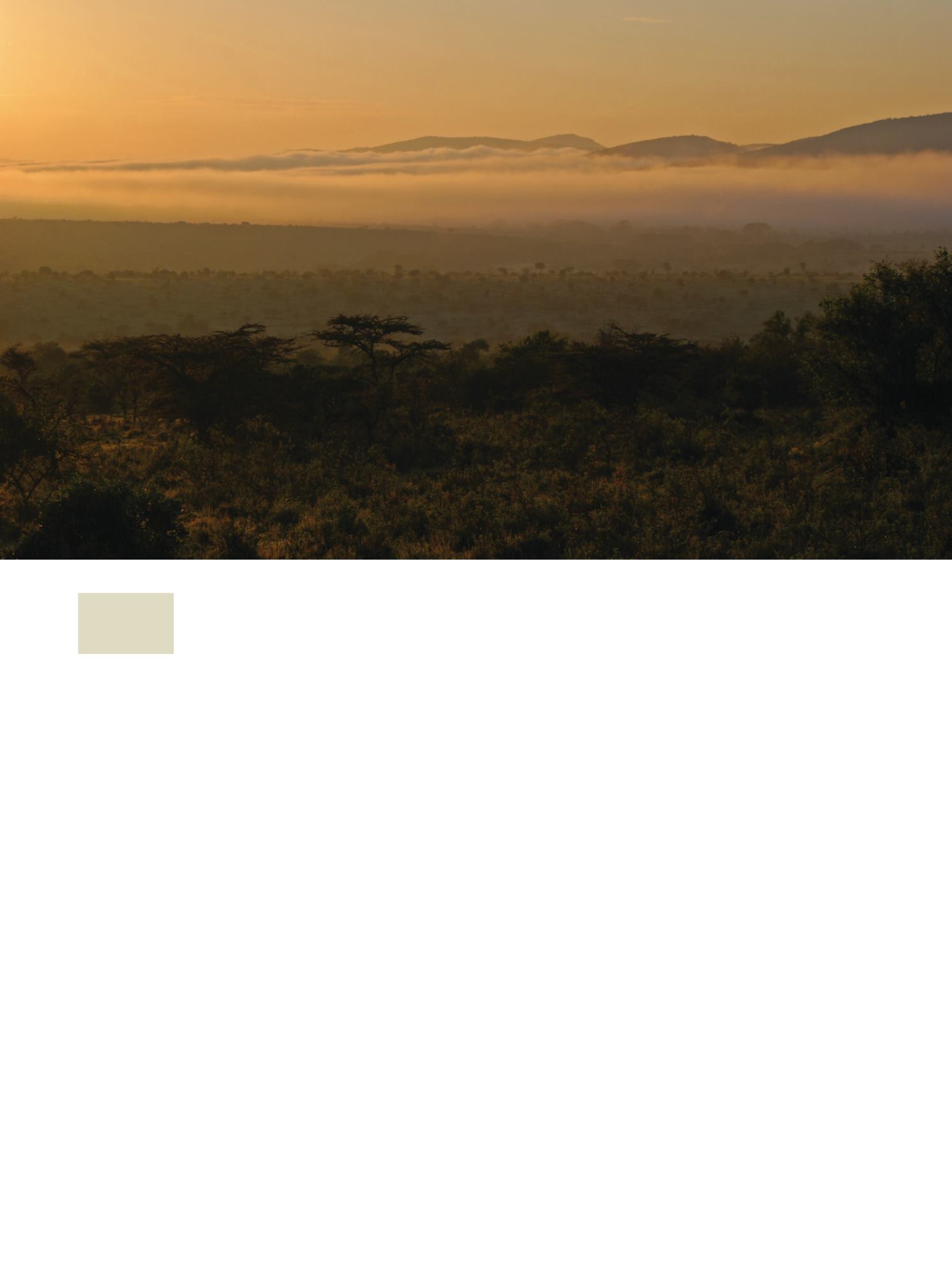
3. Espectaculares
amaneceres en el
Masai Mara. /
Sepec-
tacular dawn in The
Maasai Mara
·amura·
118
Foto /
Photo
: gbaku / On the go tours
/ OPEN WALLS / STATIC / National Geographic


