·amura·
59
compás int • int compass
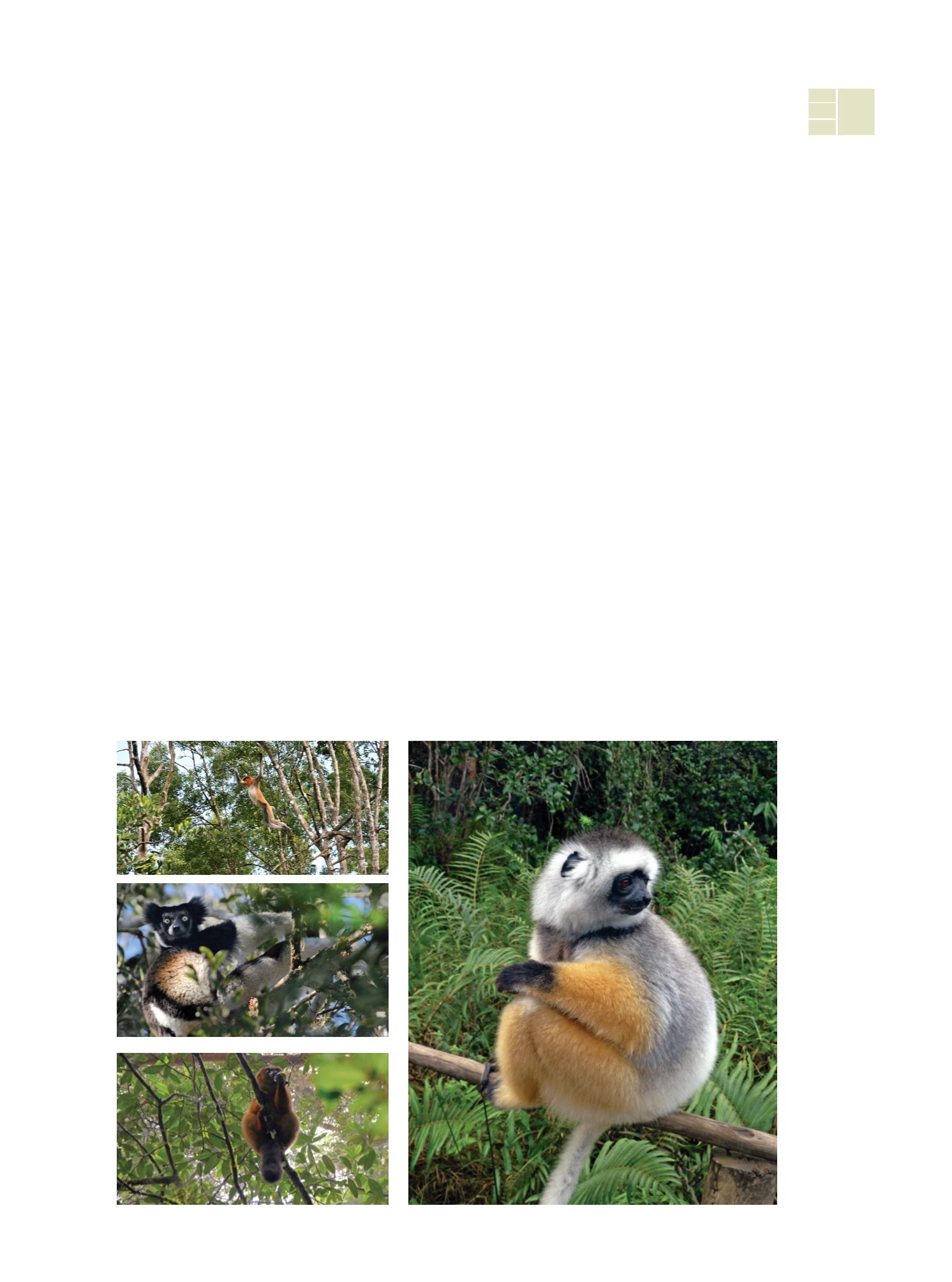
23.La islaMangabe
esunareservaque
albergadiversos
primatesyespecies
endémicasde
Madagascar./
The
Mangabeislandis
areservehometo
manyprimatesan
endemicspeciesof
Madagascar.
24y25.ElParque
Nacionalde
Ranomafanaesun
bosquequealberga
unagrancantidad
defaunadistintiva
deMadagascar. /
Ranomafana
NationalParkisa
forestthathasalotof
distinctivefaunaof
Madagascar.
26.El lémuresuna
de lasespecies
endémicasmalgaches
másreconocidas
delmundo. /
The
lemurisoneofthe
mostrecognizable
endemicmalagasy
speciesintheworld.
The legend of the Lost Continent
Speaking of Madagascar implies the legend of Le-
muria, the lost continent. In 1860, William Thomas
Blanford, an English geologist and naturalist, found
similarities among the types of rocks present in
South Africa and Madagascar Island with South
India. Rocks corresponding to the Permian were
practically identical in both continents separated
by more than 5,000 km; after deeper studies, he
came up with the theory of a possible existence of a
land connection –today, a lost bridge—that linked
both continents. It was at the same time when the
Darwinist biologist Ernst Heinrich Häckel was seek-
ing for an explanation of the lemurs presence with
similar features in Madagascar and in Asia.
When he found out Blanford’s theory, he took it
as an explanation of how come two so similar spe-
cies were evolutionally so far in space. Four years
after the first Blanford’s theory, zoologist Philip
Lutley Sclater suggested the name Lemuria for this
hypothetical land bridge between both continents,
title that obtained along the years.
Blanford, Häckel and Sclater’s theory explained
howcome this landbridgewouldhave beenanancient
continentthat,becauseofearthquakesandothernatu-
ral disasters’ effects, had ended submerged under the
ocean waters. Based on that, they managed to explain
the geological similaritieswhile, at the same time, the-
orized about a lemur ancestor inMadagascar and Asia,
that might have populated this lost continent, thus
keepingDarwin’s EvolutionTheoryas valid.
Lemuria’s story and mysticism brought about
deeper theories on the lost continent, even as-
tounding histories such as the one that Madame
Blavatsky left in 1875, in her literary piece Dzyan,
in which there were a great number of new myths,
supposedly rescued from the annals of history.
La leyenda del continente perdido
Hablar deMadagascar lleva implícita la leyenda de Lemu-
ria, el continente perdido. En1860, WilliamThomas Blan-
ford, un geólogo y naturalista inglés, encontró similitu-
des entre los tipos de rocas presentes en el sur de África
y la isla de Madagascar, con el sur de la India. Las rocas
correspondientes al Pérmico eran prácticamente idénti-
cas en ambos continentes alejados por más de de 5,000
km; después de diversos estudios más profundos, teori-
zó sobre la posible existencia de una conexión terrestre
–hoy desaparecida– que unía ambos continentes. Fue la
misma época en que el biólogo darwinista Ernst Heinrich
Häckel buscaba una explicación a la presencia de lémures
de similares características tanto en Madagascar como
en Asia.
Al enterarse de la teoría de Blanford, la tomó como
explicación de cómo dos especies tan similares evolutiva-
mente estaban tan lejos en el espacio. Cuatro años más
tarde de la primera teoría de Blanford, el zoólogo Philip
Lutley Sclater sugirió el nombre de Lemuria para este hi-
potético puente de tierra entre ambos continentes, nom-
bre quemantuvo durante el paso de los años.
La teoría de Blanford, Häckel y Sclater explicaba cómo
este puente de tierra habría sido un antiguo continente,
que por los efectos de terremotos y otros desastres na-
turales había terminado sumergido bajo las aguas de los
océanos. Con ello conseguían explicar las similitudes geo-
lógicas, así como teorizaban sobre un antecesor de los
lémures de Madagascar y Asia que habría poblado este
continente perdido, manteniendo como válida la Teoría de
la Evolución de Darwin.
La historia y misticismo de Lemuria provocó que sur-
gieran teoríasmás profundas sobre el continente perdido;
incluso historias asombrosas como la que Madame Bla-
vatskydejó en1875, en suobra literariaDzyan, en la cual
había gran cantidad de nuevos mitos supuestamente
rescatados de los anales de la historia.
23
24
25
26


