38
·amura·
compás int •
compass int
Tibnin, built by Hugues de Sain Omer in 1104, and
Beaufort Castle (
Qala’at ash Shaqif
), built during the
Byzantine age and conqueredby theArabs, dominate
a striking scene. The very welcoming people are
peaceful and busy with their rural life in a place
where the rivers that descend from the mountains
have carved stunning valleys and great ravines.
We sailed to the north, passing by a low coast
where there are a series of long beaches and several
rocky areas, discovering Sarafand (ancient
Zarephath, where Elijah miraculously resurrected
the son of a widow and which is now famous for its
work in glass), until we reached Saida, also known
as Sidon, one of the most ancient cities.
Saida, or Sidon, owes its revival to the Murex, a
mollusk that makes purple ink and, later on, to the
glass objects it produces since the 14th century B.C.
The cemetery, many centuries old, is located over
an ancient Murex shell deposit. The Sea Castle, built
by the Crusaders in 1229, protects this peaceful
harbor and it offers the perfect shelter. It is an
important fishing port with a small area for yachts
and sailboats and the very old city is located next to
it, dominated by the ruins of the Saint Louis castle
on the hill.
This walled city is explored through its narrow
streets that guard authentic treasures fromthe past
such as its mosques, hammams and the immense
Khan Al Franj, a caravanserai that, in its huge cen-
tral arched patio, lodgedmerchants and their wares.
Some of the streets go beneath the houses and end
up in the small plazas where the men smoke nar-
guiles… The conversations are very lively and the
en 1104, o el castillo de Beaufort (
Qala’at ash Shaqif
),
edificado en la época bizantina y conquistado por los
árabes. La gente es muy acogedora, apacible, ocupa-
da en su vida rural, los ríos que bajan de las monta-
ñas han forjado hermosos valles o grandes
barrancos.
Zarpamos hacia el norte, recorriendo una costa
baja donde se suceden largas playas y algunas zonas
rocosas, descubriendo Sarafand (antigua Zarephath,
donde tuvo lugar el milagro de Elijah, que revivió el
hijo de una viuda, y famosa por su trabajo de vidrio),
hasta llegar a Saida, llamada también Sidon, una de
las ciudades más antiguas.
Saida o Sidon debía su auge al murex, ese molus-
co del cual se produce el tinte púrpura, y más tarde a
sus objetos de vidrio, desde el siglo XIV a. C. El
cementerio se encuentra sobre un antiguo depósito
de conchas de murex, utilizado durante siglos. Es un
tranquilo puerto protegido por el castillo del mar
construido por los cruzados en 1229, y que le da un
perfecto albergue. Es un importante puerto de pesca
con una pequeña zona para yates o veleros, y la ciu-
dad antigua se encuentra a su lado, dominada por los
restos del castillo de Saint Louis en la colina.
Esa ciudad amurallada se recorre por medio de
angostos callejones que guardan auténticos tesoros
del pasado, como las mezquitas, los
hammams
, y el
inmenso Khan Al Franj, un caravanserai que alojaba a
los comerciantes y sus mercancías, con su inmenso
patio central y sus arcos. Unos callejones pasan por
debajo de las casas y desembocan en placitas donde
los hombres fuman el narguile. Las conversaciones
son muy animadas y la gente nos invita a platicar, a
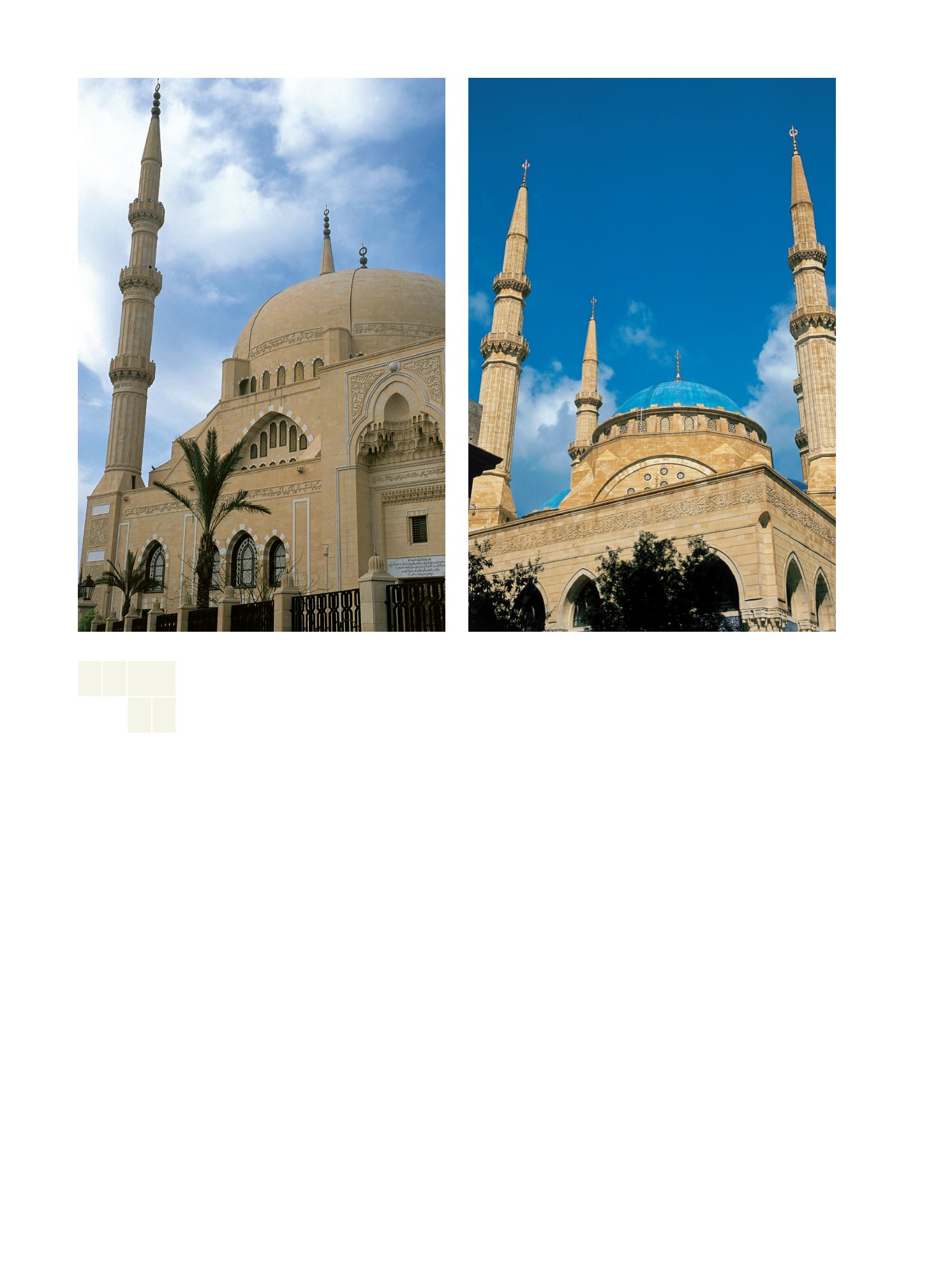
1. La mezquita moderna de
Sidon alza sus torres a la
orilla del mar
The modern mosque of
Sidon extends its towers to
the edge of the sea
2. La gran Mezquita de Beirut,
en el centro, compite en
belleza con las iglesias y su
techo azul brilla como el mar
The great mosque of Beirut,
in downtown, competes in
beauty with the churches
and its blue roof shines like
the sea
3. El restaurante-pastelería
“Paul” es uno de los lugares
más concurridos y famosos
de Beirut, donde se encuentra
la gente
The “Paul” restaurant-cake
shop is one of the most
visited and famous places
in Beirut and a great
meeting place
4. La mezquita Al Omari fue
construida como la iglesia de
San Juan bautista y convertida
al Islam en 1291
The Al Omari mosque was
built as the St. John the
Baptist and was converted to
Islam in 1291
1 2 3
3 4


