42
·amura·
compás int •
compass int
ruins live in harmony and the sacred places have
changed their religion. This is the case of the Al-
Omari Mosque, which was originally the church of
Saint John the Baptist, and the superb Saint George
Cathedral, which is of the Maronite religious
group. The Great Mosque raises its golden towers
towards the blue sky, protecting those of the
neighboring church.
Gouraud Street is where trendy restaurants
and bars are located and the terrace of Paul, the
finest pastry shop in Beirut, is filled with hand-
some people driving eye-catching cars. In the
Achrafiye neighborhood the elegant buildings live
side by side with the bars, restaurants and a very
modern shopping center. The Albergo, an exqui-
site hotel decorated with eastern antiques, is the
ideal spot inwhich to relax in this city that beats to
the passionate rhythm of a rebirth marked by the
enjoyment of life’s pleasures and its warm nights.
In the afternoons people stroll along the cor-
niche, Muslims and Christiansmeet, fishermen defy
the sunset to capture the finest fish and the elegant
apartments admire the sea and a horizon that, for
centuries, has seen so many ships set sail. In the
Saint George Bay, the marina waits for the return of
its Mediterranean lifestyle, such as it knew when
Beirut was the little Paris of the Middle East and a
never-ending party during the hot summers. The
best hotels are being built on its shore.
Baalbeck and the Bekaa Valley
Passing the mountain that dominates Beirut you
reach the fertile Bekaa Valley, swathed in fruit trees,
vineyards and cultivated fields and harvested since
ancestral times. Since 1857, the Jesuits turned a
number of caverns into natural wine cellars used
Las mezquitas, las iglesias, las ruinas de los tem-
plos romanos, los restos fenicios conviven, los luga-
res sagrados han cambiado de religión, como la
mezquita Al-Omari, que era originalmente la iglesia
de San Juan Bautista, o la soberbia catedral de San
Jorge que es de culto maronita. La gran mezquita
alza sus torres doradas hacia un cielo azul, prote-
giendo las torres de la vecina iglesia.
En la calle Gouraud se juntan los restaurantes y
bares de moda, la terraza de Paul, la mejor pastelería
de Beirut, se llena de gente guapa con coches des-
pampanantes. En el barrio Achrafiye los elegantes
edificios conviven con los bares, restaurantes y un
modernísimo centro comercial. El Albergo, un exqui-
sito hotel decorado con antigüedades orientales, es
un refugio ideal para alojarse en la ciudad que vibra al
ritmo de un renacimiento lleno de la fiebre de gozar
de los placeres de la vida, de las noches cálidas.
En la corniche la gente pasea por las tardes,
musulmanes y cristianos se encuentran, los pesca-
dores desafían el atardecer para atrapar al mejor pez,
los elegantes departamentos admiran el mar y su
horizonte que ha visto zarpar tantos barcos a lo largo
de los siglos. La marina, en la bahía Saint George,
espera el retorno de la vida mediterránea, como en el
tiempo en que Beirut era la fiesta perpetua del vera-
no ardiente, cuando era el pequeño París de Medio
Oriente. En su orilla se están construyendo los mejo-
res hoteles.
Baalbeck y el valle de la Bekaa
Pasando la montaña que domina Beirut se alcanza el
fértil valle de la Bekaa, vestido por sus árboles fruta-
les, sus viñedos y sus campos de cultivo, trabajados
desde tiempos ancestrales. Unas cavernas naturales
han sido convertidas por los jesuitas desde 1857
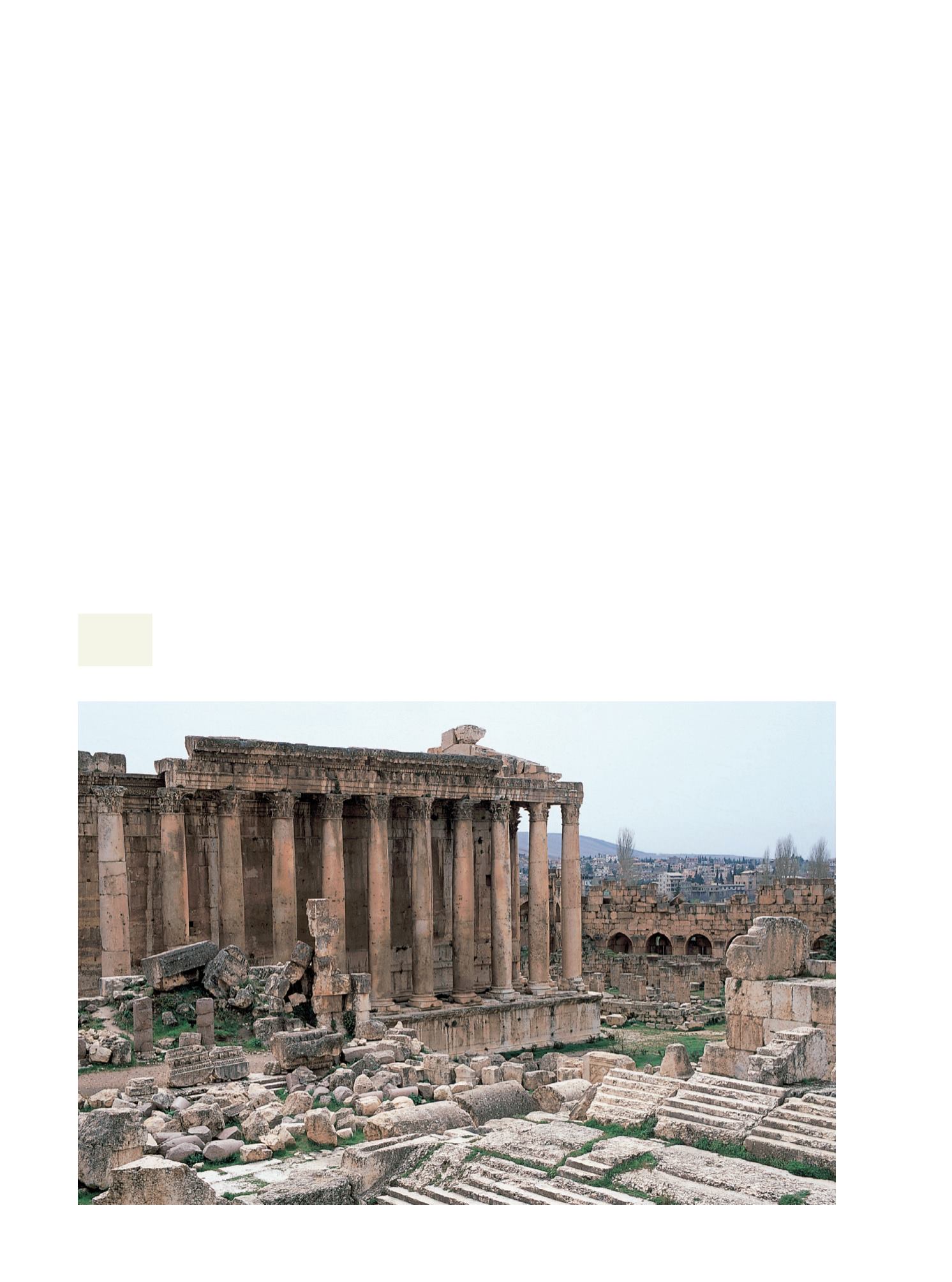
El templo de Bacchus, uno de los
más impresionante y bien con-
servado de las ruinas romanas de
Baalbek
The Bacchus temple, one of
the most impressive and
well-preserved of the Roman
ruins of Baalbek


