45
compás int •
compass int
·amura·
restos de los antiguos templos de Resheph y de
Balaat Gebal que datan de los siglos III y IV a. C., o el
de los obeliscos que fue deificado en el siglo XIX a. C.,
los restos del teatro romano.
En la ciudad medieval, además de la zona del
soco, destaca la iglesia de San Juan Bautista y el
puerto, protegido por sus torres guardianas entre las
cuales se extendía una cadena. Ha sido un puerto
importante desde la antigüedad, desde el cual se
exportaba la madera de cedro, y en los años de las
décadas de 1950 a 1970 era el lugar favorito del
jet
set
que lo invadía durante el verano, haciendo del
Club de Pesca el reino de su dueño, Pepe el Pirata, el
lugar de mayor fama, donde desfilaban las estrellas
de cine. Ahora es un pequeño pueblo tranquilo que
vibra los fines de semana al son de las terrazas de
cafés invadidas, de sus bares, con un ambiente rela-
jado y goza de un maravilloso atardecer.
Desde Biblos hasta Trípoli
La costa sigue el relieve de las montañas, con hermo-
sas playas delimitadas por rocas, sembrada de luga-
res de veraneo, donde encontramos a Batroun, un
pequeño puerto de pescadores maronitas, en su
mayoría, cuya historia remonta al tiempo de los
egipcios.
Pasando el cabo Qubba descubrimos la bahía de
Chekka y el pequeño pueblo de Enfe, con su marina
del sol donde los modernos apartamentos se rentan
para el verano.
Finalmente llegamos a Al Mina, el gran puerto de
Trípoli, con su agradable corniche (malecón), donde se
alojan los mejores restaurantes y cafés de la ciudad. El
puerto es inmenso, uno de los más activos, y las islas
the 12th century, the wall, the ruins of the antique
temples of Resheph and Balaat Gebal, which date
from the 3rd and 4th centuries B.C.; the one of the
Obelisks, that was sanctified in the 19th century B.C.;
as well as the ruins of the Roman theater.
In the medieval city, the area of the souq (mar-
ket) is outstanding as are the church of Saint John
the Baptist and the port, watched over by its pro-
tecting towers that used to be linked by a chain. An
important harbor since ancient times and from
where cedar wood was exported, during the decades
of the 50s to the 70s it was a site favored by the jet
set, who invaded it during the summer, turning the
Fishing Club—the kingdomof itsmonarch, Pepe de
Pirate— into a popular place where movie stars
paraded by. Now it is a sleepy fishing village that,
during the weekends, vibrates to the beat of its
crowded café terraces and bars that have a relaxed
ambiance and offer a view of spectacular sunsets.
From Byblos to Tripoli
The coast follows the trace of the mountains and
includes attractive beaches framed by rocks,
dotted with summer places and where we found
Batroun, a small village of mainly Maronite fisher-
men and whose history dates back to the time of
the Egyptians.
Passing Qubba Cape we discovered the Bay of
Chekka and the small town of Enfe and its sunny
marina, where modern apartments are leased for
the summer.
Finally we reached Al Mina, the great port of
Tripoli, with its pleasant corniche (seaside prome-
nade) where the finest restaurants and cafés of
1
2
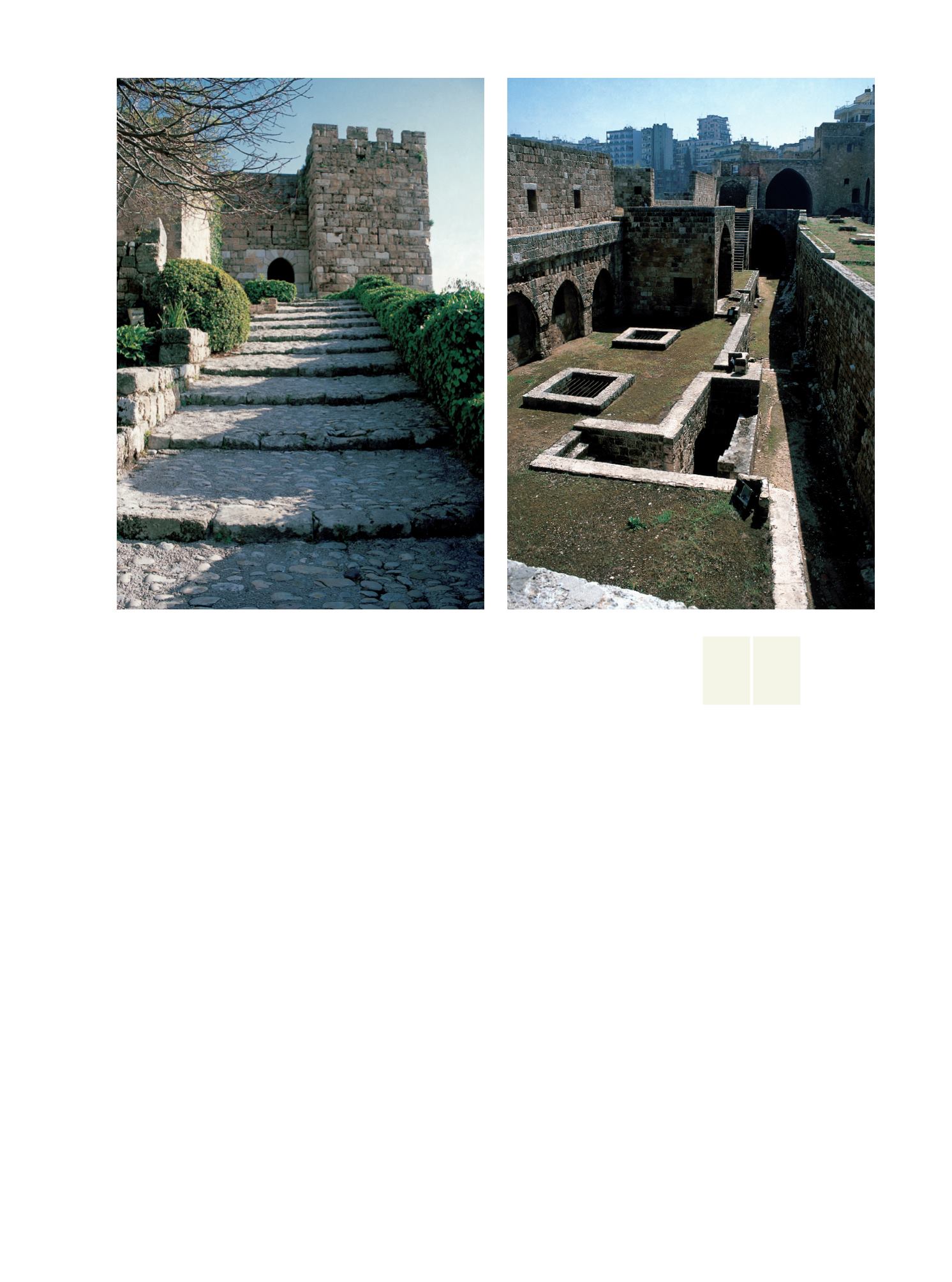
1. El castillo de Moussalayha data
del siglo XV y vigilaba el valle de
Ras Ech-Chekka, camino hacia el
norte
The Castell of Moussalayha date
fromXV Century andwatched
out the Ras Ech-Chekka valley,
toward north
2. El fuerte de Biblos vigila la
entrada del puerto desde los
tiempos que era la ciudad
romana hasta nuestros días
The Biblos Fort has watched over
the entrance to the port since
Roman times


