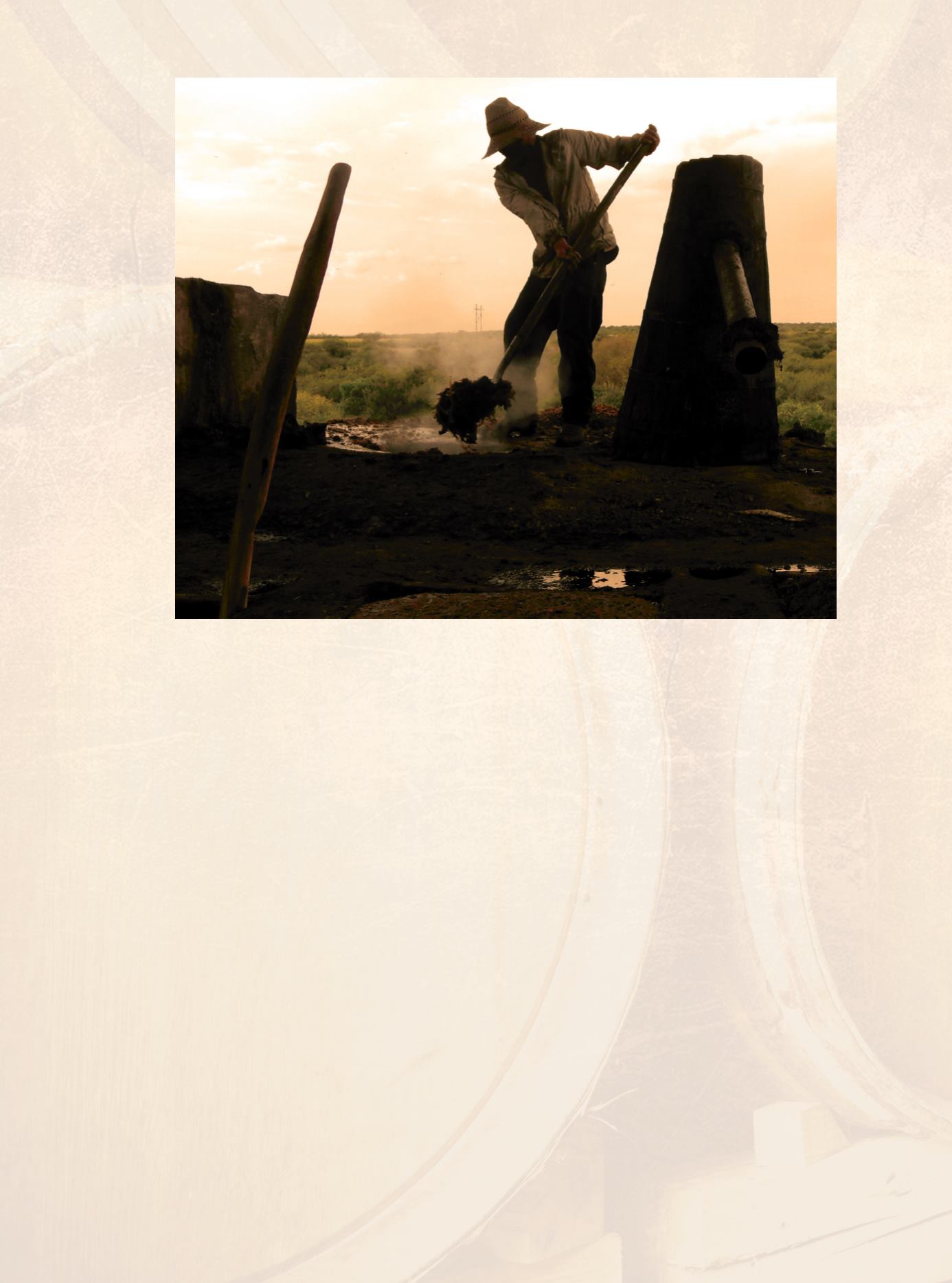
PROCESO
El proceso del Mezcal inicia con el cultivo del ma-
guey, seleccionando plantas maduras de acuerdo a
su tipo y edad, que va de los ocho a los 20 años, de-
pendiendo la especie. La jima, es el proceso de cor-
tar las pencas hasta obtener una piña, que es el co-
razon del agave; el cual puede pesar desde 20 hasta
650 kilogramos. Las piñas se cortan en pedazos, de
acuerdo al gusto del maestro mezcalero, y se apilan
en un horno cónico en cuyo interior se ha prendido
una fogata con madera de encino y piedras de río, las
cuales, cuando llegan al rojo vivo, reciben los trozos
de las piñas para su cocción.
Una vez que inició este proceso, se tapa el horno
con tierra para dejar que el calor y el humo inicien la
mágica transformación de los almidones de la piña, en
azúcares. Posteriormente, se extraen para dar paso a
la molienda, que consiste en triturar los fragmentos
de la piña cocida en un molino de piedra, tirado por
una mula o a golpe de mazo sobre una canoa de en-
cino hasta alcanzar un bagazo desmembrado, el cual
es muy dulce al aroma y al gusto. Aquí es en donde se
extraen los azúcares para la fermentación.
El bagazo del agave es depositado en tinajas de
madera de encino en donde se le agrega agua de ma-
nantial, para comenzar el proceso de fermentación.
Dicho fermento, junto con el bagazo, es colocado en
alambiques de cobre de destilación discontinua u
ollas de barro, para su separación por evaporación y
condensación. Esta fase se repite y el líquido que se
obtiene de la segunda destilación es de donde se nace
el fabuloso sabor y aroma del Mezcal.
PROCESS
The process of the Mezcal begins with the growing of
the Maguey (a type of agave), selecting mature plants
based on their type and age, which can go from 8 to
20 years, depending on the species. The “jima” is the
process of cutting the “leaves” (pencas) until reach-
ing the “heart” (piña) of the agave, which can weight
anywhere from20 to 650 kilos. The hearts are cut into
pieces, dependingonthestyleof theMaestroMezcale-
ro(MasterofMezcal),andarepiledonaconicalfurnace
inside of which a fire is startedwith oakWood and riv-
er stones, which, when they heat enough to turn red,
they get the pieces of the hearts to be cooked.
Once the process has started, the furnace is
covered with soil to allow the heat and the smoke
begins the magic transformation of the starches of
the heart into sugars. Afterwards, they are extract-
ed to be milled, process which consists of grinding
the fragments of the cooked heart in a Stone mil,
moved by a mule or by hitting a mallet on an oak
wood canoe until the chaff is lose, and has an aroma
and a flavor that are, both, very sweet. Here is where
the sugars are extracted to be fermented.
The chaff of the agave is set in wooden jars
where spring water is added to begin the fermen-
tation process. This ferment and the chaff are put
together in copper stills of discontinued distilla-
tion or pots of clay, to be separated and evaporat-
ed and condensed. This phase is repeated and the
liquid that is obtained in the second distillation
is the one that has the fabulous flavor and aroma
of the Mezcal.
·amura·
110
publirreportaje •
advertisement


