·amura·
40
ciudad vieja), siendo la parte más medieval donde
se concentran parte de las torres que dan a Praga
su apodo de la “Ciudad de las Cien Torres”. En su
centro descubrimos la Plaza de Staré Město, una
de las plazas más bonitas de Europa que empezó
a ser construida desde el siglo XI, cuando la ciu-
dad empezó a crecer a partir del castillo.
La plaza tiene un peculiar encanto con sus ca-
sas de 3 pisos terminadas por un penacho al estilo
bohemio, pintadas de colores pasteles, y el ayunta-
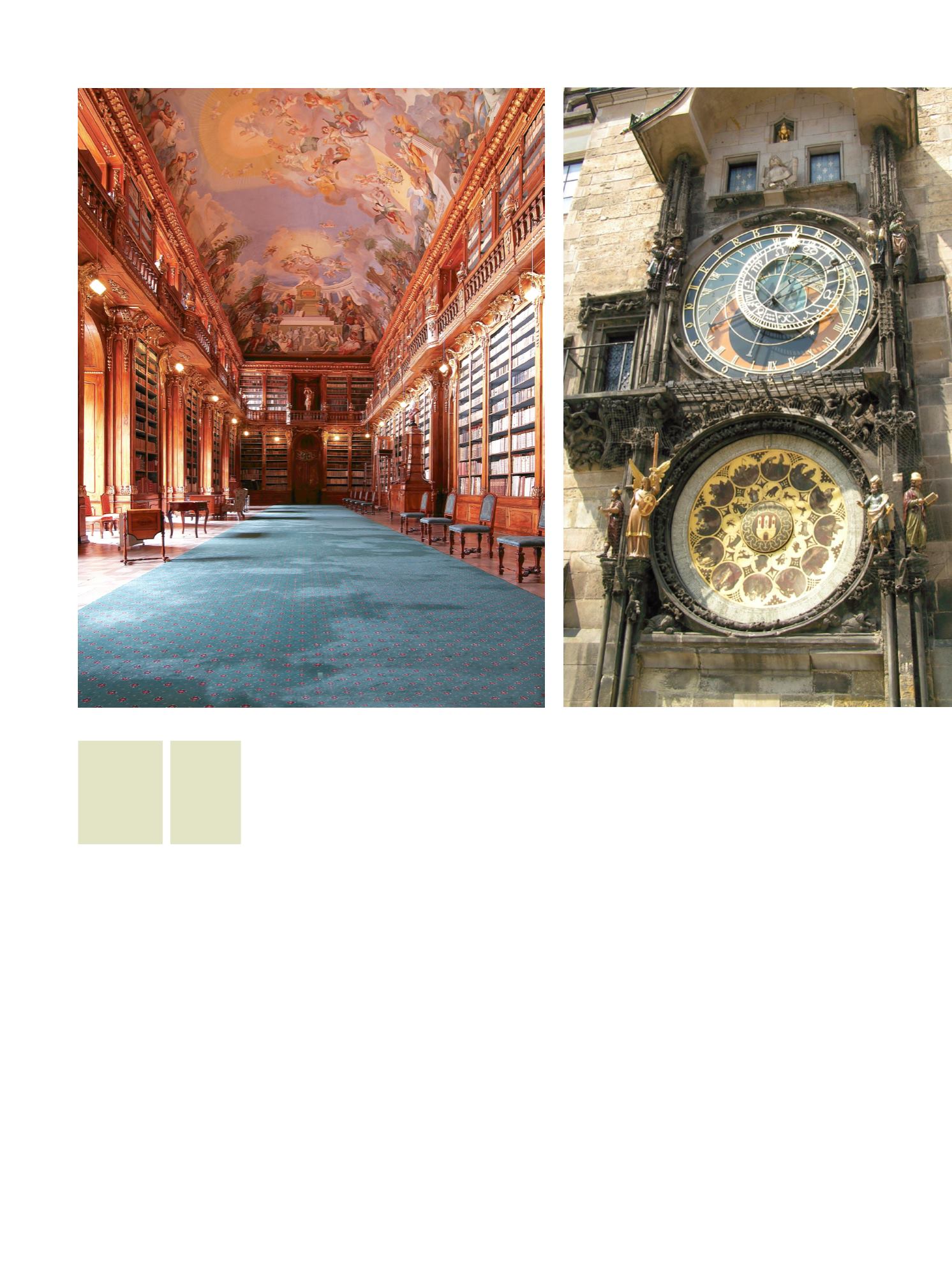
miento domina la plaza con su elegancia y la Torre
con su reloj astronómico medieval más famoso del
mundo, construido en 1490 por el maestro Hanus y
perfeccionado por Jan Taborsky en el siglo XVI. Ese
reloj se compone de 3 partes: el Calendario de Josef
Mánes en la carátula inferior que representa los 12
meses mediante pinturas, los signos del Zodiaco,
en el centro el Escudo de Armas de la ciudad vieja,
adornado por cuatro pequeñas esculturas (un filó-
sofo, un ángel, un astrónomo y un orador); el Reloj
Astronómico es la carátula superior y representa las
órbitas del sol y de la luna y como van evolucionan-
do en el tiempo; las figuras animadas, en las ven-
tanas superiores, son el principal atractivo del reloj
con su desfile de los doce apóstoles cada vez que
el reloj marca las horas y además de los apóstoles
desfilan 4 figuras adicionales (el Turco, la Avaricia,
la Vanidad y la Muerte representada por un esquele-
compás int • int compass
which is considered to be almost medieval, and
were most of the towers of the city are concen-
trated. Hence, it is now as the “City of a Hundred
Towers”. In the downtown are we discovered the
Staré Město Plaza, one of the most beautiful in all
of Europe, built in the 9th century, when the city
began to grow around the castle.
The plaza has a peculiar charm to it, with
its three-story houses built in a Bohemian
style, painted in rich pastel colors, while the
City Hall dominates the plaza. The clock tower
features what is perhaps the most famous me-
dieval astronomical clock in the world, built in
1490 by watchmaker Hanus, and perfected by
Jan Taborsky in the 16th century. This watch
is composed of three parts: The Josef Mánes
calendar, on the upper sphere which represents
the 12 months of the year in paintings, the Zo-
diac signs, at the center of the Coat of Arms of
the old city, adorned with fours small sculp-
tures (a philosopher, an angel, an astronomer,
and an orator); the Astronomical Watch in the
upper sphere represents the orbits of the sun
and the moon and who these have evolved over
time; the animated figures, on the upper circle
of the clock, are the main attraction, given the
movement of the twelve apostles when the clock
rotates. Four additional figures adorned the
1. La biblioteca de
Strahovsk
ý
Klá
š
ter
(Monasterio de
Strahov) conserva
testimonios literarios
checos que van del
siglo IX al siglo XVIII./
The Library (former
Strahov Abbey)
keeps testimonies
of Czech literature
from centuries 9th
through 14th.
2.Orloj (Reloj
Astronómico), fue
colocado en la parte
inferior de la torre
del ayuntamiento a
inicios del siglo XV./
Orloj (Astronomical
Clock) was placed
in the lower part of
the City Hall tower
in the beginnings of
the 15th Century.
1
2


