·amura·
45
compás int • int compass
las paredes engalanadas por cordones dorados. La
subida a su torre es emocionante y permite tener
una vista espectacular de la ciudad.
Descubrimos también la iglesia de Nuestra
Señora de la Victoria que alberga la famosa esta-
tua del Niño Jesús de Praga, pasamos por el Jar-
dín Vrtba y terminamos por el monte Petřín donde
se encuentra la Torre de Petřín, el mirador más
famoso de la ciudad.
Nos dirigimos entonces hacia Hradčany para
descubrir el Castillo de Praga, la parte más antigua
de la ciudad que se construyó en el siglo IX como
residencia de los reyes de Bohemia, volviéndose la
del presidente de la República Checa desde 1918.
Al pasar el portón principal, descubrimos la Catedral
de San Vito de estilo gótico que alberga las joyas
de la corona y la tumba de Wenceslao IV, pasamos
por el Callejón de Oro, una estrecha y hermosa calle
que debe su nombre a los orfebres que la habitaron
en el siglo XVII. Esa calle esta bordeada de un lado
por casitas de colores construidas en los muros del
castillo para abrigar los guardianes y que datan del
siglo XVI. En el número 22 vivió Franz Kafka entre
1916 y 1917, el escritor más famoso de Bohemia.
Seguimos por el antiguo Palacio real, la basílica de
San Jorge y la Torre de la Pólvora. Los jardines del
palacio son hermosos y en ellos se realizan concier-
tos soberbios. Después de esa larga visita, nos ins-
talamos en uno de los restaurantes cercanos para
disfrutar de una comida típica.
Al lado del castillo descubrimos el Loreto, uno
de los centros de peregrinación más importante de
Praga, cuyo origen data de 1626 aunque el edificio
adquirió su aspecto actual en tiempos posteriores. En
el recinto encontramos la réplica de la supuesta casa
donde tuvo lugar la Anunciación de la Virgen María.
Petřín, where the Tower of Petřín is found, themost
famous outlook post in the city.
From there, we headed to Hradčany to dis-
cover the Castle of Prague, the most ancient
part of the city, built in the 9th century as a
residence for the kings of Bohemia, and later
becoming the residence of the President of the
Czech Republic (1918). Passing the main gate,
we discovered the Cathedral of Saint Vito,
in Gothic style, which houses the crown jew-
els and the tomb of Wenceslaus IV. We then
passed the Golden Alley, a narrow and beau-
tiful street which owes its name to the gold-
smiths that inhabited it in the 17th century.
The street is lined on each side by colourful
houses built on the walls of the castles to shel-
ter guards, and date all the way back to the
16th century. The house numbered “22” was
the home of Franz Kafka between 1916 and
1917, the most famous writer of Bohemia. We
continued to walk through the ancient royal
Palace, the basilica of Saint George, and the
Powder Tower. The gardens inside the palace
are wonderful, and concerts are regularly per-
formed in them. After a long visit, we seated
ourselves in one of the nearby restaurants to
try some local cuisine.
At the side of the lake, we discovered Loreto,
one of the most important pilgrimage sites in
Prague, which was built in 1626, although the
building was acquired in its current state on a
later date. In it, we found the supposed replica
house where the Annunciation of the Virgin Mary
was delivered. The original home is found in Lo-
reto, Italy. This Holy Home was built on the 3rd
of June, 1626, and it attracts numerous pilgrims.
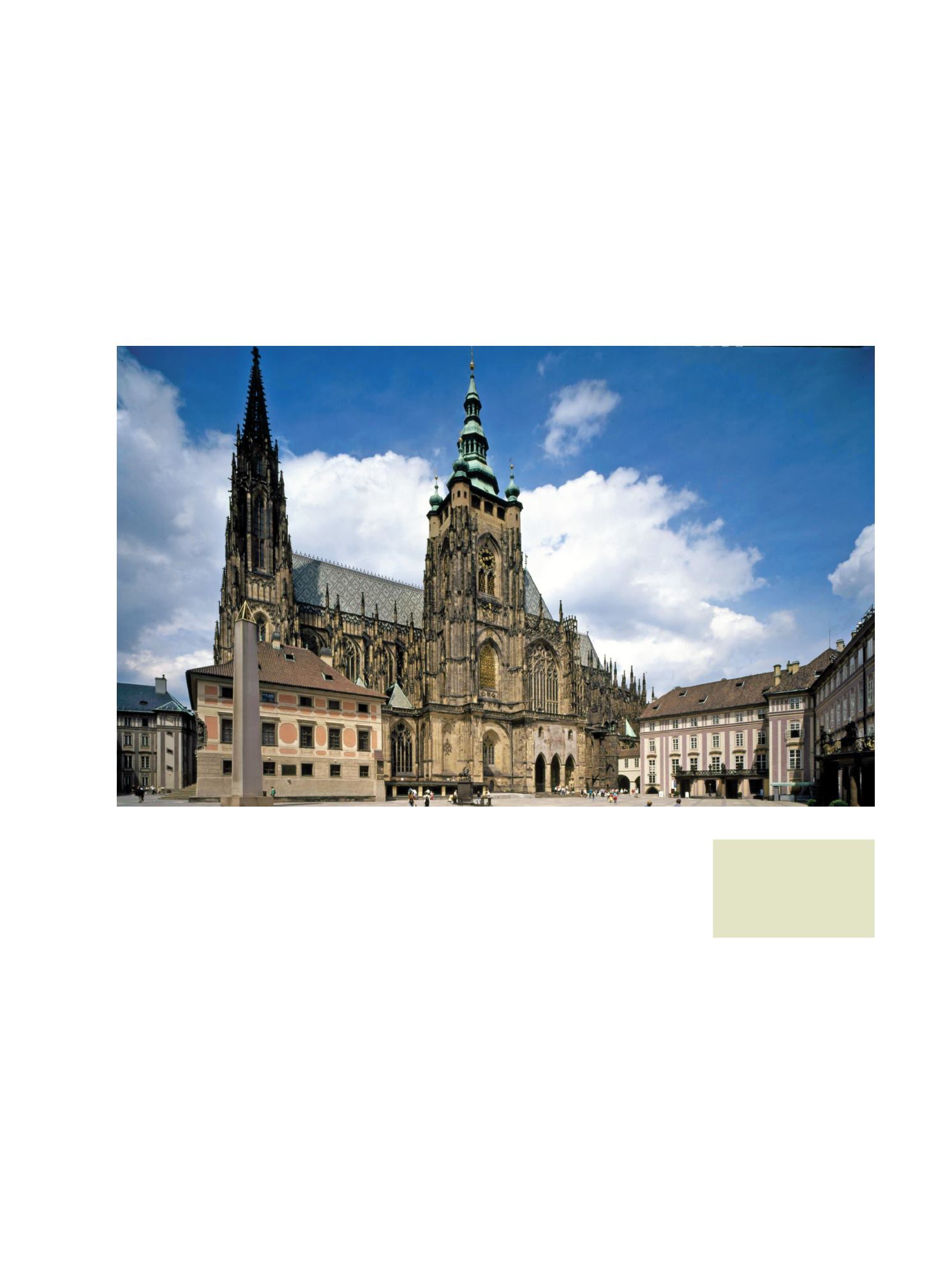
1. Chrám sv. Víta (Ca-
tedral de San Vito),
fue concluida en
1929, actualmente es
el corazón espiritual
de todo el país./
The Chrámsv. Víta
(Sainy Vito’s Cathe-
dral), whas finished
in 1929. Today it is a
spiritual center for
the whole country.


