Europa con los constructivistas
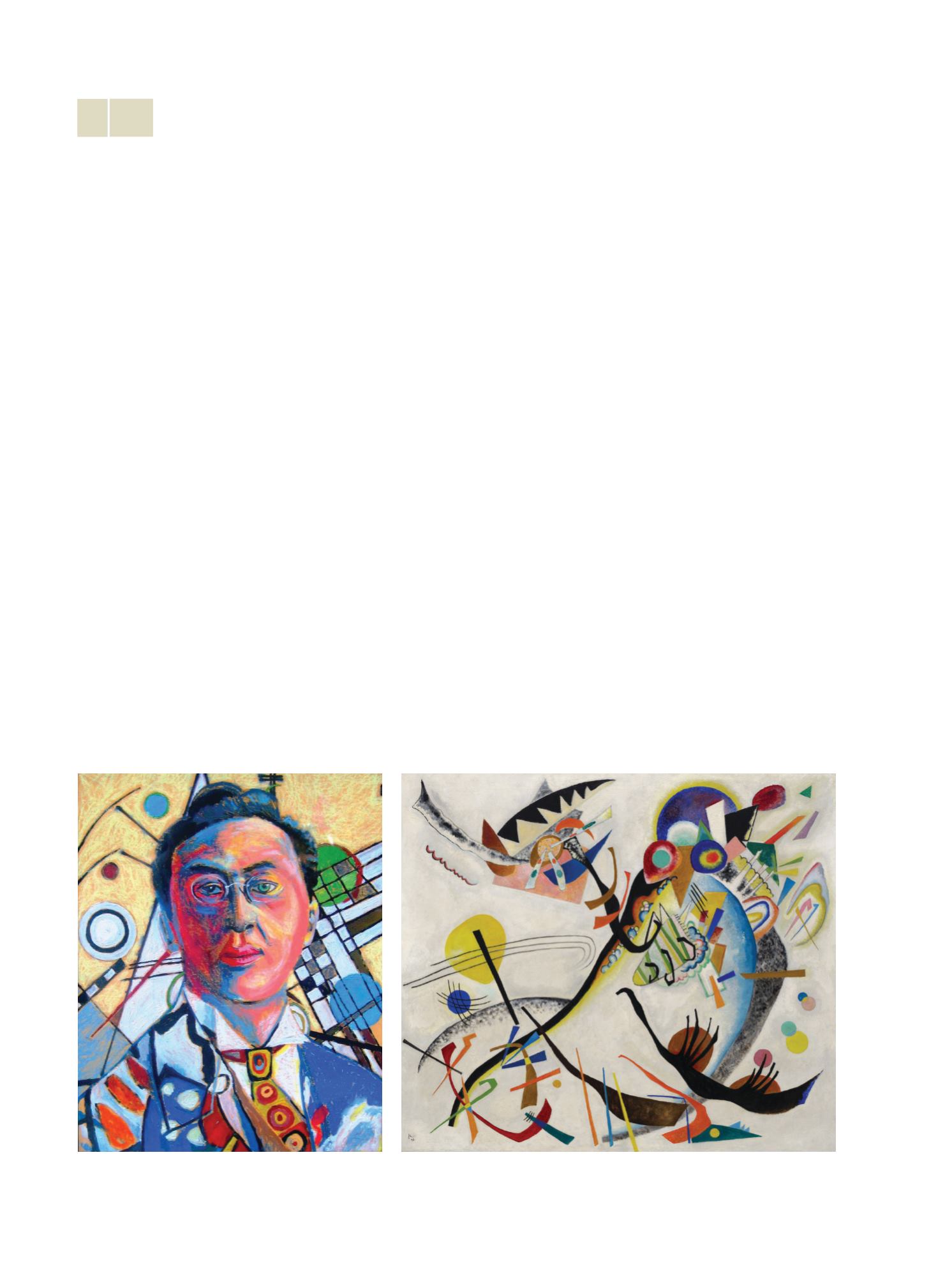
Wassily Kandinsky
(Moscú, Rusia, 1866 - Neuilly-sur-
Seine, 1944). En la construcción subjetiva, su intuición
creadora se desarrolló hasta los treinta años. Había es-
tudiado derecho y se dedicaba a la docencia. Renunció
para irse a formar en la plástica en Munich, adonde fue
impactado por Paul Klee (1879-1940). Su obra se ubica
en las influencias deel fauvismo y el jugendstil alemán,
con el Grupo The Blue Rider (1911-14) de pintores abs-
traccionistas, evolucionó a formas orgánicas, la pintura
se centra en el color y el movimiento geométrico que
indaga en la naturaleza. Trabajó en Rusia con el movi-
miento constructivista.
Antoine Pevsner
(Orel, 1886 - París, 1962) Escul-
tor ruso. Tras seguir estudios en la Academia de Bellas
Artes de San Petersburgo, viajó en 1911 a París, donde
admiró los trabajos de Delaunay, Gleizes, Metzinger y
Léger. En una segunda visita a París, en 1913, conoció
a Modigliani y a Archipenko, que estimularon su inte-
rés por el cubismo. Durante la guerra permaneció en
Oslo; volvió a Rusia en 1917 y enseñó en la Academia
de Bellas Artes de Moscú. En 1920, Pevsner y Gabon su
hermano apoyaron y publicaron el Manifiesto Realista:
“Hay que sacar el arte del callejón sin salida en que se
halla desde hace veinte años”. En 1923 visitó Berlín,
donde conoció a Duchamp y a Catherine Dreier. A partir
de su encuentro con Duchamp, abandonó la pintura y
se volcó en la escultura constructivista.
Vladimir Yevgráfovich Tatlin
(Moscú, 1885 – 1956).
Creador y promotor estético, entra a las masas de trabaja-
dores y campesinos durante la primera etapa de la revolu-
ción. Consideraba necesario dimensionar las tareas estéti-
cas y la producción de bienes culturales. Para Tatlin había
que encontrar los vínculos entre ciencia, producción y cons-
trucción. El arte tenía que deselitizarse para perder su lugar
reservado a las aristocracias y volverse proceso demasas.
Europe with the constructivists
Wassily Kandinsky
(Moscow, Russia, 1866 - Neuilly-
sur-Seine, 1944). In the subjective construction, his
creative intuition was developed up to thirty years.
He had studied law and engaged in teaching. He re-
signed to go to train in plastic arts in Munich, where
he was struck by Paul Klee (1879-1940). His work is
located in the influences deel fauvism and German
jugendstil, with the abstractionist painters Group
The Blue Rider (1911-14), evolved into organic forms,
the painting focuses on the color and the geometric
movement that explores the nature. He worked in
Russia with the constructivist movement
Antoine Pevsner
(Orel, 1886 - Paris, 1962) Rus-
sian sculptor. Following studies at the Academy of
FineArts inSt. Petersburg, he traveled in1911 toParis,
where he admired works of Delaunay, Gleizes, Metz-
inger and Léger. On a second visit to Paris, in 1913, he
met Modigliani and Archipenko, who stimulated his
interest in Cubism. During the war he remained in
Oslo; He returned to Russia in 1917 and taught at the
Academy of Fine Arts inMoscow. In 1920, Pevsner and
Gabon his brother supported and published the Real-
istic Manifest: “We must take the art of the dead end
that is twenty years”. In 1923, he visited Berlin, where
he met Duchamp and Catherine Dreier. From his en-
counter with Duchamp, he abandoned painting and
turned in the constructivist sculpture.
Vladimir Yevgráfovich Tatlin
(Moscow, 1885-
1956).Creatorandestheticpromoter,entersthemasses
of workers and peasants during the first stage of the
revolution.Heconsiderednecessarytomeasureesthet-
ic tasks and the production of cultural goods. To Tatlin
had to find the links between science, production and
construction. The Art had to diselitist to lose its place
reserved toautocracies andbecomemassprocess.
16. Wassily
Kandinsky es
conocido como uno
de los primeros
artistas abstractos. /
Wassily Kandinsky,
is recognized as one
of the first abstract
artist.
17. Blue Segment
Wassily Kandinsky
1921 Óleo sobre
lienzo 120.6 x 140.1
cm /
Oil on canvas.
47 1/2 x 55 1/8 in.
16 17
·amura·
98
los conquistadores •
the conquerors


