·amura·
166
planeta azul •
blue planet
Scientific research on the White Sea beluga
whale began almost one hundred years ago and was
largely focused on determining their abundance
(tracking the white whale populations from the
coast, ships and the air).
The main objective of the above research was to
estimate the abundance of white whales for their
subsequent industrial use.
Mostly large migrating herds of white whales
could be tracked using traditional methods of
tracking the animal from sea vessels and aircraft.
Such methods did not allow researchers to gain a
detailed understanding of the life of white whales
and adequately estimate their numbers.
Various methodologies for estimating the con-
dition of White Sea beluga whale populations had
been developed and applied, however, due to the
incompatibility of methods, different timing of re-
search and inconsistent approaches it proved prac-
tically impossible to either make an objective es-
timate of the total number of beluga whales in the
White Sea, or monitor changes in their numbers, or
come up with general conclusions.
Observations of white whale migrations in the
1930s from fixed coastal stations on the White
Sea coast and along the straits linking the Bar-
ents and the Kara Seas put the number of white
whales at 6,000 to 8,000 during the summer sea-
son. Later a number of researchers (G. Matishov, G.
Ognetov in 2006; Kleinenberg et al. in 1960, 1964,
1964) counted animals from coastal observation
points and analysed their findings. The analyses
showed that the total number of white whales
ranged between several hundreds and several
thousands depending on the year, season and the
observation point.
4
La investigación científica dentro de este mar
comenzó hace siglos y fue enfocada de manera
determinante en su abundancia (el rastreo de la
población de ballenas blancas es monitoreado por
tierra, mar y aire)
El objetivo principal de la exploración estima la
abundancia de ballenas blancas dado el uso indus-
trial subsecuente.
En su mayoría, grandes grupos de manadas pudo
ser rastreado implementando métodos de rastreo
desde barcos y aviones. Tales métodos permiten a los
investigadores recopilar el entendimiento necesario
de la vida cotidiana de las belugas y estimar sus nú-
meros de manera adecuada.
Varias metodologías han sido usadas para evaluar
la condición en la que la población de ballenas blancas
se ha desarrollado y aplicado, sin embargo, debido a la
incompatibilidad de los métodos, diferentes tiempos
de investigación y acercamientos inconsistentes han
hecho prácticamente imposible hacer un estimado to-
tal del número de belugas dentro del Mar Blanco o mo-
nitorear el cambio en su población, del mismo modo,
no se ha podido llegar a ninguna conclusión general.
Las observaciones de la migración de belugas se ini-
ciaron en 1930 y eran llevadas a cabo desde estaciones
fijadas en la costa del Mar Blanco y a través de los estre-
chos que conectan el Mar de Barent y los Mares de Kara,
mismos que han puesto el número de 6,000 a 8,000 ba-
llenas blancas divisadas durante el verano. Más tarde, un
número de investigadores (G. Matishov, G. Ognetov en
2006; Kleinenberg et al. en 1960, 1964, 1964) contaron
animales desde los puntos de observación costales y
analizaron sus encuentros. Los resultados demostraron
que el número total de estos mamíferos abarcaba un
rango significativo entre los cientos y miles, dependien-
do el año, estación y punto de observación.
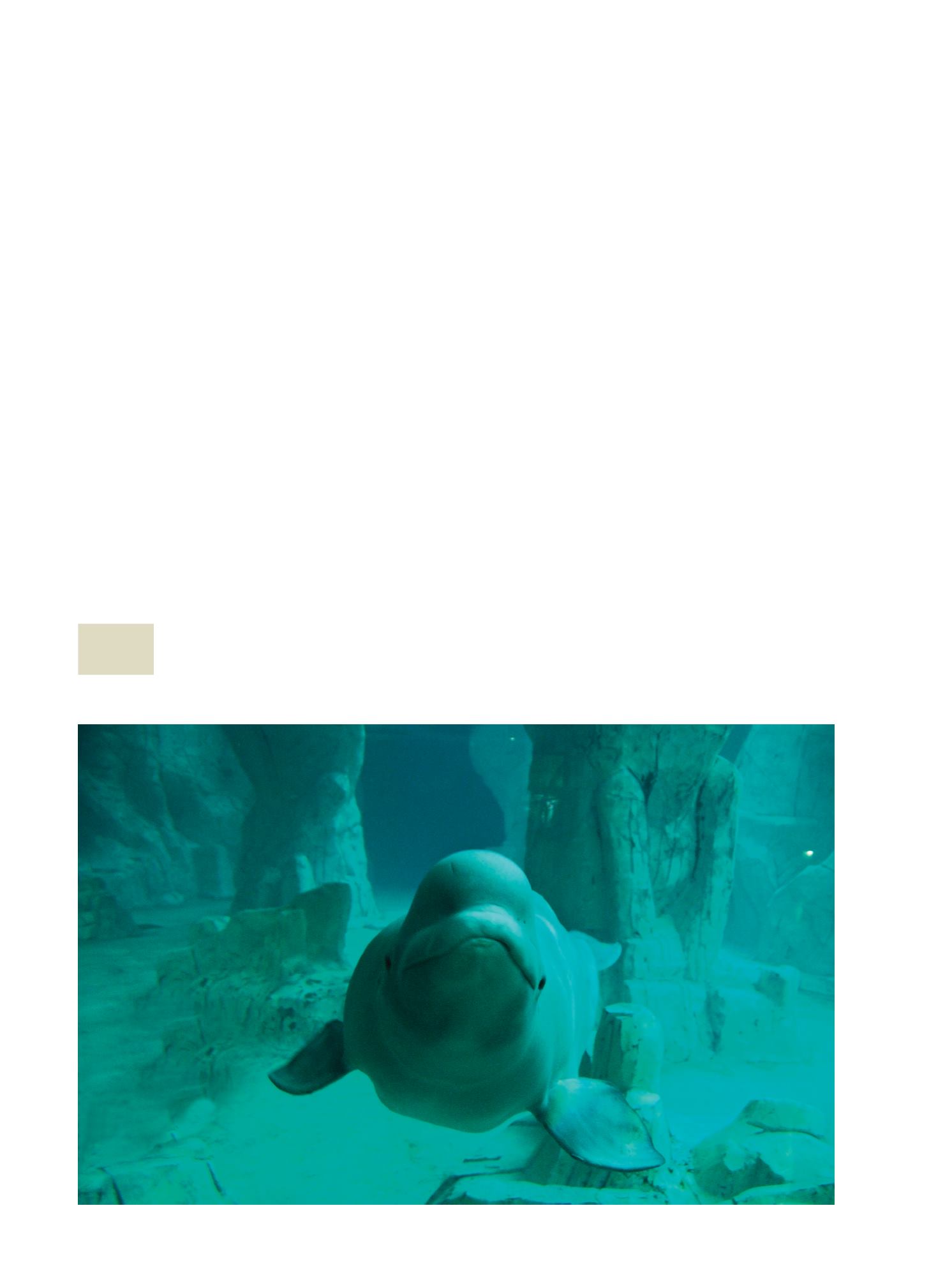
4. Estas ballenas
deben salir a respirar
aproximadamente
20 minutos. /
This
whales must come
up for air about 20
minutes.


