planeta azul •
blue planet
·amura·
164
Knowing the facts
A lack of data becomes a serious obstacle for Russia
when it needs to provide scientific arguments to
uphold its position on the issue of efficient nature
management, first of all, in its relationships with
various organizations, as well as relationships
under international agreements (International
Whaling Commission (IWC), International Council
for the Exploration of the Sea/Northwest Atlantic
Fisheries Organisation (ICES/NAFO), Mixed Rus-
sian-Norwegian Fishery Commission, agreements
with the U.S., etc.).
In 2005 and 2006, the United States, for example,
made an estimate of the total population of marine
mammals in itswaters. Norway and Japanalso take an
active part in studying and monitoring marine mam-
mals andnot only in their respectivewater areas.
In the last 10 years the above countries
have repeatedly approached Russia with re-
quests to allow their vessels to conduct such
research in the Russian Exclusive Economic
Zone. In many cases appropriate authorizations
were issued and research conducted, that has
led to a bizarre situation when foreign experts
appear to be better informed about the cur-
rent distribution range and the number of ma-
rine mammals living in our waters than their
Russian colleagues.
Conociendo los hechos
La falta de información se ha vuelto un obstáculo se-
rio para Rusia cuando de proveer argumentos cien-
tíficos se trata, así como para mantener su posición
en el tema de gerencia eficaz natural. También ha
habido problemas con las relaciones de organizacio-
nes y varios tratados internacionales como lo son la
International Whaling Commission (IWC), Internatio-
nal Council for the Exploration of the Sea/Northwest
Atlantic Fisheries Organisation (ICES/NAFO), Mixed
Russian-Norwegian Fishery Commission, acuerdos
con los Estados Unidos, etcétera.
En 2005 y 2006, los Estados Unidos, por ejemplo,
hizo un estimado del total de población de mamíferos
marinos en sus aguas. Noruega y Japón también to-
maron una postura activa en el estudio y monitoreo
de mamíferos marinos más allá de sus mares.
En los últimos 10 años los paísesmencionados se han
acercado repetidamente a Rusia con solicitudes de permi-
so para permitir a sus navíos la conducción de varias in-
vestigacionesensusmaresy laZonaEconómicaExclusiva
Rusa. Enmuchos casos las autorizaciones apropiadas fue-
ronemitidasy las investigaciones llevadasa cabo,mismas
que han derivado en situaciones incómodas, ya que al pa-
recer los expertos foráneos parecían estarmejor informa-
dos en la distribuciónde rango actual de los animales y los
números demamíferosmarinos que viven en aguas rusas
que sus colegas patrios.
2
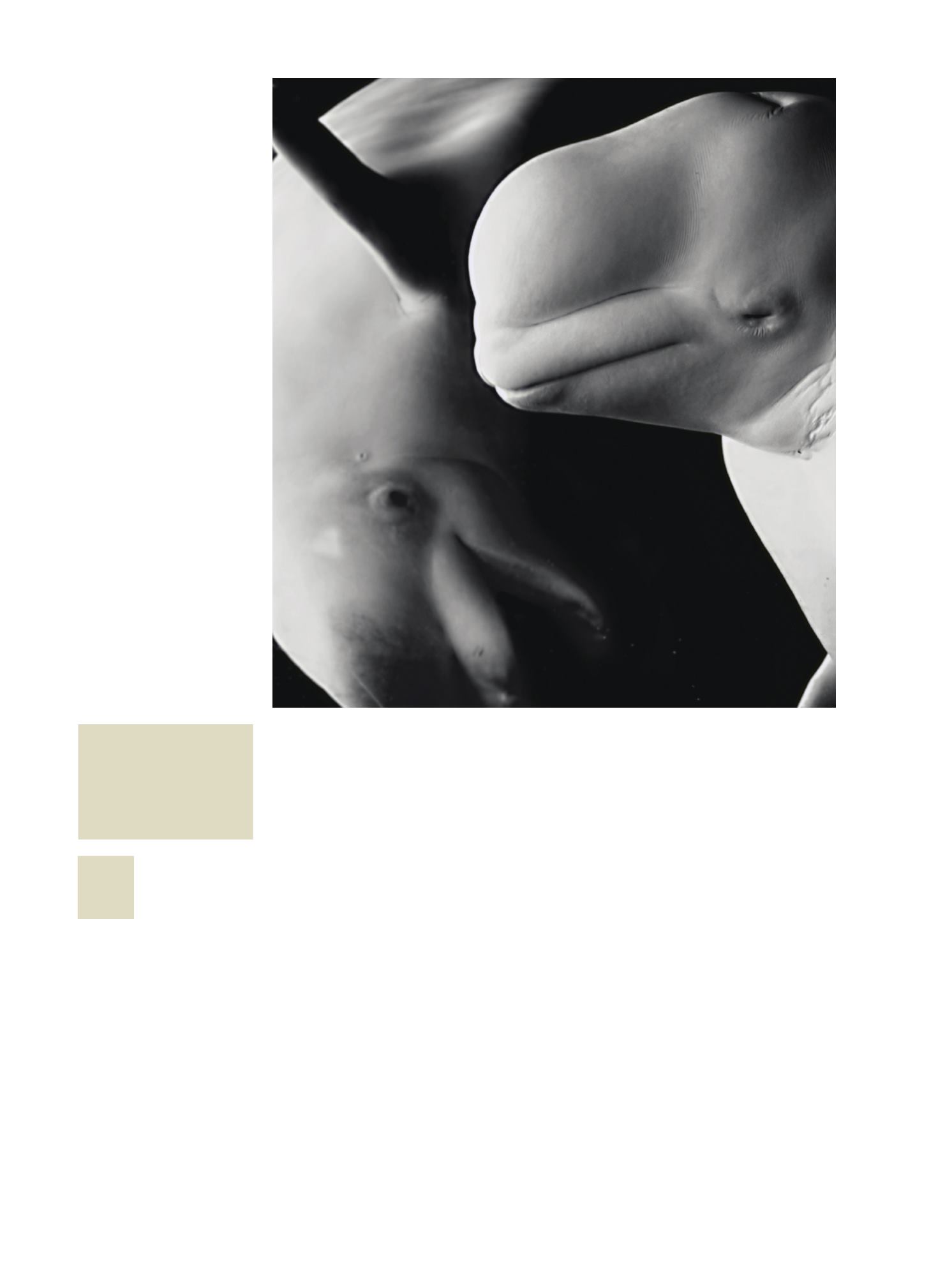
1.Las Belugas suelen
medir entre 4 y 6
metros, máximo. /
The Belugas usually
measure between
4 and 6 meters,
máximum.
2. Las Ballenas
Blancas viven en
grupos pequeños. /
The White wale lived
in small groups.
1
Foto /
Photo
: SHEDD / STOV / RAFAEL MATEO / R. STOV


