·amura·
161
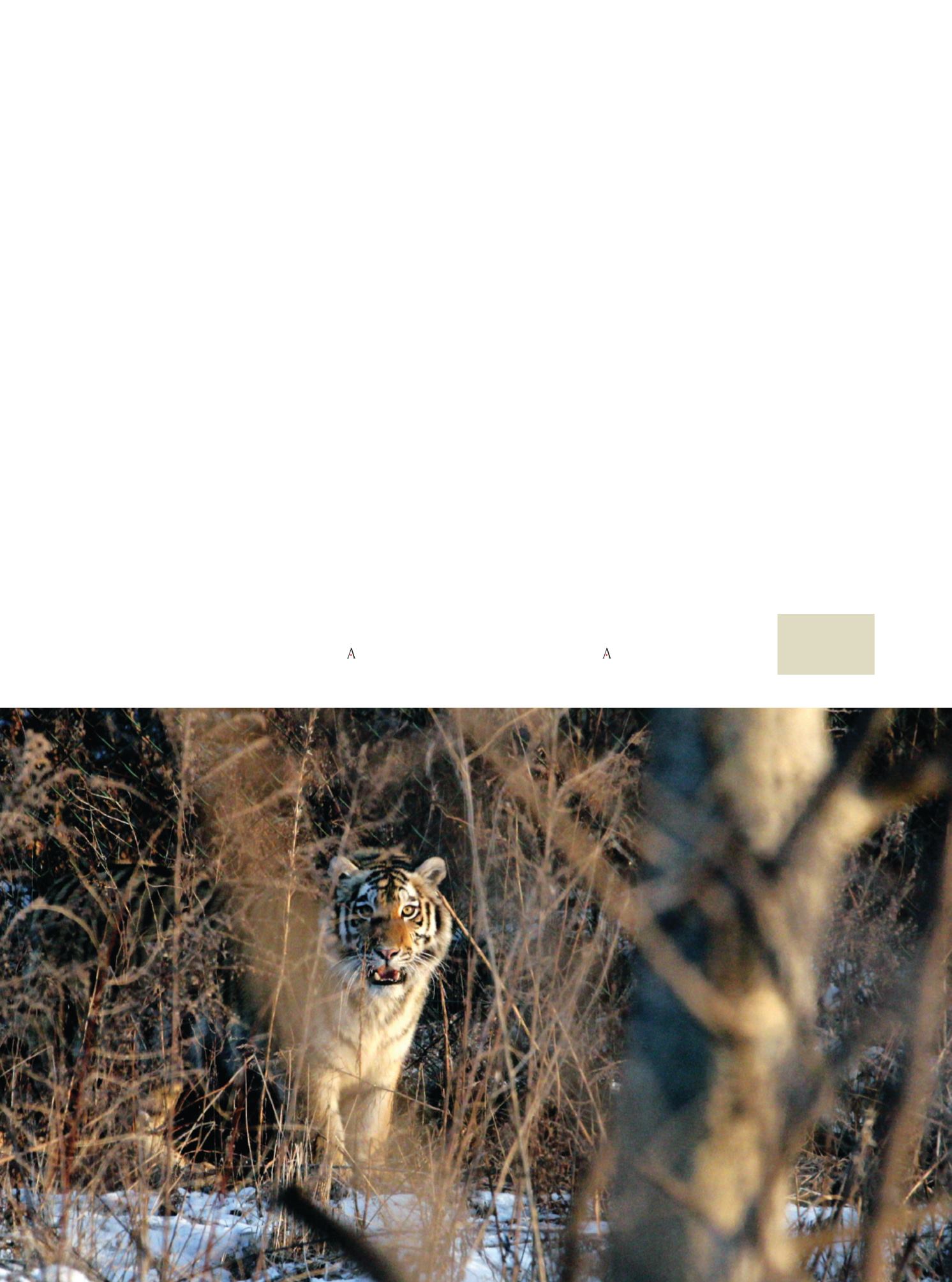
4. La caza furtiva
y la disminución
de sus presas son
motivos que causan
preocupación para la
supervivencia de la
especie. /
Big-Game
huntingandthe
dwindlingnumber
ofpreyaresufficient
causestocause
graveconcernfor
thesurvivalofthe
species.
Un nuevo acercamiento
Grupos internacionales financian el programa Inspec-
ción Tigre para detener la caza furtiva. Muchos de los
más grandes zapovedniks han recibido divisas para
mantener sus propios equipos contra la caza furtiva.
Si podemos hacer más difícil el acceso de los caza-
dores, podemos aumentar tanto la supervivencia de
tigres como la de sus cachorros. Las carreteras inne-
cesarias, como las creadas por la tala indiscriminada,
podrían ser destruidas o utilizarse para supervisión.
Cuando se termina una operación de tala de ár-
boles, los caminos se mantienen y proporcionan fácil
acceso a los cazadores. En Rusia, los cazadores legales
tienen normalmente sus cabañas, y van y vienen con
o sin carreteras. Este enfoque no funciona en todos
los casos, ya que algunos caminos son demasiado
importantes para los locales. Pero si podemos cerrar
aquellas brechas que ya no son útiles, podemos au-
mentar la supervivencia de las especies de presa de la
que ambos, cazadores y tigres, dependen.
En algunas carreteras pueden establecerse retenes.
Esta opción da a los ciudadanos oportunidades para la
pesca, recolección de leña y de bayas. Los guardias pue-
den asegurar que las armas no sean llevadas ilegalmente.
Las nuevas carreteras se deben planificar para
evitar zonas sensibles. A menudo, las carreteras se
construyen sin revisión de impacto ambiental. Si no
se planifica la construcción de carreteras, pronto no
habrá lugar salvaje alguno que quede en el extremo
oriente de Rusia.
Los únicos planes de conservación del tigre fac-
tibles serán aquellos que mejoren las condiciones de
estos animales y las personas. Para que el tigre Amur
se preserve, la gente debe quererlos.
4
conservancy •
conservación
A new approach
International groups finance the Tiger Inspection
program to halt poaching. Many of the largest Za-
povedniks have received their own foreign exchange
tomaintain their own teams against poaching.
If we can narrow access to hunters, we can in-
crease not only the survival rates of tigers, but of
their offspring, as well. Unnecessary highways, cre-
ated by indiscriminate logging, could be disman-
tled, or used to supervise their habitats.
When a logging operation is concluded, the
roads are maintained and provide easy access to
hunters. In Russia, certified hunters normally
have their own cabins, and come and go regard-
less of the existence of highways. This approach
does not work in all cases, given that some roads
are deemed too important by locals. But if we can
close those breaches that are no longer useful, we
can increase the survival rate of the species which
both hunters and tigers depend on.
Checkpoints could be set up in some roads. This
options gives citizens the opportunity to fish, col-
lect wood, and berries. The guards can make sure
that firearms are not being illegally transported.
The new roads need rigorous planning to
avoid sensible areas. Often, the roads are paved
without taking into consideration their environ-
mental impact. If planning is not undertaken,
soon there will be not wild area whatsoever left in
the far east of Russia.
The only feasible plans for the conservation of
the tiger will be those that improve the living con-
ditions of the animals and the people. For the Amur
tiger to thrive, people must cherish them.


