·amura·
158
conservancy •
conservación
1. La población del
tigre ha aumentado
desde la década de
1930 a la actualidad
/
The native tiger
population has
increased from
the 1930s to the
present time.
E
ra 15 de diciembre de 1998, caminábamos en-
tre el bosque iluminado por la luna, con la nieve
crujiendo bajo nuestros pies, entonces se oyó
un gruñido, como un trueno lejano, pero un ‘pop’ sua-
ve de dardo tranquilizante voló y dio en el blanco. Diez
minutos más tarde, la tigresa (a la que llamamos Na-
dia y equipamos con un collar) dormía plácidamente.
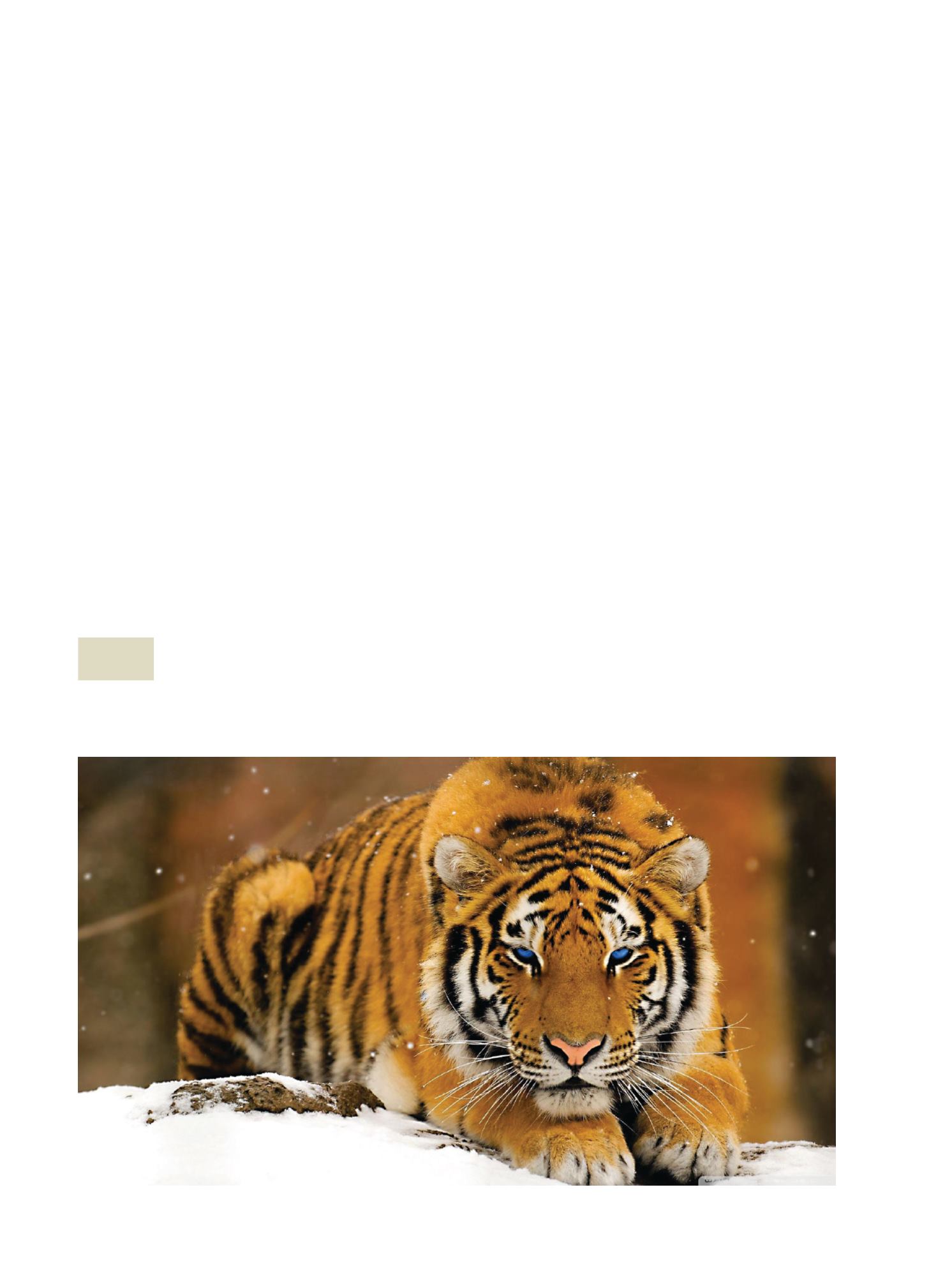
Nadia era una tigresa de la especie Amur, también
conocida como tigre siberiano (Panthera tigris altai-
ca, es su nominación científica). Es una subespecie de
tigre cuyo hábitat ecológico es el extremo sureste de
Rusia, en la región del río Amur y la frontera con China.
Tradicionalmente se le ha considerado la mayor
subespecie de tigre y el mayor de los félidos, una fa-
milia de mamíferos de orden carnívora que poseen un
cuerpo esbelto, oído agudo y excelente vista. Son los
mamíferos cazadores más sigilosos.
Nadia murió cerca de la carretera que da acceso
a los cazadores, y con ella perdimos a un importante
animal de estudio. Está claro que en estos caminos los
tigres son capturados o atropellados. Sin esas carre-
teras, los tigres vivirían hasta una edad avanzada y
morirían de causas naturales.
Nadia era una de los más de 30 tigres que tenemos
como parte de un proyecto entre el Instituto Hornoc-
ker de Vida Silvestre de la Sociedad de Conservación
y el Estado de la Biósfera de Zapovednik Sijoté-Alín.
Esta reserva de la biósfera se localiza en el krai de
Primorie, Rusia. Se creó el 10 de febrero de 1935, se
encuentra en una divisoria de aguas y laderas orienta-
les de Sijoté-Alín central, en los distritos de Terneiski
y Krasnoarmei. Mide 401,428 hectáreas, de las cuales
2,900 son de agua, y el punto más alto es el monte
Glujomanka, con mil 598 metros de altura.
I
t was the 15th of December, 1998, and we were
walking through the moonlit forest, the snow
cracking under our feet, then, a growl was
heard, like a faraway thunder. But, the soft ‘pop’ of
a tranquilizer dart was heard and hit its target. Ten
minutes later, the tigress Amur (whichwe calledNa-
dia) was sleeping placidly.
NadiawasatigressoftheAmurspecies,alsoknown
as the Siberian tiger (Panthera tigris altaica, as it scien-
tifically known). It is a subspecies of tiger whose eco-
logical habitat is located in the extreme southeastern
corner of Russia, in the region around the Amur River
and the frontierwithChina.
Traditionally,itwasconsideredthemajortigersub-
species,andthelargestofthefelines,afamilyofcarniv-
orousmammals that possess a svelte body, a sharp ear,
andexcellent sight. Theyare the stealthiest hunters.
Nadia died today, andwithher, we lost an impor-
tant animal to study. The tigress succumbed near
the highway that provides access to hunters. It is
clear that, in these roads, tigers are captured, or run
over. Without these highways, the tigers can live to
see their twilight years, and die of natural causes.
Nadia was one of more than 30 tigers that form
part of our Russian-American project between the Hor-
nockerWildlife Institute and Conservancy Society, and
the Zapovednik Sikhote-Alin Reserve.This biosphere
reserve is located in the Primorsky Krai, Russia. It was
founded on the 10th of February, 1935, to protect the
populace fromthesable. It is locatedat awatershedand
slopeseast of Sikhote-Alin, inthedistrictsof Terneysky
and Krasnoarmeysk. It measures 401,428 hectares, of
which 2,900 are water, and the highest point is Glujo-
manka, reaching1,598meters inheight.
Foto /
Photo
: natgeo / gio v / phoenix
1


