·amura·
41
Al Tíbet se le llama El Tercer Polo, porque guar-
da casi un tercio del agua dulce del planeta a través
de sus enormes glaciares. Su deshielo origina cuatro
grandes ríos: Yagntzé, Mekong, Indo y Brahmapu-
tra (6,300, 4,880, 3,180 y 2,900 Km). También forma
enormes lagos en la alta meseta, 24 de ellos con una
superficie mayor a los 200 Km2; el mayor es el Lago
Nam, con 1,961.5 Km2.
CULTURA
La cultura del Tíbet es su tradición religiosa. Ahí se
resguardó la civilización clásica budista que desapa-
reció de su tierra natal, la India, por su islamización.
Entonces el budismo se refugió en el Tíbet, donde aún
se conserva.
La tradición tibetana une la autoridad espiritual y
la política en manos de una sola persona, por el vín-
culo que establece entre la espiritualidad y la vida co-
munitaria. El encargo recae en los Dalai Lama (dalai,
“océano” y lama, “gurú”: gurú grande como el océano).
La tradición escrita del Tíbet es abundante. La
imprenta Derge conserva 270,000 planchas xilogra-
fiadas, algunas muy antiguas, que preservan las en-
señanzas de los maestros budistas más venerados.
Trabaja desde 1729.
Los tibetanos históricamente han considerado su
espiritualidad como su más grande tesoro y han temi-
do, a la luz de lo sucedido a la India, que su apertura
implique la pérdida de su cultura. Hoy, como resultado
de su circunstancia política y social, la cultura tibetana
pasa por un acelerado proceso de cambio.
Tibet is called the Third Pole because it keeps
about a third of the world’s fresh water through
its massive glaciers. Melting snow and ice lead to
four major rivers, the Yangtze, Mekong, Indus and
the Brahmaputra (6.300, 4.880, 3.180 and 2.900 Km
respectively). It also forms huge lakes in the high
plateau including 24 with an area greater than 200
km2; the largest is Lake Nam, with 1961.5 km2.
CULTURE
The Tibetan culture is its religious tradition. It
was here where the Buddhist classical civilization
was guarded when it disappeared from its native
India, due to the Islamization of the country. Bud-
dhism then fled into Tibet, where it still remains.
The Tibetan tradition places the spiritual and
political authority in the hands of a single person,
by establishing the link between spirituality and
community life. The task falls to the Dalai Lama (Da-
lai, “ocean” and Lama, “guru”: Guru big as the ocean).
The written tradition of Tibet is abundant. The
Derge Printer retains 270.000 xylographic printing
plates, some very old, preserving the teachings of
the most revered Buddhist teachers. It functions
since 1729.
Tibetans have historically considered spiritual-
ity their greatest treasure. They have feared, in light of
what happened to India, that openness may imply the
loss of their culture. Today, as a result of political and
social circumstances, Tibetan culture is going through
a rapidprocess of change.
compás int • int compass
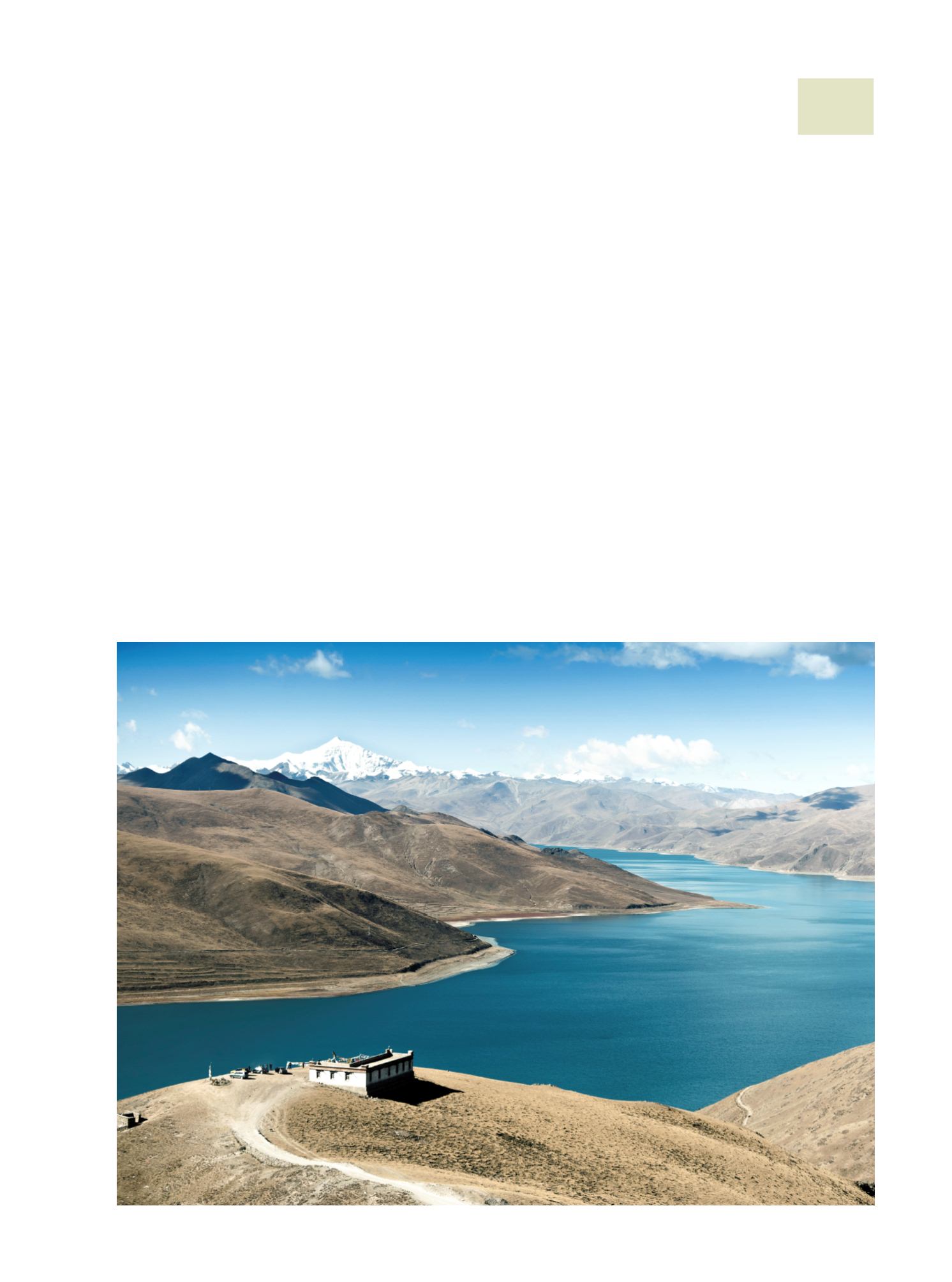
3. Lago sagrado
budista Yamdrok Tso.
/ Yamdrok Tso, Holly
Buddhist river.
3


