·amura·
48
compás int • int compass
HISTORIA
La historia escrita del Tíbet comienza en el S. VII
con el gran rey y unificador Tsong Tsen Gampo, perso-
naje importante en los anales del Techo del Mundo por
haber extendido el dominio tibetano hasta las mismas
puertas de la capital del imperio Tang chino. También es
responsable de haber encomendado la adopción de un
alfabeto sánscrito para el tibetano, así como de haber
traído el Budismo del subcontinente Indio poco tiempo
antes de que éste desapareciera del Industán.
En el siglo XIII, tras cientos de años de expan-
sión cultural budista, los mongoles asumieron la
protección del Tíbet, instituyendo en 1578 a Sonam
Gyatso como el primer Dalái-Lama, figura oficial-
mente investida con el poder político y religioso del
Tíbet. El título tiene su origen en la palabra mongola
“dalái”, océano, y de la tibetana “lama”, que signifi-
ca gurú o maestro espiritual.
Con el paso de los siglos, gracias al aislamiento geo-
gráfico, al patrocinio real, al impulso civilizador del budis-
mo, así como a la gran disposición del pueblo tibetano, el
budismo alcanzó el nivel de desarrollo más importante
de su historia. El Tíbet intentó acercarse así al ideal de
una sociedad dirigida por reyes filósofos y dedicada en
su totalidad al pleno desarrollo personal. Se ha dicho in-
cluso que en los tiempos de su aislamiento, el producto
nacional bruto del Tíbet era la iluminación interior.
Durante el prolífero período del siglo VII al XIX se
construyeron enormes monasterios, verdaderas ciuda-
des universitarias, las cuales funcionaron como centros
comerciales, políticos y culturales, alrededor de los que
giraba la vida del pueblo tibetano.
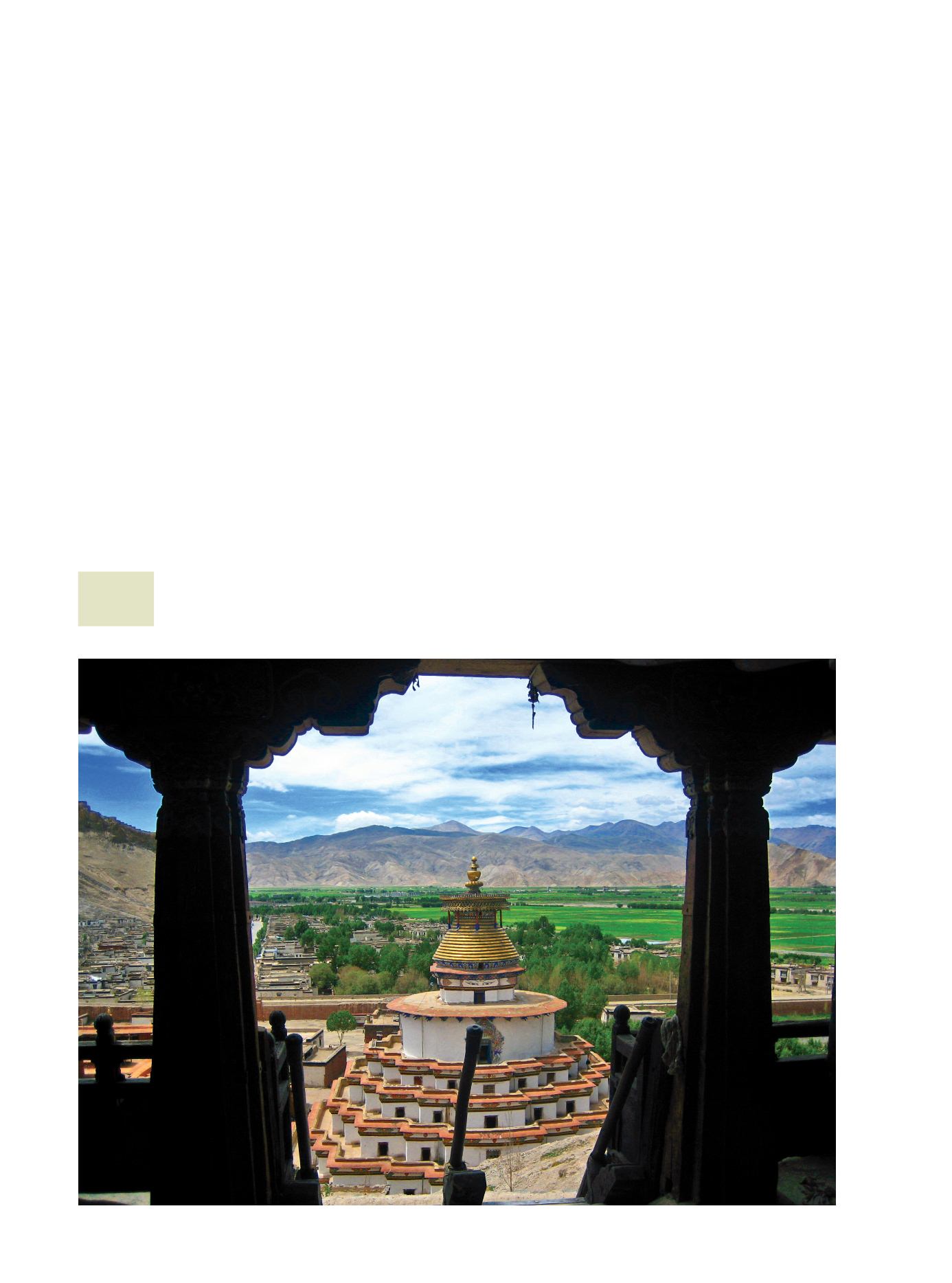
10
10. Valle de Gyantse.
/
Gyantse Valley.
HISTORY
Thewrittenhistory of Tibet begins in the VII Cen-
tury with the great and unifying King Tsong Tsen
Gampo, an important figure in the history of the
“Roof of the World” for having extended the Tibetan
domain to the gates of the Chinese Tang imperial
capital. He was also responsible for having entrusted
the adoption of an alphabet for the Tibetan Sanskrit
and for bringing Buddhism from the Indian subcon-
tinent shortly before it disappeared fromHindustan.
In the thirteenth century, after hundreds of
years of Buddhist cultural expansion, the Mongols
took the protection of Tibet and instituted in 1578
Sonam Gyatso as the first Dalai Lama, which is the
person officially investedwith the political and reli-
gious power in Tibet. The title comes from the Mon-
golian word “Dalai,” ocean, and the Tibetan “lama”
meaning guru or spiritual teacher.
Over the centuries, due to geographical isolation,
to the royal patronage to the civilizing impulse of
Buddhismand to the great willingness of the Tibetan
people, Buddhism reached the highest development
in its history. Tibet tried to approach the ideal state
of a society ruled by philosopher kings and devoted
entirely to personal development. Some have even
said that in the time of their isolation, the gross na-
tional product of Tibet was their interior lighting.
During the prolific period of the VII to the XIX
century, huge monasteries and impressive univer-
sity towns were built, which functioned as com-
mercial, political and cultural centers, all revolving
around the lives of the Tibetan people.


