·amura·
49
compás int • int compass
En 1645, el V Dalái-Lama, Ngawang Lobsang Gyatso,
emprendió la construcción de uno de los edificios más
famosos del Asia: el palacio del Potala, monasterio, sede
gubernamental y residencia de los Dalái-Lamas, con sus
más de 15 capillas y 3000 habitaciones. El Gran Quin-
to, como le llaman los tibetanos por grande y por ser el
quintoDalái-Lama, instituyó un sistema de gobierno que
perduró hasta la primera mitad del siglo pasado.
El último de los Dalái-Lamas, Tenzin Gyatso, deci-
mocuarta encarnación del Principio de la Compasión
Universal, salió del Tíbet por motivos políticos y vive
en Dharamsala, India.
LA GENTE
Cerca de seis millones de tibetanos habitan el Tí-
bet. La mayoría se dedican a las labores agrícolas con-
centradas en torno a los fértiles valles irrigados por
las aguas y los ríos del deshielo. Otros grupos habitan
ciudades como Lhasa, Shigatse o Gyantse, en donde
desarrollan actividades comerciales, artesanales o in-
dustriales. Finalmente, un importante segmento de la
población tibetana está constituida por nómadas de-
dicados principalmente al pastoreo del yak y la cabra,
animales esenciales para la economía del Tíbet.
La etnia tibetana, emparentada con la mongola y
la birmana, ha desarrollado a través del tiempo un ca-
rácter y semblanza propios. Sus prominentes pómu-
los, cabello obscuro y gran fortaleza física, así como
una misma herencia cultural, religiosa y lingüística,
han propiciado a este pueblo un alto y original nivel
de civilización.
1
1. Zacopane y Campo
In 1645, the Fifth Dalai Lama, Ngawang Lobsang
Gyatso, undertook the construction of one of the
most famous buildings in Asia, the Potala Palace.
It is a monastery, the seat of government and the
residence of the Dalai Lamas. It houses more than
15 chapels and 3000 rooms. The Great Fifth, as the
Tibetans call him, implemented a systemof govern-
ment which lasted until the first half of last century.
The last of the Dalai Lamas, Tenzin Gyatso, left
Tibet for political reasons and lives in Dharamsala,
India. He is the fourteenth incarnation of the Prin-
ciple of Universal Compassion.
THE PEOPLE
Nearly six million Tibetans live in Tibet. Most
are engaged in agricultural work concentrated
around the fertile valleys irrigated by waters
and rivers formed by melted snow and ice. Other
groups live in cities like Lhasa, Shigatse and Gyan-
tse, where they develop business, crafts or indus-
trial activities. Finally, an important segment of
the population consists of nomadic Tibetan dedi-
cated mainly to grazing yaks and goats, essential
to the economy of Tibet.
The Tibetan ethnic, Mongolian and relative of
the Burmese, has developed over time its own char-
acter and appearance. Their features are prominent
cheekbones; dark hair and great physical strength
in addition to a heritage of common cultural reli-
gious and linguistic diversity, have led this people
to a unique high level of civilization.
11
12
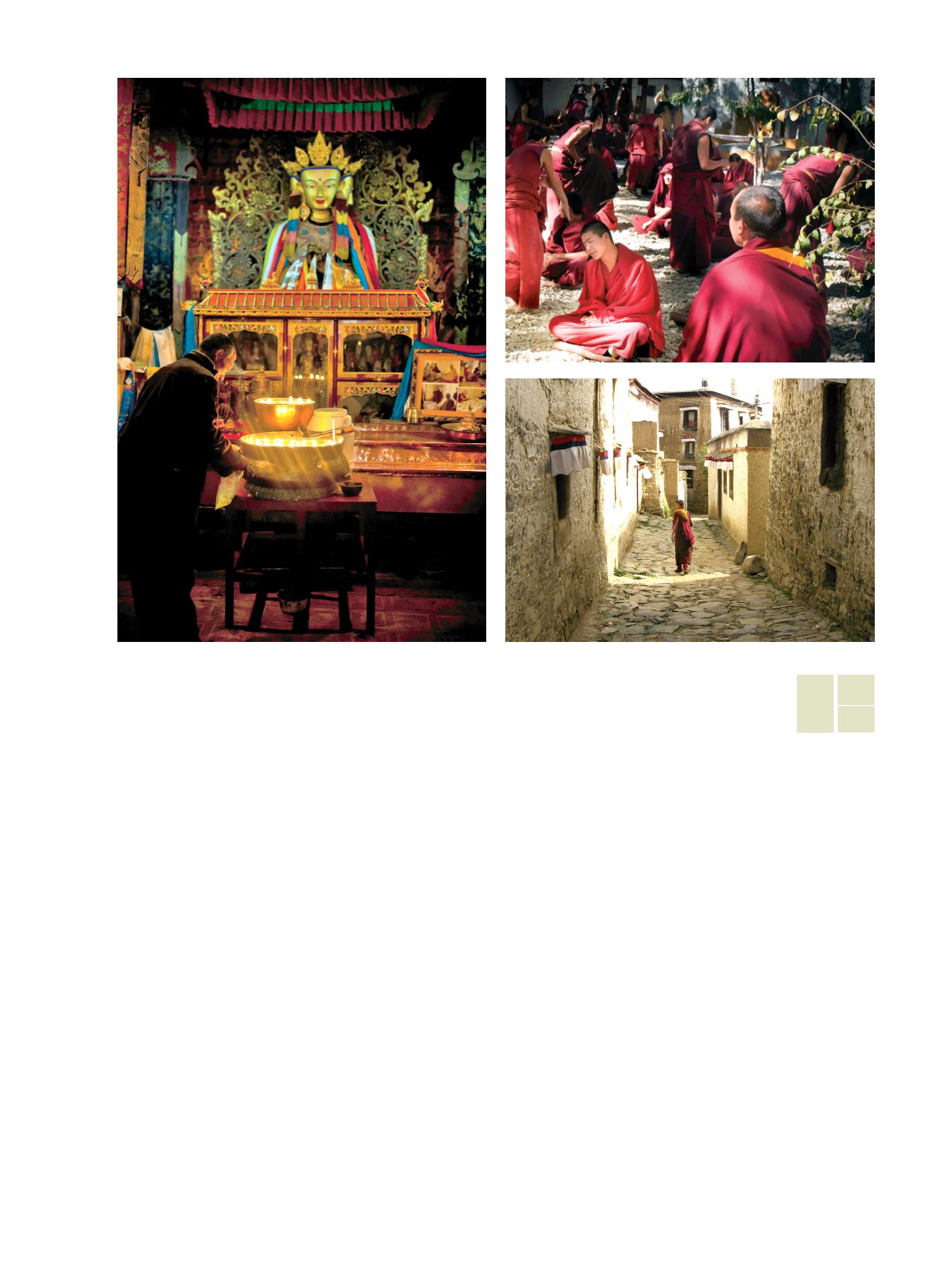
11.Imagen de
Siddharta Gautama,
el Buda (“El
Despierto”).
/ Image
of Siddhartha
Gautama, the
Buddha (“The
Awake”).
12.Lhasa - Sera,
uno de los tres
monasterios-
universidad Gelukpa
del Tíbet.
/ Lhasa
- Sera, Monastery
is one of the three
Gelukpa university
monas-
teries of Tibet.
13. Monje camina en
calle del Monasterio
Shigatse en Lhasa.
/
Monk walks a street
of the Shigatse
Monastery, in Lhasa.
13


