·amura·
107
catadores •
tasters
De Galicia a Valencia
El origen del elixir, aunque casual y controvertido,
resulta bastante diáfano; finalizaba la primera mitad
del siglo pasado, cuando el pintor gallego Constan-
te “Tino” Gil Rodríguez (1926-2009), quien dirigía la
antigua Cervecería Madrid, fundada en 1900, y que
fuera una especie de espacio museístico del artis-
ta, como una atención a la exigencia de un grupo de
parroquianos vascos, cansados del vino espumoso
habitual que solían tomar y al que llamaban Agua
de Bilbao, decidió sorprenderlos ofreciéndoles una
nueva bebida, hecho que quedó asentado en
Valencia
noche
(Plaza&Janes, Barcelona 1978) de la escritora
María Ángeles Arazo.
Tino refería que su creación representaba el fol-
clore y tradición inseparables de las tierras levantinas,
legado que para los valencianos es uno de los que
más cariño suscitan en la ciudad; quizá por ello y a
pesar del cierre de la tradicional taberna en el 2000,
el Agua de Valencia se conserva como una tradición
intrínseca de la ciudad.
Después de 55 años de haberse gestado este
néctar, que al principio sólo saciaba la sed de los ar-
tistas que acudían a las tertulias literarias del café,
que se encontraba detrás del Palacio del Marqués de
Dos Aguas, ha sufrido mil y un modificaciones, tras
popularizarse en la década de los setenta por los ba-
res y discotecas valencianas.
Si bien después del cierre de la Cervecería Madrid,
donde diversos artistas se reunían a encomiar tertulias
literarias, Tino se dedicó a la pintura, en donde en su
obra
Tertulias de café
, retrata las reuniones que dieran
fama al emblemático local, el Agua de Valencia continua
cautivando a propios y extraños.
Los secretos de una bebida
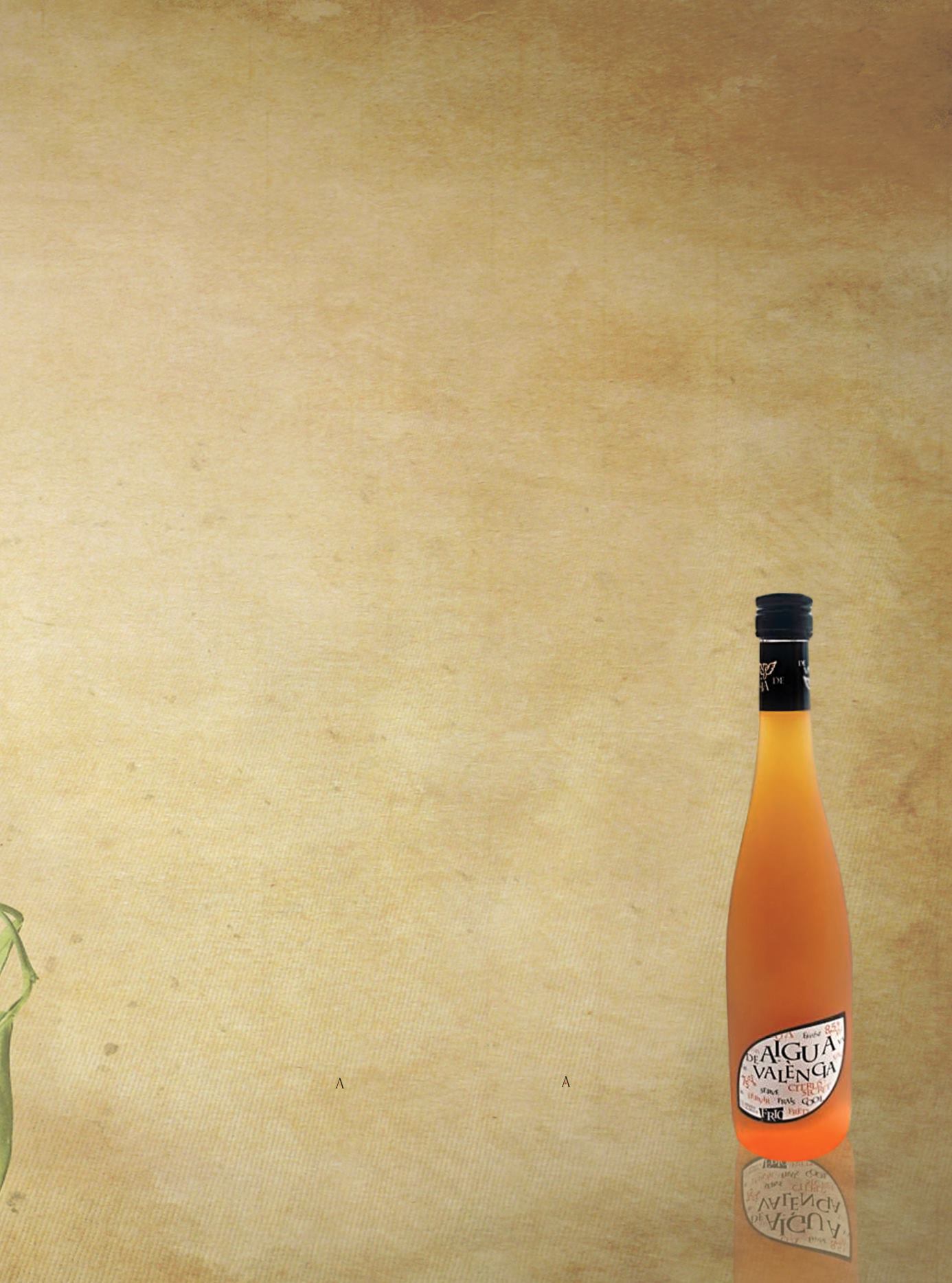
La receta más extendida que en la actualidad sirven la
mayoría de los establecimientos consiste en medio litro
de cava –algunos cantineros sugieren que no sea seco
ni Brut–, medio litro de zumo de naranja –recién expri-
mida–; dos onzas de ginebra, dos onzas de Cointreau y
la misma cantidad de vodka; dos cucharadas soperas de
azúcar blanca; hielo y rodajas de naranja para adornar.
Semezcla el jugodenaranja conel Cointreau, el vodka,
la ginebra y el azúcar y, finalmente, se vierte el cava (muy
frío),mezclansinquitarle la fuerzadel gasal cava; seañade
el hielo y las rodajas de naranja.
FromGalicia to Valencia
The origin of the elixir, though casual and disputed,
turns out to be quite transparent; it was the end of the
first half of last century, when the painter from Gali-
cia Constante “Tino” Gil Rodríguez (1926-2009), who
was the director of the ancient Cervecería Madrid, a
brewery founded in 1900 which served as a sort of
museum to the artist, as a response to the demands
of a group of Basque locals, tired of the sparklingwine
they called Agua de Bilbao (Water of Bilbao) and nor-
mally drank, decided to surprise them by offering a
new concoction, fact that was stated in
Valencia noche
(Plaza&Janes, Barcelona 1978) a book of the writer
María Ángeles Arazo.
Tino referred to his creation as a representa-
tion of the folklore and tradition inseparable from
the Levantine Lands, legacy that, for the locals is
one of the most appreciated and loved in the city;
that may be the reason why, in spite of the closing
of the bar on 2000, the Water of Valencia is pre-
served as an intrinsic tradition of the city.
After 55 years of the birth of this libation, which
at the beginning only crunched the thirst of the art-
ists who went to the literary gatherings of the café
that was located behind the Palace of the Marquis of
Dos Aguas, it has undergone thousands of modifi-
cations after turning popular in the 70’s in the bars
and discotheques of Valencia.
Even after the closing of the Cervecería Madrid,
where various artists got together to praise literary
gatherings, Tino painted and in his painting
Tertu-
lias de café
, he portraits the gatherings that made
the emblematic place famous, the Water of Valencia
continues to captivate locals and strangers.
The secrets of a drink
The most known recipe that is served in the ma-
jority of the places is as follows: half a liter of
very cold cava –some bartenders suggest it not to
be dry nor Brut-, half a liter of freshly squeezed
orange juice, 2 oz. of gin, 2 oz. of Cointreau and
the same amount of vodka, 2 spoonful’s of white
sugar, ice and orange slices.
First, mix the orange juicewith the Cointreau, the
vodka, the ginand the sugar, finally add the cava,mix
carefully to avoid the cava losing its sparkle, and fi-
nally add the ice and the slices of orange.


