Desde el exterior sus cerramientos generan for-
mas de mucho efecto plástico y óptico, lo que aporta
una panorámica urbano-paisajística modernista. La
del antiguo Colegio de San Pío V (actual Museo de Be-
llas Artes, así como sede de la Real Academia de San
Carlos), edificio reconstruido por la Generalitat Valen-
ciana, incluyendo la cúpula de lo que fuera la iglesia
(construida entre 1728 y 1744), la cual ahora es el es-
pacio distribuidor del museo. En este caso particular,
se trata de una reconstitución, dado que en 1925 el
Ministerio de Guerra ordenó su demolición; así, lo que
ahora vemos conserva el volumen que tenía, pero con
cambios sustantivos en su alzado. También portento-
sa es la del edificio de Correos, totalmente acristalada
con más de 3,000 piezas.
Del amplio listado de cúpulas que se aprecian por
Valencia, bien vale hacer una referencia particular a
dos de las más significativas: La cúpula del crucero
del Hospital General de Valencia, que según lo expone
el historiador de arquitectura Joaquín Bérchez en
Ar-
quitectura
recentista valenciana, es posiblemente la
primera cúpula sobre tambor del Renacimiento espa-
ñol y también una de las primeras experimentaciones
con la traza oval en estructuras cupuladas de ladrillo.
Además, podría constituir una obra de un tipo arquitec-
tónico, constructivo, de las más antiguas conservadas
en tierras valencianas, con sistemas y técnicas casi
olvidadas, y la de El Corpus Christi, la cual después de
El Escorial, está considerada como la cúpula española
más temprana que utiliza un modelo característico del
Renacimiento, según patrones italianos, cúpula con
tambor y forma semiesférica transcendiendo al exte-
rior. El influjo de la obra escurialense también se dejó
sentir en la Capilla de Comunión del Carmen, y en la
iglesia del monasterio jerónimo de San Miguel.
Y como recuerda Tosca, la construcción de ar-
cos y bóvedas fue “lo más sutil y primoroso de
la arquitectura”.
O
13
14
15
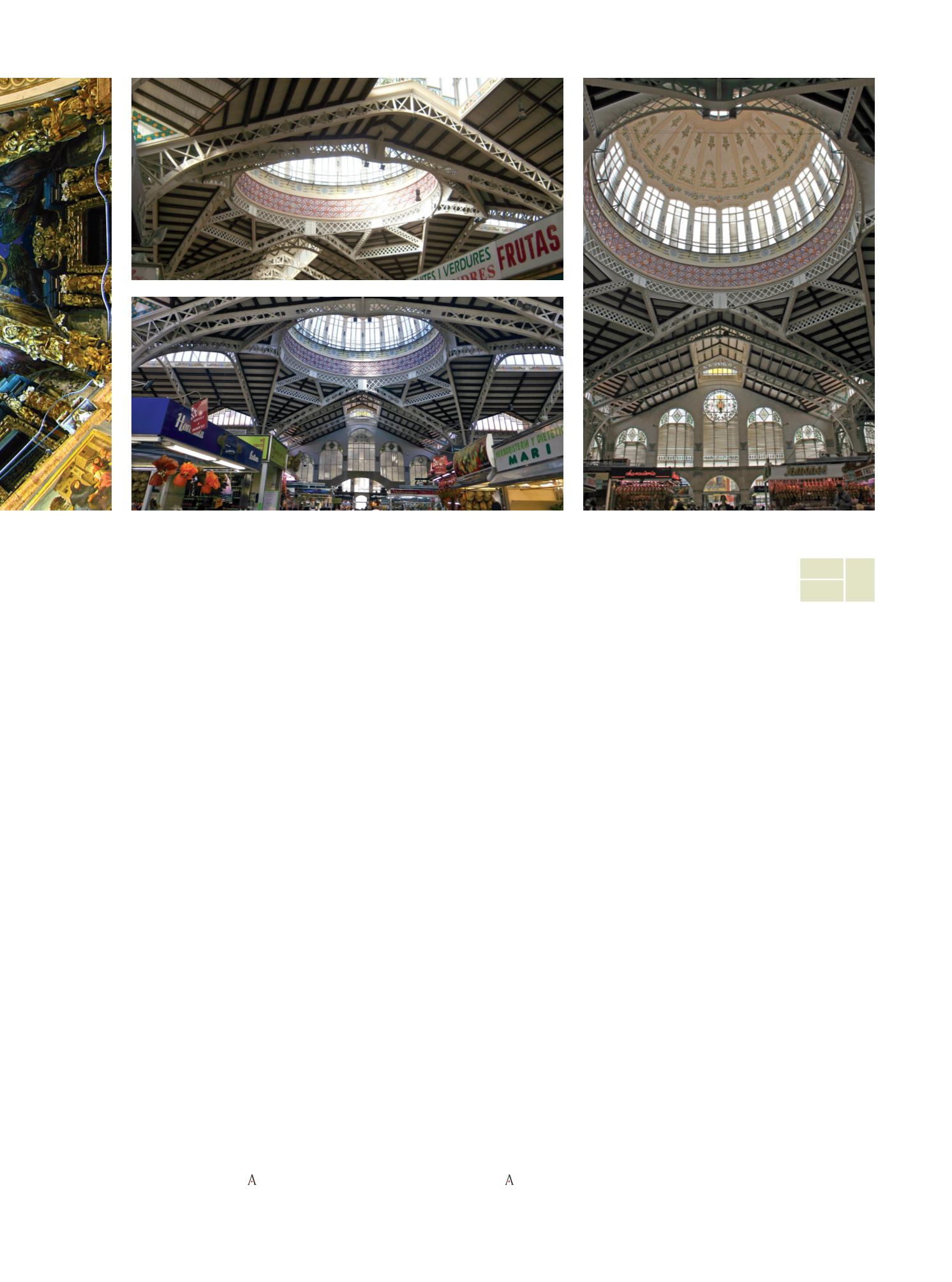
13 y 14. Cúpula del
Mercado Central -
Valencia. /
Dome
Central Market -
Valencia.
15. Cúpula dela zona
de pescaderia. /
Fish
market dome.
los conquistadores •
the conquerors
From the exterior its closures generate forms of
great plastic and optical effect, which offers a mod-
ern urban-landscape panoramic. The one of the old
San Pío V School (today the Belle arts Museum, as
well as the Royal Academy of San Carlos) is a building
that was reconstructed by the Generalitat Valenci-
ana, including the cupola of what was the church
(built between 1728 and 1744), which today serves
as the distributor space of the Museum. In this par-
ticular case, it is a reconstruction we are talking
about, since in 1925 the Ministry of War ordered it
to be demolished; so, what you see today maintains
the volume it had, but with substantial changes in
its rising. Also magnificent is the cupola of the Mail
Office Building, all crystal with over 3,000 pieces.
Of the ample list of cupolas that can be appreci-
ated in Valencia, it is worth our while to refer to two
of the most significant: The cupola of the transept of
the General Hospital of Valencia, that as mentioned
by the architecture historian Joaquín Bérchez in his
Arquitectura Renaixemista Valenciana, it is possibly
the first cupola over tambour of the Spanish Renais-
sance and also one of the first experiments with the
oval trace in brick structures with cupolas. Also, it
could be one of the oldest architectonic, construc-
tive, constructions preserved in the Province of Va-
lencia, built with techniques and systems almost
forgotten, and that of Corpus Christi, which, after
the Escorial, is considered as one of the first cupolas
to utilize a characteristic model of the Renaissance,
based on Italian patterns, cupola with tambour and
semispherical form transcending to the outside.
The influence of the Escorial was also noted in
the Communion Chapel of Carmen, as well as in the
church of the Jerome Monastery of San Miguel.
And, as Tosca remembers, the construction of
arches and vaults was “the most subtle and beauti-
ful of the Architecture”.
·amura·
113


