W
hen referencing the legendary fig-
ure of Rodrigo Díaz de Vivar, the
Cid Campeador, and his years in
Levante, it isworth todifferentiate
the historical data, firmly docu-
mented, from the literary works loaded with mythical
elements. It isalwaysnecessary tocompare them; how-
ever, they shouldnot bemixed-up.
On July 10th 1099 AC Rodrigo Díaz de Vivar, the Cid
Campeador, died in Valencia, city that he conquered in
1094, after a siege that lasted several months in what
has been considered one of the most celebrated heroic
deeds not only in the life of this native of Burgos, but
also in the Spanish History. Years before the victory of
theCid, Balansiya (which isValencia’sname inAl Anda-
lus), was under the control of Yusuf ibn Tashufin, first
Emir of theBéreber-almorávidedynastyand founder of
Marrakech (1062),whoextendedhis control fromNorth
ofMorocco,centralMaghrebandtheactualAlger,allthe
way to the Iberian peninsula, where he beat the Mon-
archof CastileandLeónAlfonsoVI of León, theBrave, in
theBattleof Sagrajas or Zallaqah in1086.
After his unfortunate exile by Alfonso VI in 1801,
and until 1085, the Cid was at the service of Yu-
suf al-Mutamin, King of the taifa of Zaragoza, who
owes most of his military successes to Díaz de Vivar,
though this part of his life is not included in
Cantar
del mio Cid
. In 1086 Don Rodrigo returns to Castile,
once he has reconciled with Alfonso VI, to be sent to
Levante to protect the Castilian interests. However,
and because of a new exile by the King, he contin-
ues battling on his own behalf, conquering Levante
(including Valencia), where he assumes his Manor
under the title of Prince of Valencia. That is how the
Valencian Principality, which lasted until May of
1102, after being reconquered by the Muslims, when
Jimena, wife of the Campeador, abandons the city.
1
A
l hacer una referencia sobre la legen-
daria figura de Rodrigo Díaz de Vivar, el
Cid Campeador y sus años en Levante,
vale diferenciar los datos históricos,
firmemente documentados, de las ela-
boraciones literarias cargadas de elementos míticos;
aunque siempre es necesario compararlos, jamás se
ha de confundirlos.
El 10 de julio de 1099 d.C. muere en Valencia Ro-
drigo Díaz de Vivar, el Cid Campeador, quien en 1094,
conquistó esta ciudad tras un asedio que duró varios
meses, en lo que fue una de las gestas más célebres,
no sólo en la vida del burgalés, sino para la misma his-
toria española. Años atrás, antes de la victoria del Cid,
Balansiya (nombre con el que se conoció a Valencia en
Al Andalus) fue dominio de Yusuf ibn Tashufin, primer
emir de la dinastía beréber almorávide y fundador
de Marrakech (1062), el cual extendió su dominio
desde el norte de Marruecos, el Magreb central y la
actual Argel, hasta la península Ibérica, donde derro-
tó al monarca castellano-leonés Alfonso VI de León,
el Bravo, en la batalla de Sagrajas o Zallaqah, en 1086.
Tras su desventurado destierro en 1081, por Alfon-
so VI y hasta 1085, el Cid estuvo al servicio de Yusuf
al-Mutamin, rey taifa de Zaragoza, quien le debe la
mayoría de sus éxitos militares a Díaz de Vivar, aunque
esta etapa de su vida no se encuentra en el
Cantar del
mio Cid
. En 1086, don Rodrigo regresa a Castilla, una vez
reconciliado con Alfonso VI, para ser enviado a Levante
a proteger los intereses castellanos; sin embargo, en
1089 a causa de un nuevo exilio, continua en batalla,
por cuenta propia, llevándolo a la conquista de Levan-
te (incluida Valencia), donde asume su señorío bajo el
título de príncipe de Valencia; es así como se conforma
el principado valenciano, el cual duraría hasta mayo de
1102, tras la reconquista musulmana, cuando Jimena,
la esposa del Campeador, abandona la urbe.
·amura·
115
personajes •
characters
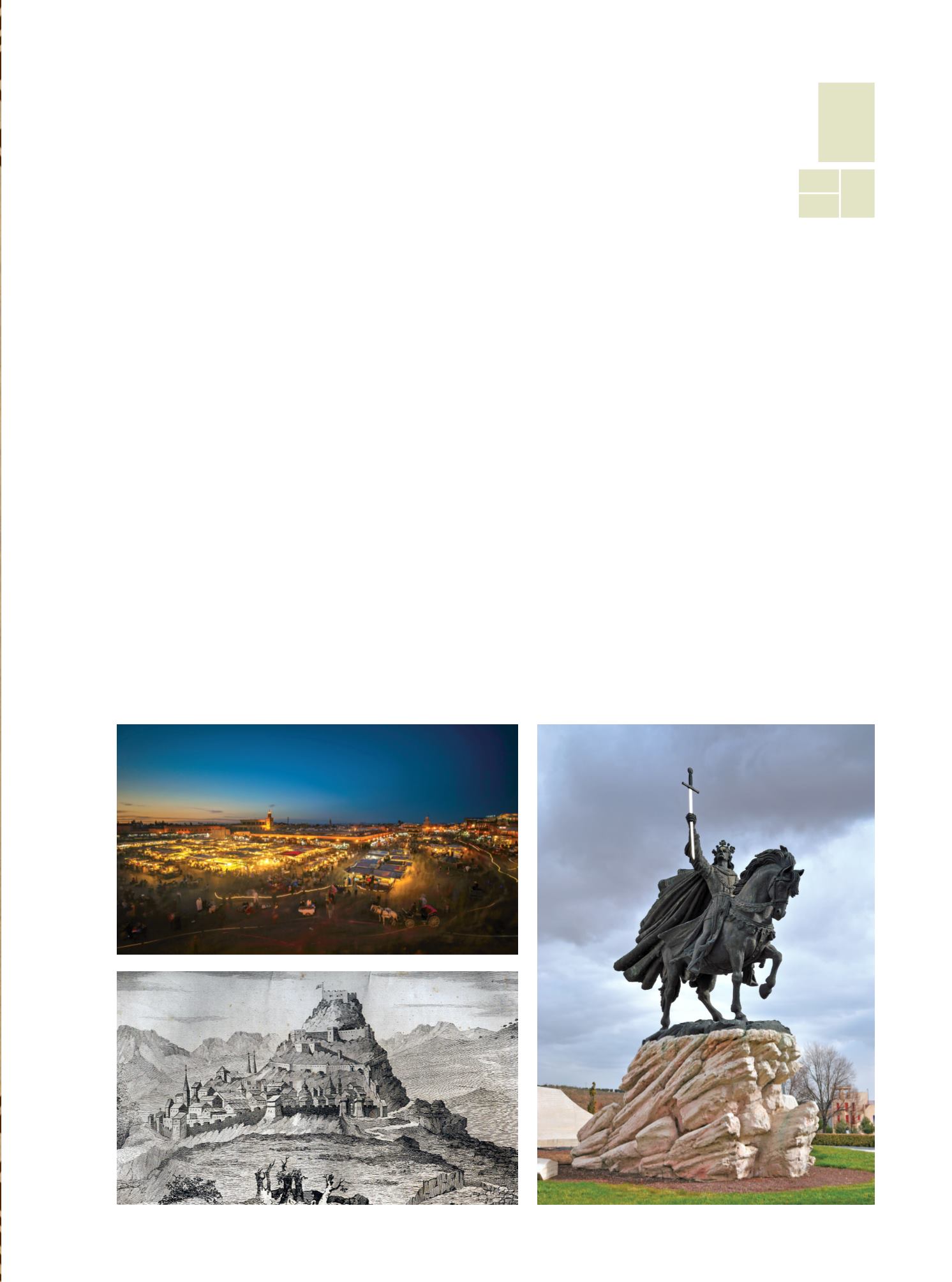
1.Representaciónde
RodrigoDíazdeVivar,
elCidCampeador.
/
Representation
of Rodrigo Diaz de
Vivar, El Cid.
2.VistadeMarrakech
localidadqueofrece
visitasculturalesque
danaconocerelpaso
delCid./
Currently
Marrakech offers
cultural tours that
highlight the passa-
ge of Cid.
3.CastilloenOndara,
en las laderasde la
SierradeSegaría,en
lascercaníasde la
ciudaddeDenia./
Ondara Castle, on
the slopes of the Sie-
rra de Segaria, near
the city of Denia.
4.Monumentodedica-
doalreyAlfonsoVI
deCastillaalcual
sirvióelCID./
Monument dedica-
ted to King Alfonso
VI of Castile which
served the CID.
2
3
4


