Cúpulas en la arquitectura valenciana
Desde el punto de vista arquitectónico, en Valencia
no sólo sobresalen las construcciones, sino las cú-
pulas de muchas de éstas, de diversas proporciones
y estilos.
Rafaél Soler Verdú
, en su estudio Actas del Primer
Congreso Nacional de Historia de la Construcción, in-
dica que con la construcción de la cúpula del Corpus
Christi, se implantó en Valencia un nuevo modelo, que
supone una importante renovación. Aunque presenta
variaciones formales, se mantiene una constante que
dota al conjunto de cúpulas estudiadas de homoge-
neidad. Incluso en casos como el de la Capilla de la Vir-
gen, de planta y directriz elíptica.
En la actualidad, Valencia posee 43 cúpulas, en
especial de tres tipos: de amplias dimensiones, con re-
vestimientos de teja azul vidriada, de influencia árabe;
pequeñas e independientes (que pueden ser cerra-
mientos de capillas), también en color azul, y las que
conforman torres-campanarios, por lo general, poste-
riores a la construcción original del inmueble.
Destaca, por ejemplo, la de las Escuelas Pías (Ba-
rroco clasicista del siglo XVIII): una cúpula semiesférica
en cuyo intradós posee veinte nervios pareados. Tiene
24.5 m de diámetro, 40 de altura y es la más grande de
Valencia. Al exterior, tanto la cúpula como su linterna
muestran teja azul, con nervios blancos; lo que, con
base en las características de técnica y materiales,
responde a la permanencia de rasgos comunes, dando
continuidad a la misma cultura arquitectónica cons-
tructiva, que señala Soler Verdú.
Otras cúpulas dignas de admirarse son las del
Mercado Central, construido en 1914, bajo una pro-
puesta modernista. Restaurado por completo en el
2003, presenta cúpulas de hierro, cristal y cerámica;
la central con 30 m de altura.
11 12
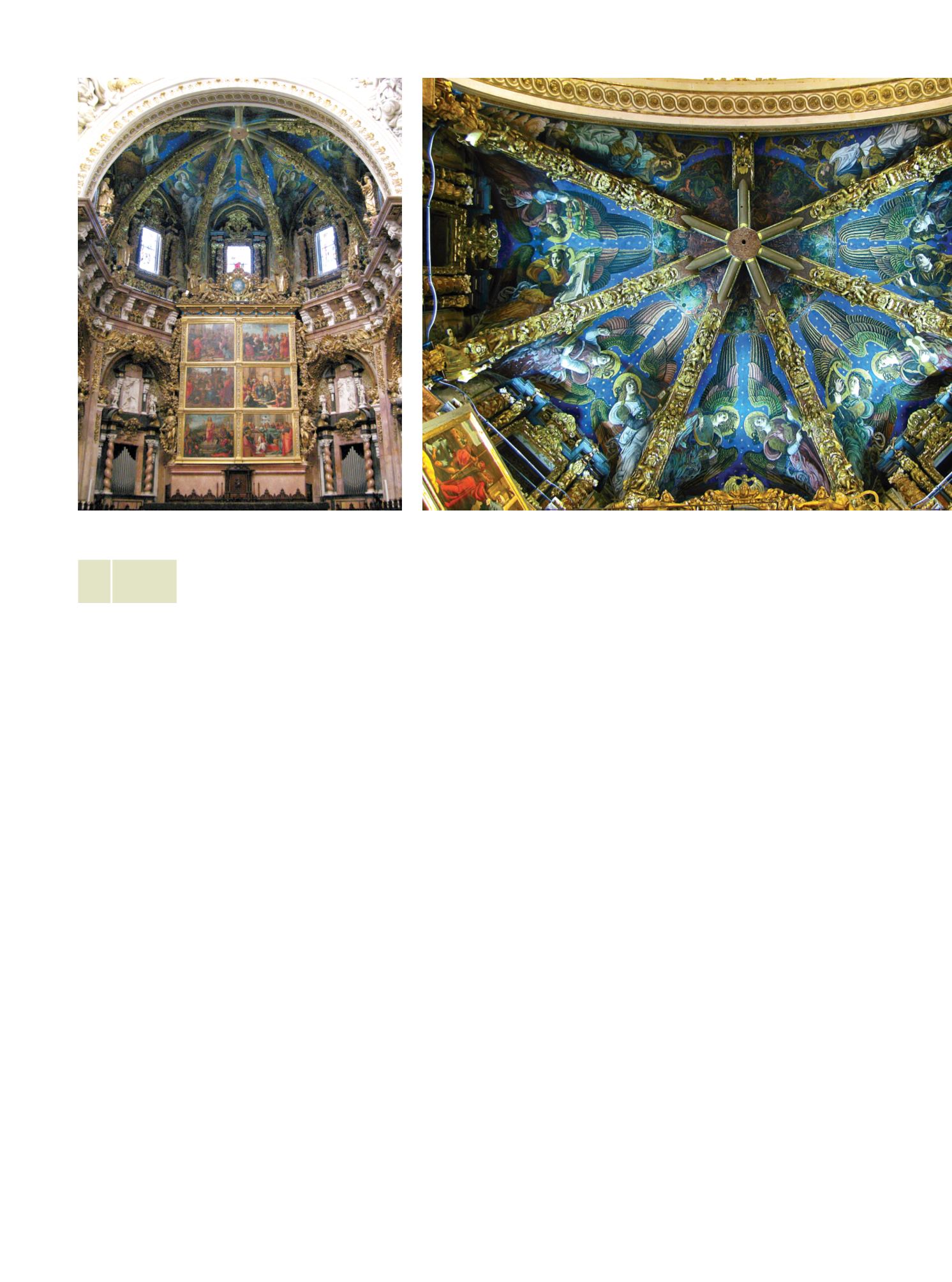
11 y 12. Cúpula de
la capilla mayor de la
Catedral de Valencia.
/
Dome of the chapel
of the Cathedral
of Valencia.
·amura·
112
los conquistadores •
the conquerors
Cupolas in theValencianArchitecture
Fromthe architectonic point of view, inValencia not
only the constructions are outstanding, but also
the cupolas of lots of them, of various proportions
and styles.
Rafaél Soler Verdú
, in his study called Minutes of
the First National Congress on the History of Con-
struction, indicates that with the construction of the
cupola of Corpus Christi a newmodel was implanted
in Valencia, which implies an important renovation.
Even though it presents formal variations, it main-
tains a constant homogeneity throughout the group
of cupolas studied. Even in cases such as the Chapel
of the Virgin, of elliptical base and directrix.
Today, Valencia has 43 cupolas, mainly of
three kinds: of ample dimensions, with facing
of glazed blue tile of Arab influence; small and
independent (that can be closures for chapels),
also in blue color, and those that conform tow-
ers-bell towers, generally added after the origi-
nal construction of the building.
An outstanding example is that of the Pious
Schools (Classic Baroque of XVIII century): a semi-
spherical cupola with 20 paired ribs in its internal
arch. It has 24.5mt indiameter, 40 inheight and is the
largest in Valencia. In the outside, the cupola and its
lantern show blue tile with White ribs; which, based
on the characteristics of the technique and the mate-
rials, correspond to the permanence of the common
traits, giving continuity to the same constructive ar-
chitectonic culture that Soler Verdú refers to.
Other cupolas worth admiring are those of the
Central Market, built in 1914, following a modern
proposal. Totally restored in 2003, it shows iron,
glass and ceramic cupolas; the central one with
30 mt in height.


