·amura·
compás int •
compass int
42
1
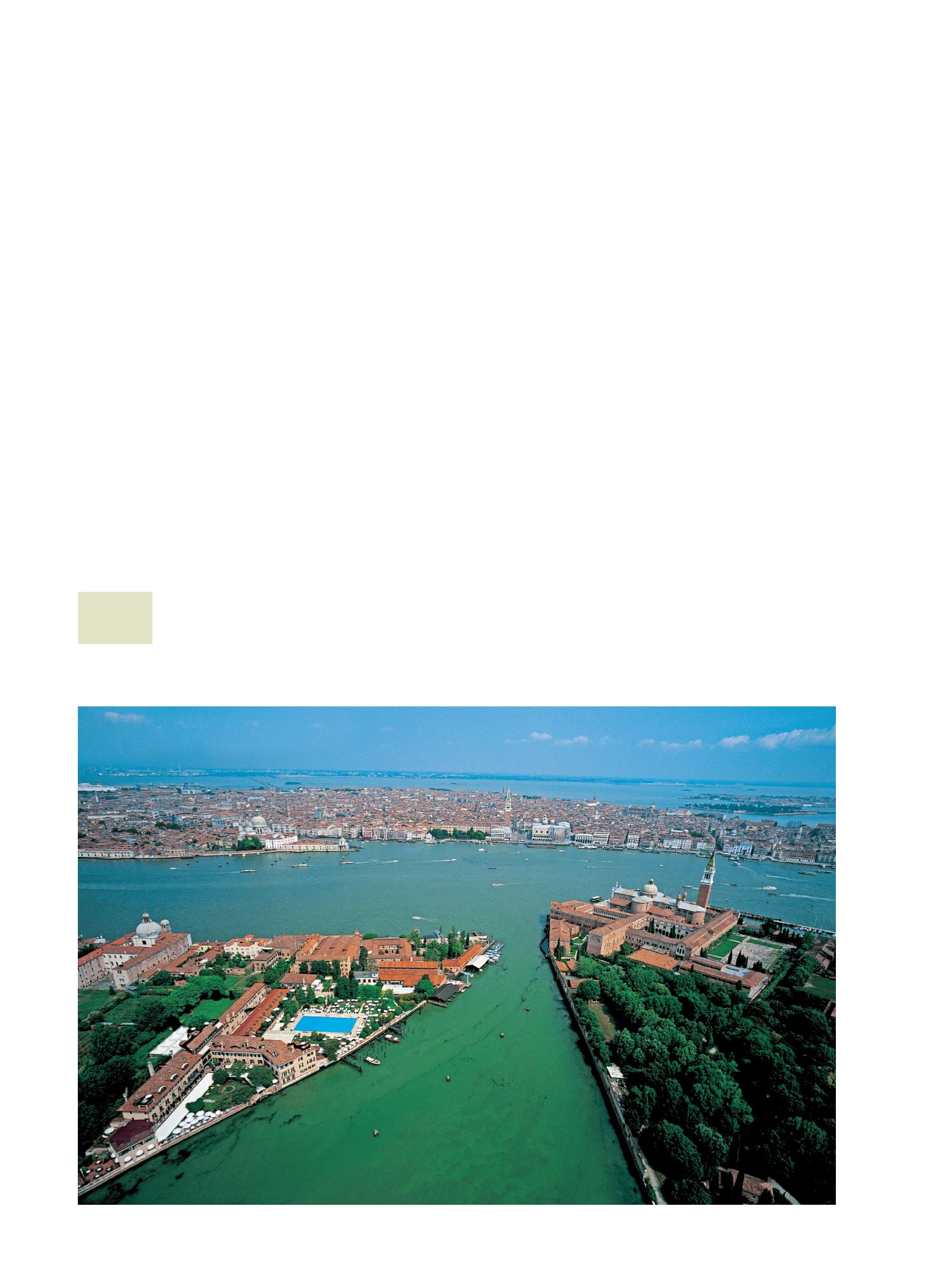
1. Los Bellini,
Giorgione, Tin-
toretto, Tiziano
y Veronés son
nombres asociados
a la gloria artística
de Venecia./ The
Bellini, Giorgione,
Tintoretto, Tiziano
and Verones are
the names associa-
ted to the artistic
glory of Venice.
Por sus callejones y edificios
Debido a toda esta historia es que la mejor mane-
ra de conocer Venecia es visitándola a pie, conociendo
cada uno de sus detalles, callejones y edificios rebo-
santes de historia de una Europa romántica, clásica y
artística. Y debemos empezar por el Gran Canal que
es una gran avenida lacustre, de 30 a 80 metros de
ancha, en cuyo entorno se alinean iglesias y palacios,
en una sucesión sorprendente y llena de belleza.
Si comenzamos en los aledaños de la estación, lo
primero que veremos es el Puente de los Descalzos.
A su izquierda queda la bella portada de la iglesia de
los Carmelitas Descalzos, sumamente armoniosa, del
Siglo XVII, enfrente se halla La de San Simeón Piccolo,
de líneas clasicistas y algo posteriores.
Unos 300 metros más adelante, a la izquier-
da, aparece la Iglesia de San Geremia, del XVIII.
Adosado a ella, en el canal que surge en la mis-
ma esquina se halla el Palacio Labia, del XVII, con
frescos de Tiépolo.
Apenas 300 metros más adelante, en la orilla de-
recha, el Museo de Historia Natural, en el edificio Fon-
tego dei Turchi, originario del XIII pero reconstruido en
el XIX. Enfrente la iglesia de San Marcuola.
A partir de aquí y hasta el puente de Rialto hay
un elevado número de edificios de interés. En la orilla
izquierda, el Palacio Vendramin-Calergi, última resi-
dencia de Ricardo Wagner, obra del Siglo XVI, y algo
más adelante, la Ca’d’Oro, tal vez la casa palaciega
más bella (aparte del Palacio Ducal) de un estilo góti-
co veneciano, obra del Siglo XV.
En este tramo, en la orilla derecha se halla,
entre otros Ca’Pesaro, barroca y del Siglo XVII;
Palacio Brandolin, gótico del Siglo XV; y las Fa-
briche Nuova y Vecchia de Rialto, ambas del
entorno del XVI.
For its Alleys and Buildings
Due to all this history the best way to visit and
know Venice is by foot, discovering each and every
detail, alleys and brimming buildings of history of
a romantic, classic and artistic Europe. Andwemust
begin at the Great Canal which is a big moist ave-
nue, 30 to 80 meters wide, in whose environment
churches and palaces are lined up, in a surprising
filled with beauty succession.
If we start in the station’s surroundings, the
first thing we will see is the Bridge of the barefoot.
At the left there is a beautiful cover of the church
of the Barefoot Carmels, very harmonius, from the
XVII century, in front the Saint Simeón Piccolo is
found, of somewhat latter classicists lines.
Some 300 meters ahead, at the left, the Saint
Geremia church from the XVIII century is found. At
its side, in the canal which emerges from the same
corner the Palace Labia from the XVII century is lo-
cated with Tiepolo paintings.
At just 300 meters ahead, at the right edge, the
Natural History Museum, in the Fontego dei Turchi
building originated in the XIII century but rebuilt
in XIX. In front the Saint Marcuola church.
From here and up to the Rialto bridge there is
a high number of interesting buildings. On the
left border, the Vendramin-Calergi Palace, the last
residence of Richard Wagner, work of the XVI cen-
tury and further ahead the Ca’d’Oromaybe themost
beautiful palaciegahouse (besides theDucal Palace)
of a gothic venetian style, work of the XV century.
On this stretch, on the right edging, it is found
among others Ca’Pesaro, baroque and from the XVII
century; Brandolin Palace, gothic from the XV cen-
tury; the Fabriche Nuova and the Vecchia de Rialto
both from the XVI century.


