·amura·
135
conservancy •
conservación
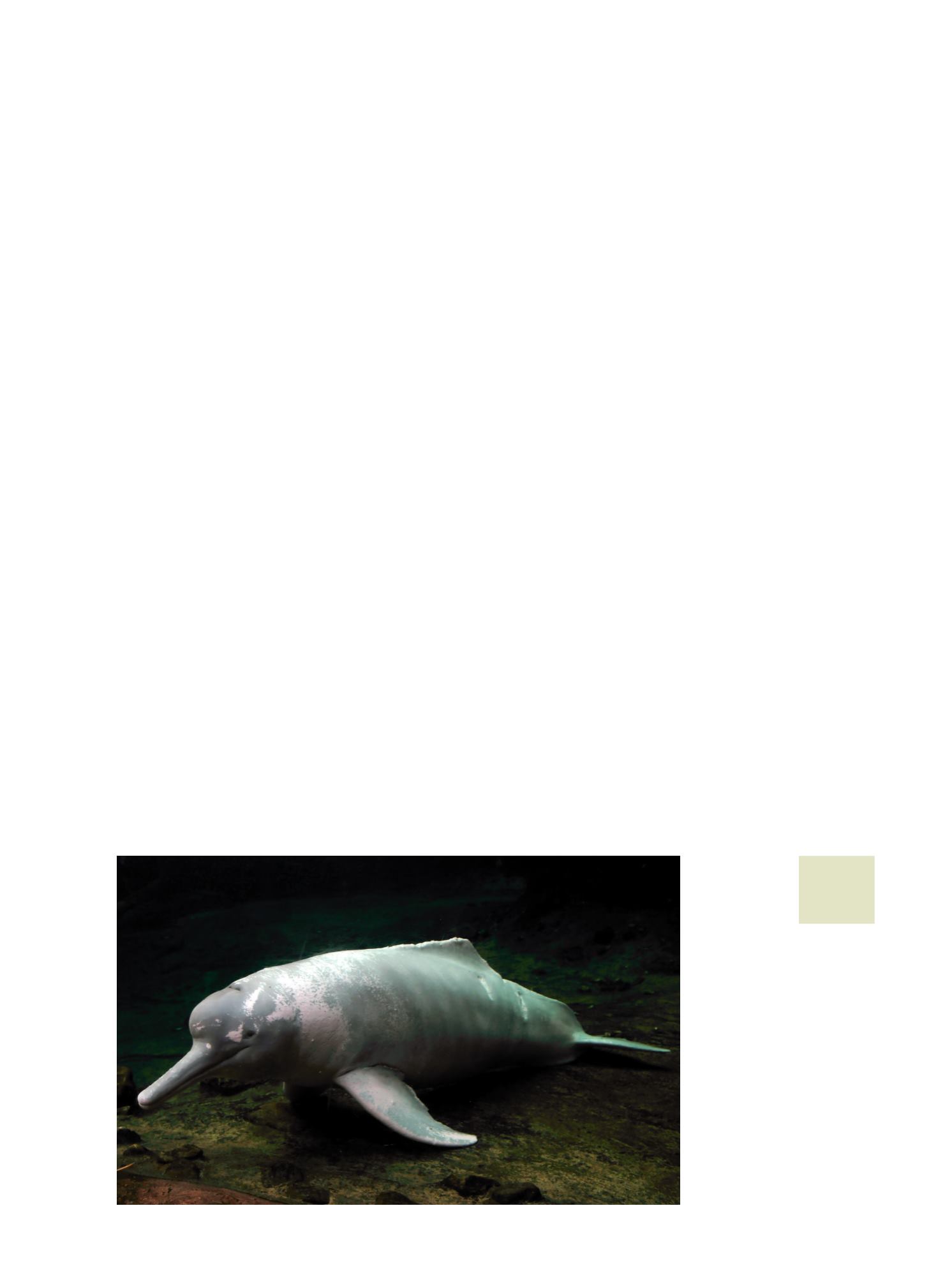
18.Eldelfínrosado,
tambiénconocido
comoboto,bufeo,
delfíndelAmazonas
ytonina,eseldelfín
deríomásgrande;su
aletadorsaltienepoca
alturaperoesmuy
largaysusaletaspec-
toralessongrandes.
/ The pink dolphin is
also known as boto,
bufeo, dolphin of the
Amazon and tonina.
It is the largest river
dolphin, its dorsal fin
has little hight but is
very long, its chest
fins are large.
18
Dedicamos un día a trasladarnos entre autobuses y
lanchas con motor fuera de borda. Sin entender bien el
portugués, idioma utilizado por los choferes de los au-
tobuses y los capitanes de las lanchas, logramos llegar
a una parte del río Amazonas, donde me quedé boca
abierta al ver la grandeza del río; más de un kilómetro de
longitud. Por mi mente se cruzó el pensamiento de que
una quinta parte del agua dulce que existe en el planeta
pasa por allí. Hace varios miles de años no existía el río
Amazonas, algunos siglos más tarde, la región donde
hoy queda la Cordillera de los Andes subió abruptamen-
te, creando una barrera para las aguas y allí se formó un
gran lago interior, por esta razón, especies demamíferos
marinos como el delfín rosa, localmente llamado “boto
roso” y los tucuxis tuvieron que adaptarse forzosamen-
te a vivir en aguas dulces quedando atrapados en este
“gran lago” un río supremo llamado Amazonas.
A bordo de una lancha, a lo lejos en el horizonte vis-
lumbro unas pequeñas aletas dorsales saliendo de la su-
perficie, en el siguiente segundo tomo mis binoculares
para identificar que eran, y al momento el lanchero dice
“tucuxis” volteo a verlo y le pregunto -¿qué?-, vuelve a
pronunciar “tucuxis” y a través de mis binoculares me
doy cuenta de se trata de un grupo de delfines pequeños
brincando y saltando sobre el agua. Averigüé que es una
especie de delfines de agua dulce, pequeños, color gris
obscuro y similar a un delfín nariz de botella, con la única
diferencia de que estos sólomiden unmetro.
Al darme cuenta de que estaba siendo testigo a
los primeros delfines de agua dulce en mi vida, salió
un grito de emoción, diciendo -¡Que increíble, que
emoción estar aquí!-, un poco más adelante llega-
mos a un sitio donde se unen el río negro y el río
amarillo localmente conocido como rio blanco; con
3,200 km de largo, tiene las aguas completamente
negras. En la época de sequía salen a relucir playas
de blanca. Los ríos de éste margen zigzaguean en
su recorrido por la planicie arenosa, van erosionan-
do barrancos, crean islas y arrastran aldeas. Ese río
mueve 800 millones de toneladas de sedimentos al
año, y los lanza al mar. Todos estos afluentes arras-
tran, en suspensión, toneladas de tierra, minerales,
materia orgánica y sedimentos diversos. Sus aguas
tienen un color marrón claro y se llaman nativamen-
te ríos de agua blanca.
We dedicated one day to arrival, moving on
buses and engine boats, without understand-
ing a word or Portuguese, language spoke by the
drivers of the vehicles and sailors of the embar-
kations. I stood stunned by the width of it; over
a kilometer of extension. A thought crossed my
mind, one fifth of the sweet water in the world
remains here…Thousands of years ago the Ama-
zon River didn’t exist, centuries passed and the
region known as the Andes raised abruptly, cre-
ating a water barrier which formed a great inte-
rior lake. Reason why the submarine mammals
as the pink dolphin, locally called “botoroso” and
the tucuxis adapted to make their life in sweet
water due to the fact they were “caught” in this
great lake with flows of a supreme river called
the Amazon.
Aboard a little boat, we could see on the
horizon small dorsal fins coming to the sur-
face; I swiftly took my binoculars to identify
what it was. At the moment one of the sailors
said “Tucuxis” – I took a quick glance- What?
– I asked, as we repeated once more “Tucuxis”.
Through my binoculars, I could see a group of
small dolphins jumping in and out of the wa-
ter, of dark grey color, similar to the bottled
nose dolphin; these however, only measure
a meter.
When I realized I was witnessing dolphins
that lived in sweet water for the first time in
my life a scream came out of my mouth – In-
credible! It is amazing to be here!—a bit further
we arrived to the spot where the yellow and the
black river (or white river as it is locally known)
unite. With 3,200 km it’s waters are completely
dark. In the time of drought white beaches be-
come visible. The rivers of this size zigzag in its
flow through the sandy prairie, they erosion the
cliffs, create islands and drag entire villages.
The river moves 800 million tons of sediments
per year, and deposits them into the ocean.
These fluent drag in suspension tons of earth,
minerals, organic matter and diverse materials.
Its brown colored waters are called by the na-
tives white water Rivers.


