60
·amura·
compás int •
compass int
We passed the islands of Tierra del Fuegowith a very
rough sea, as if each waves wanted to swallow us,
until de entered the Cockburn Channel, a spot pro-
tected from the wind, and reached the Magallanes
Strait, where moderate winds stir up the surface of
thewater.We passed the famous Bulnes Fort, built in
1843 to mark the occupation of this territory and
later abandoned due to lack of drinking water and
the harsh climate. Its wooden structures defy the
strong winds that force the small number of trees to
grow crooked and close to the ground. We passed
Puerto Hambre, established in 1584 by Pedro
Sarmiento de Gamboa as “The city of King Don
Felipe” and quickly abandoned until the middle of
the 19 th century, when it became a fishing village.
Finally Punta Arenas appeared, a place where we
would be able to rest our bodies and recover fromthe
seasickness that had us in its grip since we left
Ushuaia.
Punta Arenas and the Magallanes Strait
Punta Arenas, founded in 1848 on the western bank
of the Magallanes Strait, is the liveliest and most
interesting city in Patagonia. It has mansions that
date fromthe economic boomof the regiondue to the
exploitation of wood at the end of the 19 th century
and, later, sheep farming in the ever greenplains. It is
an excellent place in which to enjoy wonderful
seafood and explore the mansions that are a symbol
of the history of the colonial families thatmade their
fortunes in this region such as the Braun-Menéndez
house, the Castillo de Piedra, that belonged to Charly
Milward, and the house of Sara Braun. They stand out
hasta penetrar por el canal Cockburn, en parte prote-
gido del viento, y alcanzar el Estrecho de Magallanes,
donde el viento moderado agita la superficie del
agua. Pasamos el famoso Fuerte Bulnes, creado en
1843 para marcar la ocupación del territorio. Sus
construcciones de madera desafían los fuertes vien-
tos que han obligado a los árboles a crecer poco y
medio acostados. El Fuerte fue abandonado por falta
de agua y su duro clima. Pasamos Puerto Hambre,
fundado en 1584 por Pedro Sarmiento de Gamboa,
como “Ciudad del Rey don Felipe”, rápidamente
abandonada hasta mediados del siglo XIX cuando se
convirtió en aldea de pescadores. Apareció por fin
Punta Arenas, adonde íbamos a poder descansar
nuestros cuerpos de ese mareo que no nos soltó
desde Ushuaia.
Punta Arenas y el Estrecho de Magallanes
Punta Arenas, fundada en 1848 en la orilla oeste del
Estrecho de Magallanes, es la ciudad más viva e inte-
resante de la Patagonia, con sus mansiones que
datan del auge económico de la región debido a la
explotación de la madera al final del siglo XIX y luego
del criadero de borregos en las llanuras siempre ver-
des. Es un excelente lugar para disfrutar de los exce-
lentes mariscos y conocer las mansiones que
simbolizan la historia de esas familias de colonos
que hicieron sus fortunas en esa región: la casa
Braun-Menéndez, el Castillo de Piedra que pertene-
cía a Charly Milward, la casa de Sara Braun, destacan
en el centro donde la catedral domina el escenario,
orgullosa de su pasado. El cementerio es digno de ser
visitado para admirar los imponentes mausoleos,
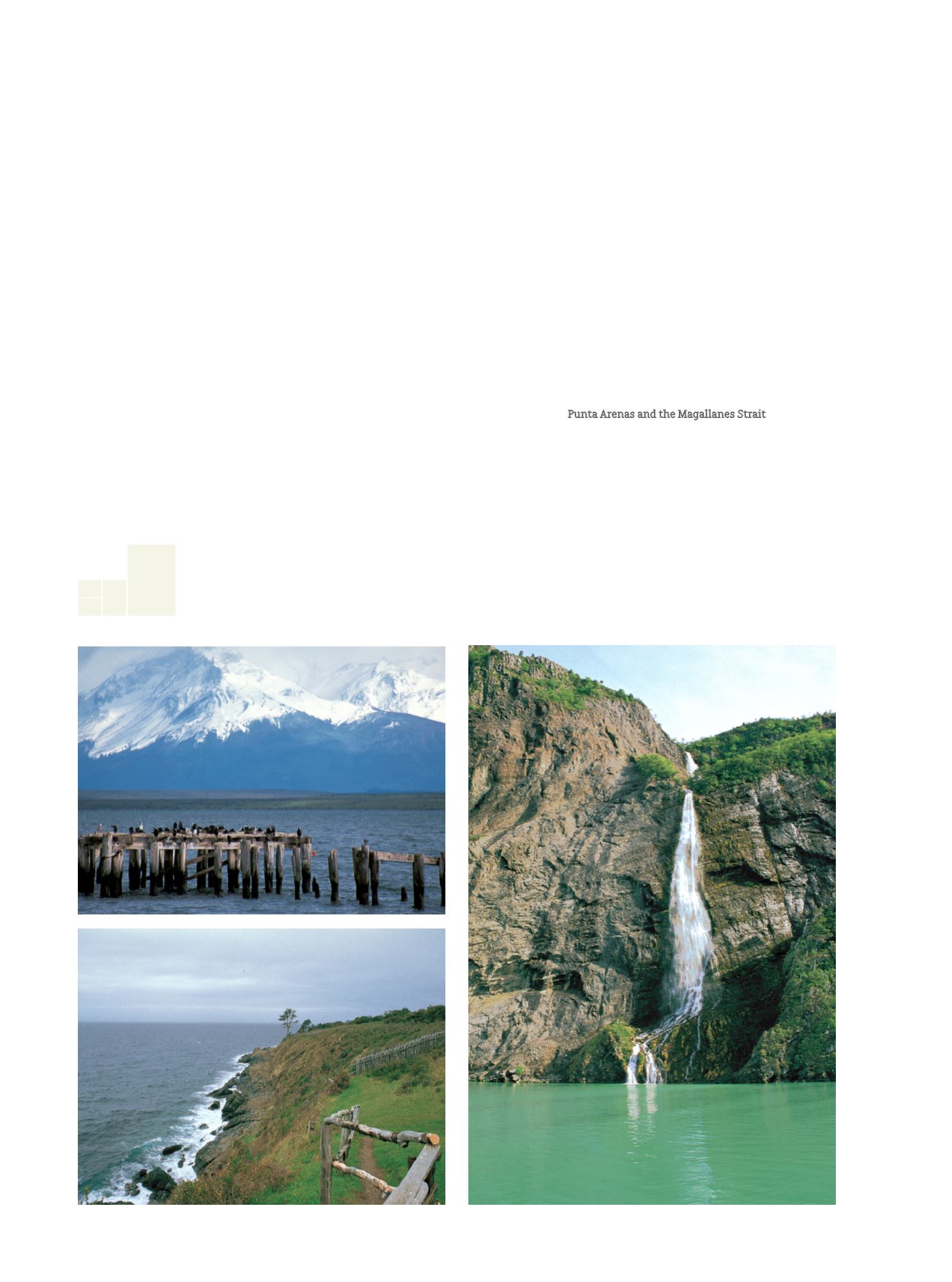
1. En Puerto Natales, la calma
de las aguas del seno
reflejan la majestuosidad de
las montañas.
In Puerto Natales, the calm
of the waters of the cove
reflect the majesty of the
mountains.
2. El Fuerte Bulnes vigila el
estrecho de Magallanes,
aislado, solitario
The Bulnes Castle guards
the Magellan’s Strait,
isolated and lonely
3. Las cascadas son el reino de
los cóndores que viven en el
Seno de Última Esperanza
The waterfalls are the
kingdom of the condors
that live in the Seno de
Última Esperanza
4. El glaciar Balmaceda ha
retrocedido notablemente
en los últimos años, señal
del calentamiento de la Tierra.
The Balmaceda glacier has
retreated notably in recent
years, a sign of global
warming.
1
2
3
4


