73
compás int •
compass int
·amura·
trastes, donde cada esquina nos reserva una sor-
presa, un palacio, una divina catedral o una lujosa
iglesia, unos temibles callejones o unas elegantes
avenidas. La capilla Palatina es el mejor ejemplo del
arte normando, edificada en 1131 con un excepcio-
nal decorado en mosaicos al igual que la catedral
de Monreale, un impresionante edificio con su
interior cubierto de los más hermosos mosaicos y
el inmenso patio del convento con columnas labra-
das y capiteles esculpidos.
Desde Palermo hasta Porto Empedocle
Pasando el Capo Gallo, el Golfo di Castellamare con
su larga playa, el Capo S.Vito con sus acantilados,
alcanzamos Trapani, donde dejamos el yate para
visitar Erice, un pueblo anidado en la montaña,
dominado por su fortaleza y serpenteado por
callejones empedrados, y también Segesta, con su
templo perfectamente conservado en las verdes
colinas.
Seguimos la costa oeste de Sicilia, dejando las
islas Egadi, los puertos de Marsala y Mazara, para
anclarnos frente a Selinunte y descubrir ese her-
moso puerto griego con sus calles empedradas, su
Acrópolis, sus nueve templos.
Pasando las ciudades costeras de Sciacca y
Heraclea llegamos a Porto Empedocle donde nos
alojamos en la marina para visitar Agrigento y el
Valle di Templi o Akragas. Fundada alrededor
de 580 a.C., entre su conjunto destacan el Templo
de Zeus Olímpico, uno de los más grandes del
mundo antiguo, mide 113 metros de largo por 36
de ancho, con columnas de 20 metros de alto con
rounded by high mountains. Unique, terrifying
and enchanting, Palermo is a city of contrasts
where each corner reveals a surprise, a palace, a
divine cathedral or a lavish church as well as some
frightening alleys and elegant avenues. The
Palatine chapel is the best example of Norman art:
built in 1131, it features an exceptional mosaic
décor such as can be found in the Monreale cathe-
dral, an impressive building with an interior cov-
ered in striking mosaics and an impressive
convent patio with carved columns and capitals.
From Palermo to Porto Empedocle
Passing Capo Gallo, the Gulf of Castellamare, with
its long beach, and Capo S. Vito and its cliffs, we
reached Trapani, where we left the yacht to visit
Erice, a town nesting in the mountain, guarded by
its fort andwith zigzagging cobblestone streets, as
well as Segesta, with its perfectly preserved tem-
ple set in the green hills. We followed the west
coast of Sicily, leaving behind the Egadi Islands,
the ports of Marsala and Mazara, and anchored fac-
ing Selinunte, where we discovered this splendid
Greek port of cobblestone streets, an Acropolis and
nine temples.
Passing the coastal cities of Sciacca and
Heraclea, we reached Porto Empedocle, where we
docked in the marina and visited Agrigento and
the Valle di Templi or Akragas. Established around
280 BC, its outstanding buildings include the
superb Tempio della Concordia and Tempio di Hera
Lacinia and the Olympic Temple of Zeus, one of the
largest of antiquity, which is 113 meters (371 feet)
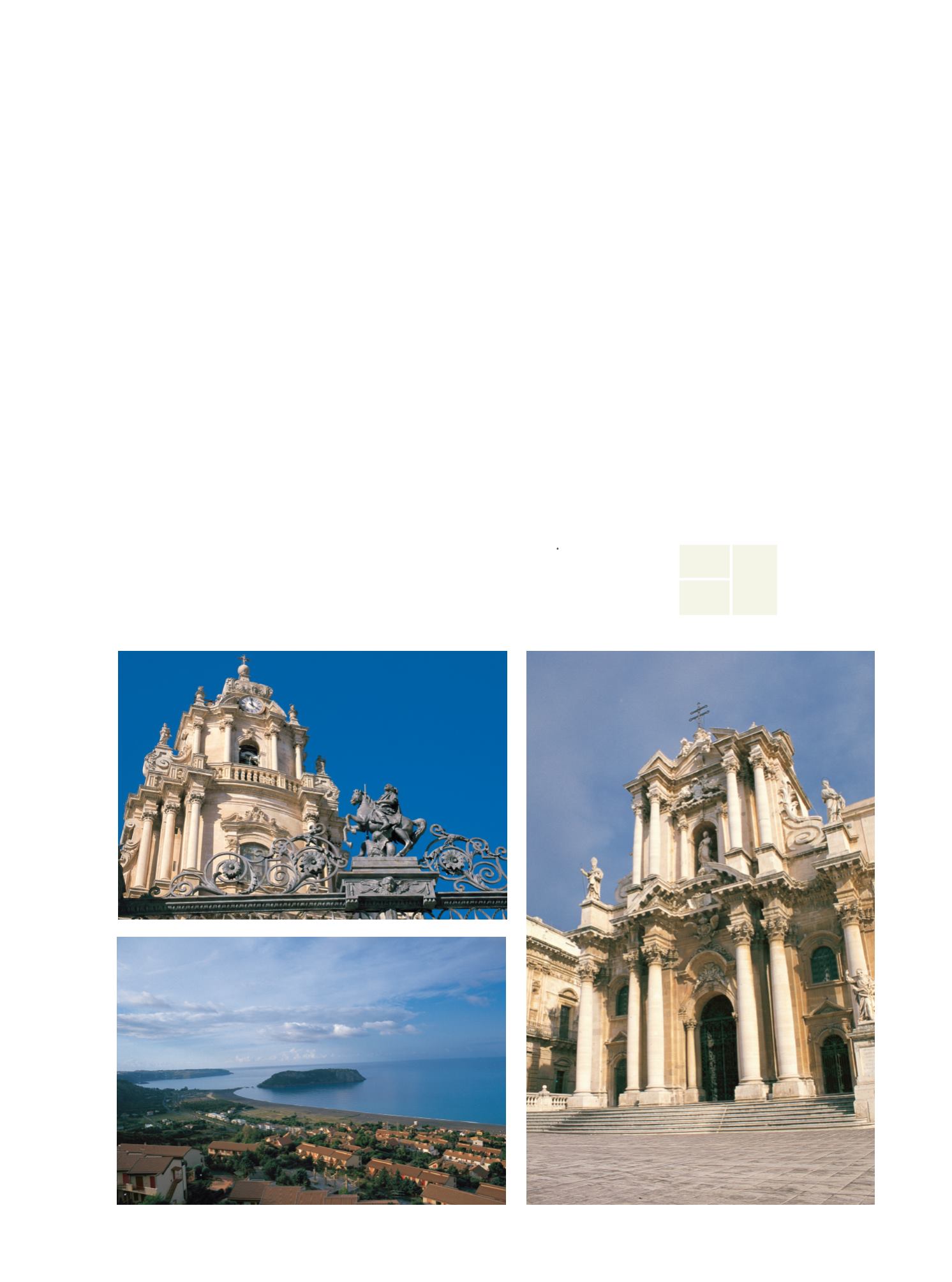
1. La catedral de Ragusa, símbolo del
barroco siciliano.
The Cathedral of Ragusa, the
symbol of Sicilian baroque
architecture.
2. La catedral de Siracusa es un
templo griego remodelado y
luce su inmensa belleza.
Syracuse Cathedral is a
remodeled Greek temple and
shows of its immense beauty.
1
2


