compás int •
compass int
52
·amura·
este territorio del control de los suecos en 1703,
decidió construir una fortaleza a orillas del río Neva
para protegerse de posibles ataques. Fue la primera
edificación que mandó construir Pedro el Grande
sobre una pequeña isla pantanosa.
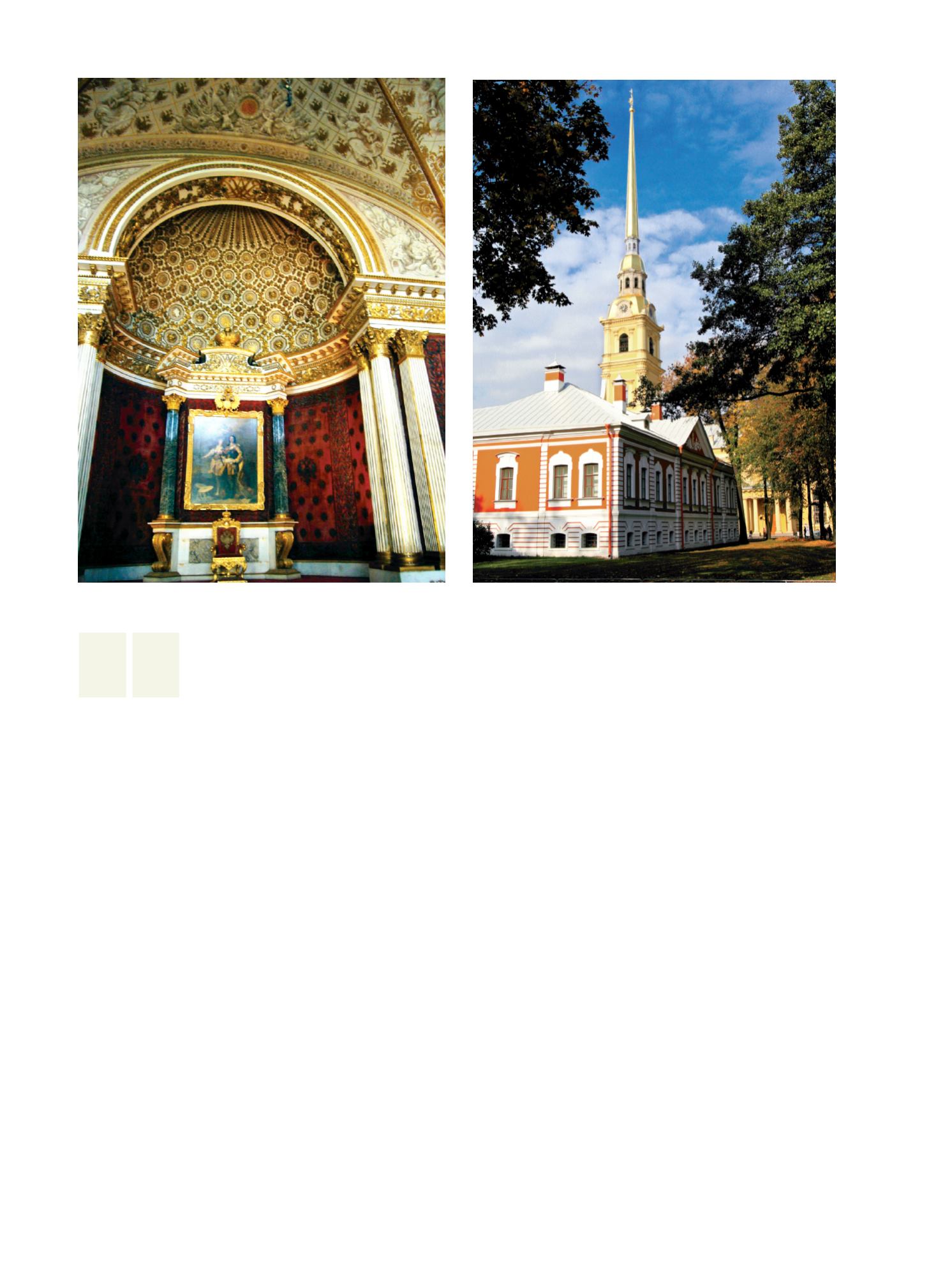
Dentro de la fortaleza se encuentra la Catedral de
San Pedro y San Pablo, la más antigua de la ciudad.
Aquí están las tumbas de los monarcas de la dinastía
de los Romanov. En 1998 fueron enterrados Nicolás II
con su familia en la catedral, fusilados en
Ekaterinburgo en 1918.
Catedral de Kazan
Nevsky Prospekt, la arteria principal de la ciudad, con-
duce a las principales atracciones, incluyendo la
Catedral de la Señora de Kazan. Construida entre 1801
y 1811 por el arquitecto Andrei Voronikhin, este edificio
es uno de los más interesantes de la ciudad.
Catedral de Smolny
Pedro el Grande mandó a construir esta iglesia para
convertirse en el complejo principal de un monasterio
destinado a ser el hogar de su hija Elizabeth, después de
que ella manifestara su deseo de renunciar al trono y
convertirse en monja. Más adelante, Elizabeth desistió
y prefirió heredar el trono después de todo.
La catedral es un suntuoso ejemplo de las obras
realizadas por el maestro italiano Rastrelli, quien tam-
bién creó el Palacio de Invierno en San Petersburgo, el
Gran Palacio en Peterhof, y el Gran Palacio en Pushkin,
ambos ubicados en las afueras de San Petersburgo. El
estilo barroco del edificio se conserva solamente en su
exterior ya que el interior fue terminado años después
en estilo neoclásico por Vasily Stasov.
from the Swedish control in 1703, he decided to
build a fortress in the banks of the Neva River to
protect from possible attacks. It was the first edifi-
cation that Peter the Great built on a small bogged
island.
Within the fortress there is the Cathedral of Saint
Peter and Saint Paul, the oldest in the city. Here are
the tombs of the monarchs of the Romanov dynasty.
In 1998 Nicholas II with his family were buried in the
cathedral, executed in Ekaterinburg in 1918.
Cathedral of Kazan
Nevsky Prospekt, the main artery of the city, takes
to the main attractions, including the Cathedral of
the Lady of Kazan. Built between 1801 and 1811 by
the architect Andrei Voronikhin, this building is
one of the most interesting of the city.
Cathedral of Smolny
Peter the Great built this church to turn it into the
principal complex of a monastery intended to be
the home of his daughter Elizabeth, after she
express her wish to renounce the throne and
become a nun. Further on, Elizabeth desisted and
preferred to inherit the throne after all.
The cathedral is a sumptuous example of the
work realized by the Italian master Rastrelli, who
also created The Winter Palace in Saint Petersburg,
the Grand Palace in Peterhof, and the Great Palace
in Pushkin, both located in the outskirts of Saint
Petersburg. The baroque style of the building is
preserved only in its exterior since the interior was
finished years later in the neoclassic style by
Vasily Stasov.
1
2
1. Interior de una de las salas del
Museo del Hermitage.
Room at the Hermitage
Museum.
2. Catedral de San Pedro y San
Pablo en San Petersburgo.
Cathédrale Pierre et Paul in
Saint Petersbourg.


