49
compás int •
compass int
·amura·
The reconstruction of the temple started in 1994
with the support of the President Boris Yeltsin. The
project was originally proposed by a public organiza-
tion. The reconstruction was in charge of the Russian
architect Posokhin. His teamcarriedout a complex task
based on what remained of the original project:
sketches, measurements and photographs.
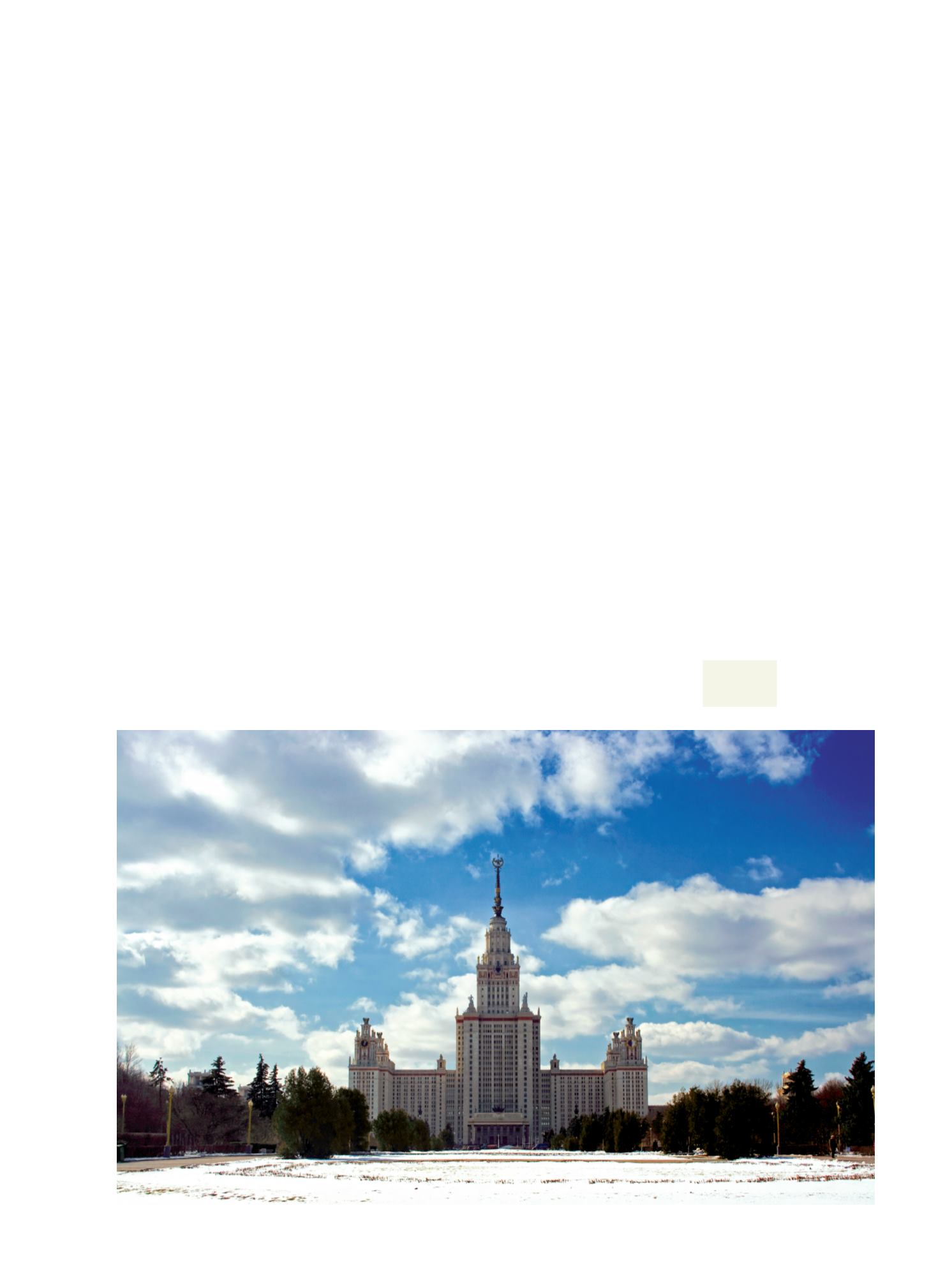
The State University of Moscow
Located in the Hills of Vorobyovy Gory, themain buil-
ding of the university is one of the most mysterious
and majestic constructions of the city. As many other
buildings in Moscow, its history is also mixed with
tragic events. The work of Gothic style, Neoclassic was
commissioned by Stalin along with other 6 buildings
denominated The Seven Sisters between 1949 and
1953. To carry out the job thework of thousands of peo-
plewas required that had to construct the building in a
rush during a period of four years. The university
building is the highest of the Seven Sisters. Its style, as
well as the other 6 buildings, is very special.
The metro of Moscow
The subway stations of Moscow have been called the
People’s Palaces thanks to the elegant materials and
designs that were used for its construction: from
large pieces of marble to candelabras.
One of the most interesting stations is
Kropotkinskaya (knownuntil 1957 as “The Palace of the
Soviets”). This station is a part of the first line of the
metro inaugurated in 1935 and was designed by the
architect Dushkin. The marble columns and walls were
taken from the old Cathedral of the Savior Christ that
the soviets pulled down.
Weather
The weather in Moscow is extreme. If you visit during
the winter months, you will stop asking why the
fue propuesto originalmente por una organización
pública. La reconstrucción estuvo a cargo del arqui-
tecto ruso Posokhin. Su equipo llevó a cabo una com-
pleja tarea basándose en lo que quedaba del
proyecto original: bocetos, medidas y fotografías.
La Universidad Estatal de Moscú
Situado en las Colinas de Vorobyovy Gory, el edificio
principal de la universidad es una de las construcciones
másmajestuosas ymisteriosas de la ciudad. Como tan-
tos otros edificios en Moscú, su historia está también
mezclada con eventos trágicos. La obra de estilo Gótico,
Neoclásico fue comisionada por Stalin junto con otros 6
edificios denominados Las Siete Hermanas entre 1949
y 1953. Para llevar a cabo la obra se requirió el trabajo de
miles de personas que tuvieron que construir el edificio
a marchas forzadas durante un periodo de cuatro años.
El edificio de la universidad es el más alto de las Siete
Hermanas. Su estilo, así como el de los otros 6 edificios,
es muy especial.
El metro de Moscú
Las estaciones delmetro deMoscúhan sido llamadas los
Palacios del Pueblo debido a los elegantes materiales y
diseños que fueron empleados para su construcción:
desde grandes piezas de mármol hasta candelabros.
Una de las estaciones más interesantes es
Kropotkinskaya (conocida hasta 1957 como “El Palacio
de los Soviets”). Esta estación forma parte de la prime-
ra línea del metro inaugurada en 1935 y fue diseñada
por el arquitecto Dushkin. Las columnas y los muros de
mármol fueron tomados de la vieja Catedral del Cristo
Salvador que derrumbaron los soviéticos.
Clima
El clima en Moscú es extremoso. Si visita durante los
meses de invierno, dejará de preguntarse por qué los
rusos tienen la tradición de usar abrigos de pieles. Con
Edificio principal de la
universidad estatal de
Moscú. La obra de estilo
Gótico, Neoclásico fue
comisionada por Stalin
junto con otros 6 edificios
denominados Las Siete
Hermanas.
Main building of the
State University of
Moscow. The work of
Neoclassical, Gothic style
was commissioned by
Stalin along with other 6
buildings called The
Seven Sisters.


