36
·amura·
compás int •
compass int
A
orillas del río Moldava se encuentra la ciudad
más importante de la República Checa: Praga.
Con su historia y su ubicación especial, entre
oriente y occidente, ha desarrollado un carácter
único: mezcla de culturas y tradiciones que le brin-
dan una armonía especial y un paisaje difícil de
encontrar en otra ciudad del mundo.
Praga y sus rincones secretos
El origen de la ciudad de Praga se remonta al
Paleolítico superior, aunque su primer asentamiento
urbano tomó forma en el siglo X. Fue entonces cuan-
do los eslavos construyeron dos fortificaciones
sobre dos colinas opuestas, con el fin de controlar el
paso por el Moldava. Su ubicación pronto la convirtió
en un importante centro de intercambio comercial.
Su desarrollo comenzó a partir del siglo XI, cuan-
do ya se levantaba el núcleo de la ciudad de Praga: la
Ciudad Vieja. Los asentamientos de mercaderes
alemanes, la Ciudad Hebrea, la Malá Strana (Parte
Pequeña), la Ciudad de San Galo y la primera muralla,
construida por orden del rey Wenceslao I, se encuen-
tran entre las primeras edificaciones que forjaron
la Ciudad.
En esa época Praga fue elegida como la residen-
cia de los reyes de Bohemia, y en el siglo XIV fue la
sede de la corte del Sacro Imperio Romano, bajo el
dominio de Carlos IV. Fue durante este periodo que,
por Orden Real, el arquitecto eslavo Peter Parler llevó
a cabo la construcción del Puente de Carlos, una de
las principales atracciones de la ciudad.
A
t the river banks of theMoldavianRiver there is
the most important city of the Czech Republic:
Prague. With its history and its special ubica-
tion, between east andwest, it has developed a unique
character: mix of cultures and traditionswhich bring a
special harmony to it and a landscape difficult t o find
in another city of the world
Prague and its secret corners
The origin of the city of Prague goes back to the upper
Paleolithic, although its first urban settlement took
place in the Xth century. It was then when the slaves
built two fortifications upon two opposing hills, with
the purpose of controlling the passing through the
Moldavian. Its location soon turned it into an impor-
tant commercial exchange center.
Its development started since the XIth century,
when the nucleus of the city of Prague was rising:
the Ancient City. The settlements of the German
merchants, the Hebrew city, the Malá Strana (Small
Part), the City of Saint Gaul and the first wall, built
under the orders of the king Wenceslaus the Ist,
they are among the first buildings which create
the city.
In this time Prague was chosen as the residence of
the Bohemian kings, and in the XIVth century it was
the seat of the court of the Sacred Roman Empire,
under thedomainof Charles IV. Itwas during this peri-
od that, byRoyal Orders, the slave architect Peter Parler
carried out the construction of the Charles Bridge, one
of the city’smain attractions.
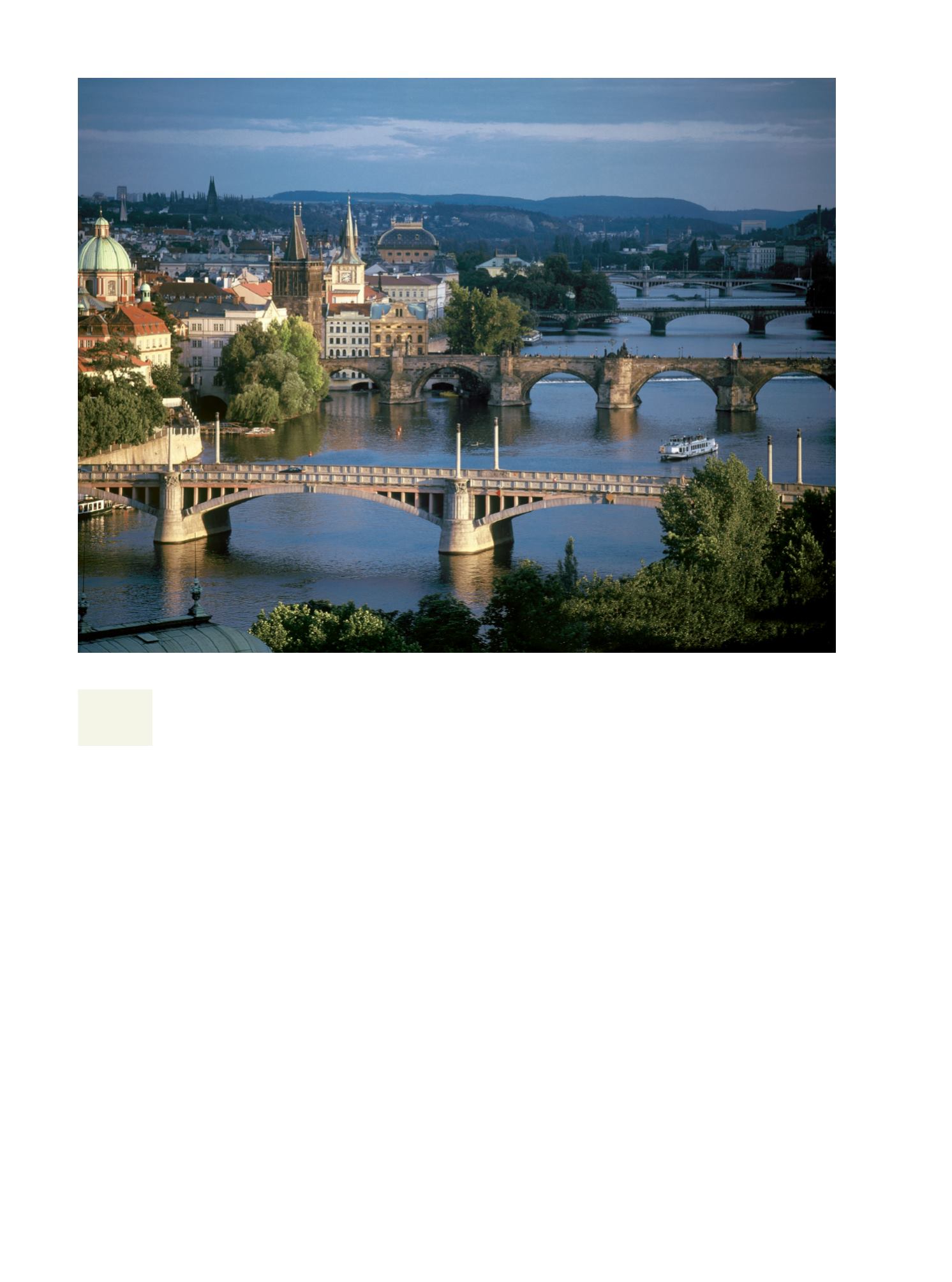
Puentes sobre el río Moldava, el río
más largo de la República Checa. En
su curso pasa por Cesky Krumlov,
Ceske Budejovice y Praga.
Bridges over the Moldavia River,
the largest river of the Czech
Republic. In its course it passes
by Cesky Krumlov, Ceske
Budejovice and Prague.


