37
compás int •
compass int
·amura·
At the end of the XIVth century, Prague was
already a four urban nuclei metropolis and two
castles, populated by 50 thousand people from
different origins. In the next centuries –under the
Habsburg Empire- the city experimented an
important development as a cultural, political and
religious center.
During the Nazism, the city lost a fundamental
part of its population: the Hebrew community
(decisive for its identity). Later on, the German
community would also disappear. Today, the city
continues its evolution with a definitively Czech
character; however, the language and culture mix
can be admired in each one of its streets.
After that in January 1st of 1993 the division
of the Czech Federative Republic in two inde-
pendent states: Slovakia and Czech Republic, this
nation represents today a modern country, with a
rich cultural and historic legacy ideal to visit.
Picturesque Quarters
The Ancient City has been since the IXth century
the landscape of the international exchanges. In
the Square of the Ancient City, there is the astro-
nomical clock of the City Hall, one of the city jewels.
There is also the Church of Sv. Jakub one of the
most significant gothic buildings: the Temple of
Tyn. One of the main attractions of this area is the
house where Franz Kafka lived for many years.
The Charles Bridge communicates the Ancient
City with the Malá Strana Quarter, a small region
which extends at the feet of the Prague Castle. The
Quarter was practically destroyed in 1541 and had
to be rebuilt almost entirely. There are a lot of
palaces and historic buildings in its surroundings.
A finales del siglo XIV, Praga era ya una metrópoli
de cuatro núcleos urbanos y dos castillos, poblada
por 50 mil personas de distintos orígenes. En los
siglos posteriores -bajo el imperio de los Habsburgo-
la ciudad experimentó un importante desarrollo
como centro cultural, político y religioso.
Durante el nazismo, la ciudad perdió una parte fun-
damental de su población: la comunidad hebrea (decisi-
va para su identidad). Más tarde la comunidad germana
también desaparecería. En la actualidad, la ciudad con-
tinúa su evolución con un carácter decididamente
checo; sin embargo, la mezcla de lenguas y culturas se
puede contemplar en cada una de sus calles.
Después de que el 1 de enero de 1993 se produjo la
división de la República Federativa de Checoslovaquia
en dos estados independientes: República Eslovaca y
República Checa, esta nación representa en la actua-
lidad a un país moderno, con un rico legado cultural e
histórico ideal para visitar.
Barrios pintorescos
La Ciudad Vieja ha sido desde el siglo IX el escenario
de los intercambios comerciales. En la Plaza de la
Ciudad Vieja, se encuentra el reloj astronómico del
Ayuntamiento, una de las joyas de la ciudad. También
aquí está la Iglesia de Sv. Jakub y uno de los edificios
góticos más significativos: el Templo de Tyn. Una de
las principales atracciones de esta zona es la casa
donde residió Franz Kafka durante muchos años.
El Puente de Carlos comunica la Ciudad Vieja con el
barrio de la Malá Strana, una pequeña región que se
extiende a los pies del Castillo de Praga. El barrio fue
prácticamente destruido en 1541 y tuvo que ser
reconstruido casi por completo. En sus alrededores se
encuentran muchos palacios y edificios históricos.
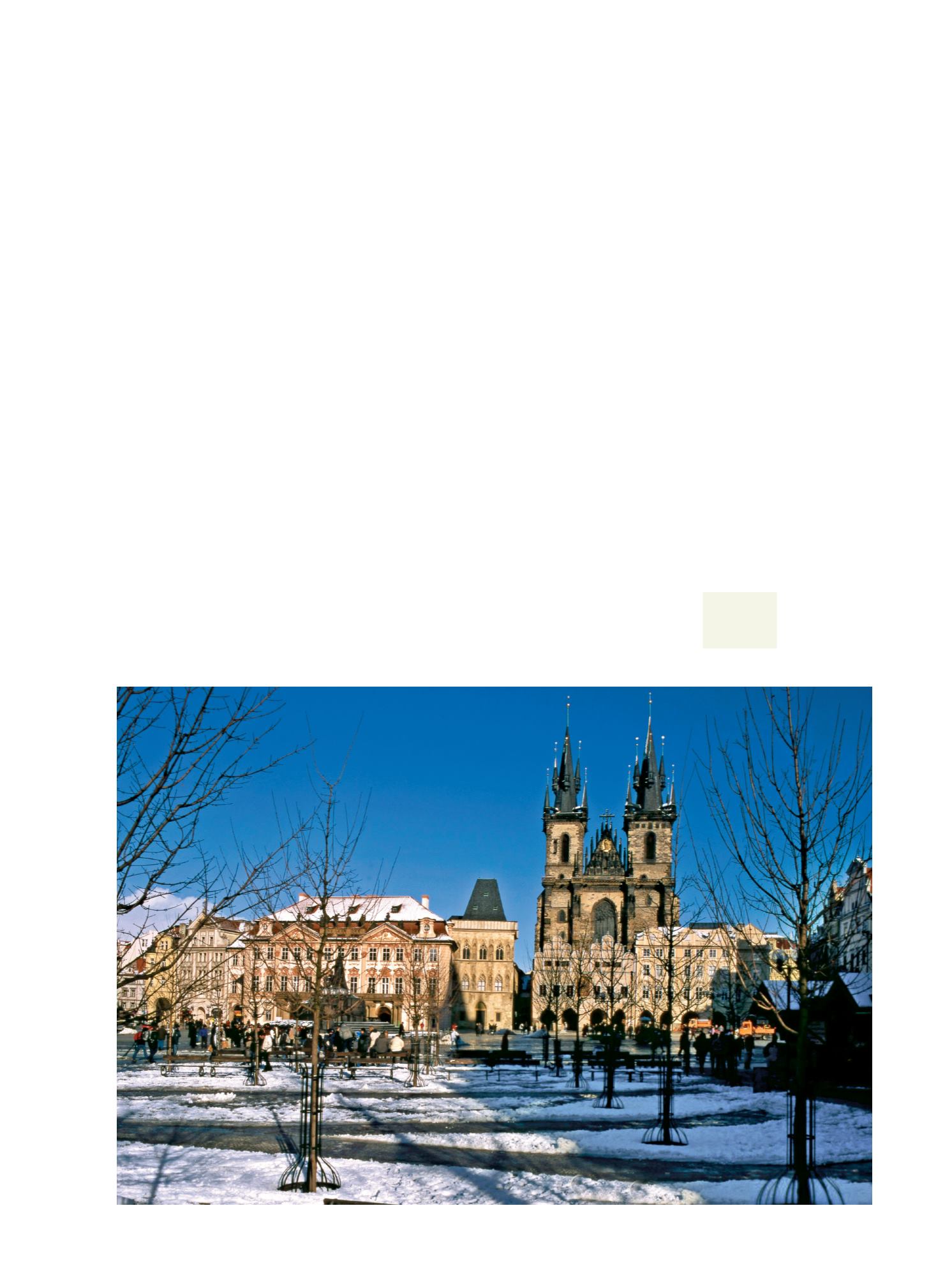
La plaza de la Ciudad Vieja en
invierno. A pesar de muchas
modificaciones, sigue manteniendo
un inigualable estilo gótico.
The Old Town Square in winter.
Despite many modifications, it
preserves an incomparable
gothic style.


