39
·amura·
Founded by Charles IVth, the New City houses
numerous convents, monasteries, churches and
squares being the largest, Wenceslaus Square.
There has been multiple celebrations and activi-
ties in the open air in this place.
Near the Ancient City there is the Vysehrad
Quarter, which during the XIth and XIIth centuries,
was seat of the Czech princes. The remains of
the fortress have been preserved until today. The
Church of Saint Peter and Saint Paul is located
here, one of the most famous of Prague. The old
monuments in the surroundings contrast with
three cubist buildings built between the years
1911 and 1913.
The Jewish Quarter (Josefov) is another famous
area of the city. Although a large part of its original
aspect has been lost, this region still preserves its
mysterious and legendary character. There are
many histories and legends inwhich there has been
captured the originality of the old community.
The monument for excellence of the Jewish
Quarter is the Ancient New Synagogue, the most
ancient of all of those which have been preserved
in Europe (around 1270), and one of the oldest
gothic constructions in Prague.
The Jewish cemetery in this quarter is an obli-
ged visit. In this place it is possible to appreciate the
mysterious sensibility and spirituality of the old
community. The most visited tombstone is wit-
hout a doubt where themost significant personality
of the Jewish community Prague rests: the rabbi
Jehuda Low Ben Bezalel (1525-1609), better known
Fundada por Carlos IV, la Ciudad Nueva alberga
numerosos conventos, monasterios, iglesias y pla-
zas siendo la más grande, la Plaza Wenceslao. En
este lugar se celebran múltiples espectáculos y
actividades al aire libre.
Cerca de la Ciudad Vieja se encuentra el barrio
de Vysehrad, que durante los siglos XI y XII, fue
sede de los príncipes checos. Los restos de la forta-
leza se han conservado hasta nuestros días. Aquí
se encuentra la Iglesia de San Pedro y San Pablo,
una de las más célebres de Praga. Los monumentos
antiguos en los alrededores contrastan con
tres edificios cubistas construidos entre los años
1911 y 1913.
El Barrio Judío (Josefov) es otra zona famosa de
la ciudad. Aunque gran parte de su aspecto original
se ha perdido, esta región conserva aún su carácter
misterioso y legendario. Son muchas las historias y
leyendas en las que se ha plasmado la singularidad
de la antigua comunidad.
El monumento por excelencia del Barrio Judío
es la Sinagoga Viejo Nueva, la más antigua de todas
las que se han conservado en Europa (alrededor de
1270), y una de las construcciones más antiguas
del gótico en Praga.
El cementerio judío en este barrio es una visita
obligada. En este lugar es posible apreciar la miste-
riosa sensibilidad y espiritualidad de la antigua
comunidad. La tumba más visitada es sin duda
donde descansa la personalidad más significativa
de la comunidad judía de Praga: el rabino Jehuda
Low Ben Bezalel (1525-1609), mejor conocido como
compás int •
compass int
1. Teatro Nacional Checo
National Czech Theater
2. Vista de Praga con la
Catedral de San Vito en el
fondo
View of Prague with the
Saint Vito Cathedral in
the back
3. Vista de la Plaza Vieja
View of the Old Town
Square
4. Vista del Castillo de Praga
por la noche
View of Prague Castle at
night
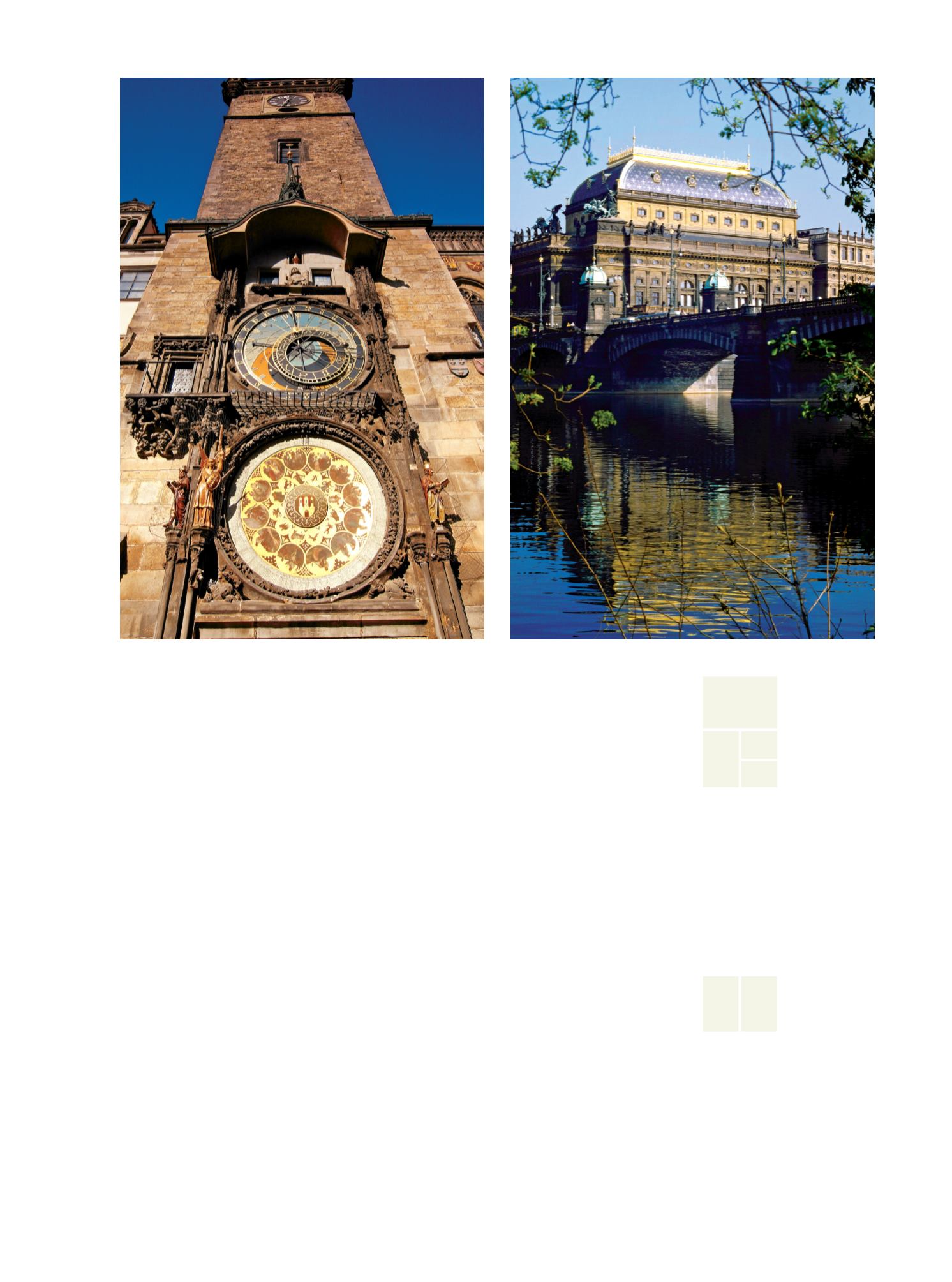
1. Reloj astronómico medieval
en la Plaza Vieja
Astronomical medieval clock
in the Old Town Square
2. Teatro Nacional: un símbolo
de identidad checa
National Theater: a symbol of
the Czech identity
1
1
2
2
3
4


