·amura·
134
personajes •
characters
Sin embargo, su gozosa percepción de la ciudad
se oscureció por la necesidad de estudiar en la Acade-
mia de Ingeniería Militar. Allí sus sueños y la realidad
comenzaron a divergir. El sueño de la ciudad hizo que
la urbe se convirtiera en una ciudad fantasma, donde
todo era irreal y artificial. Para el joven Dostoievski, San
Petersburgo parecía un teatro de marionetas: “Oculto
detrás de toda esta gente fantástica, alguien me esta-
ba haciendomuecas ymoviendo los hilos: los hilos y los
títeres se movían mientras se reían y se reían”.
El padre de Dostoievski eligió la profesión de inge-
niero militar para su hijo. El, sin embargo, no sirvió ni
siquiera la mitad de un año para el Departamento de
Redacción. En lugar de una posición estable y un salario
regular prefería una vida desordenada, una dependencia
constante a sus editores, el trabajo sinfin, y las dudas del
escritor agonizante: “Me retiré porque me retiré, es de-
cir, te juro que no podía servir más tiempo. Odias la vida
cuando el mejor momento es arrebatado y llevado lejos
de ti. Para nada voy a trabajar como el diablo”.
Dostoievski escribió constantemente, sin detener-
se a descansar: “Estoy convencido de que ninguno de
nuestros escritores, fallecido o con vida, escribieron en
las condiciones en las que constantemente escribo”.
Cuando renunció al servicio, Dostoievski, necesi-
taba darse a conocer, y esto lo hizo con vigor y talento
en 1846 con su primera novela Pobres Gentes, lleván-
dole brillantemente al éxito. Todos en San Petersbur-
go comenzaron a hablar de Dostoievski. Continuó es-
cribiendo y publicó varias obras más: El matrimonio,
La casera, Netochka Nezvanova y Noches Blancas.
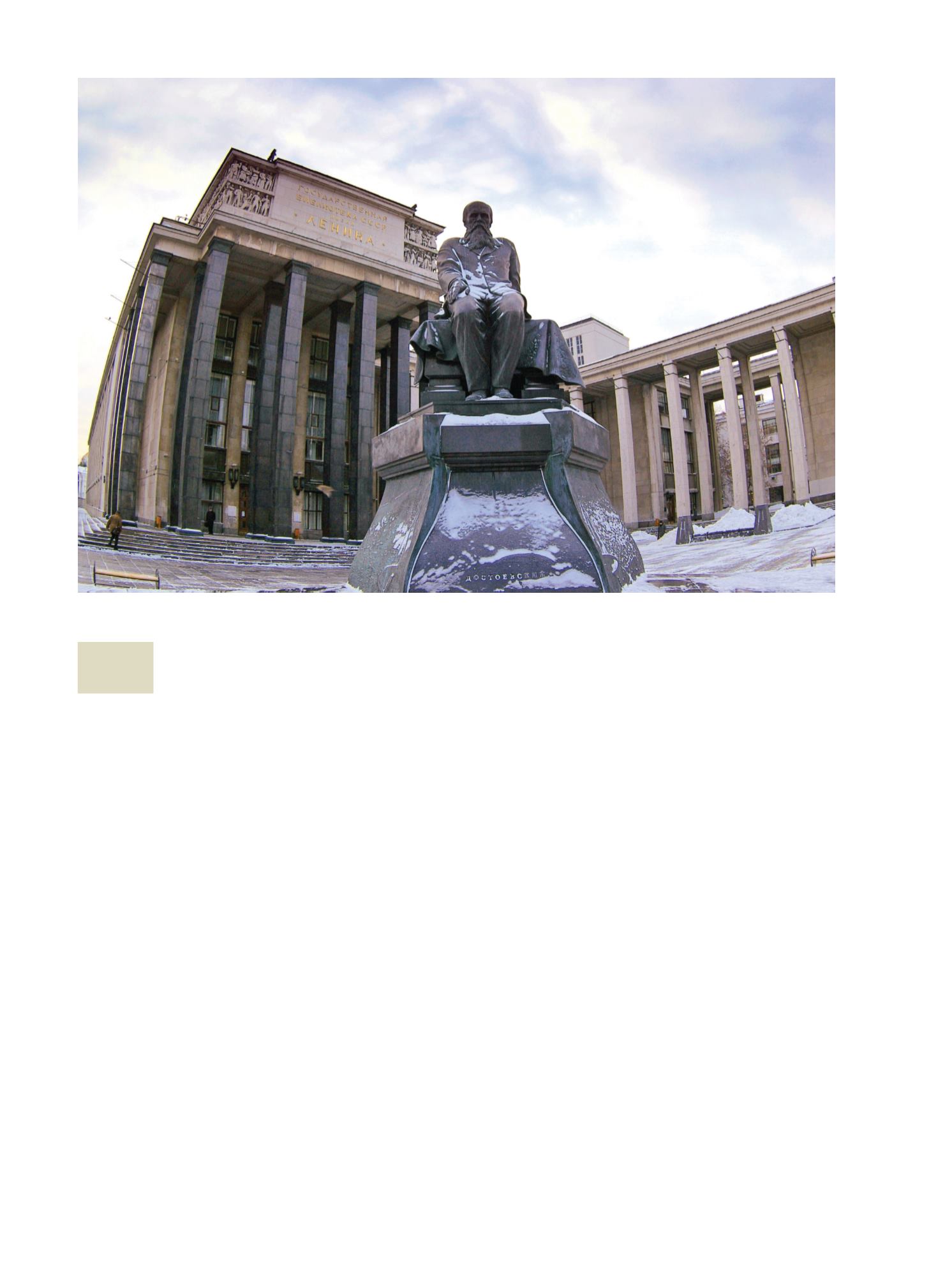
3
3. La biblioteca
estatal de Rusia,
ubicada en Moscú,
es la tercera más
grande del mundo
y está adornada
con una estatua de
Dostoievski, por ser
uno de los íconos de
la literatura rusa y
universal.
/ The state
library of Russia,
located in Moscow,
is the third largest in
the world, and it is
adorned with a sta-
tue of Dostoyevsky,
being on the icons on
Russian and Western
literature.
However, his joyous perception of the city was
darkened by the need to study at the Academy of Mili-
tary Engineering. Here the dreams of Dostoevsky and
his reality began to diverge. The dream of the city be-
gan to turn into a ghost town, where everything was
unreal and artificial. For the young Dostoevsky, St. Pe-
tersburg looked like a puppet show : “ Hidden behind
all these fantastic people, someone was making faces
atme and pulling the strings: the strings and puppets
movedwhile they laughed and laughed .”
Dostoevsky’s father chose the profession of
military engineer for his son. He, however, did
not serve even half a year for the Writing Depart-
ment. Instead of a stable position and a regular
salary he preferred a disorderly life, a constant
editor’s dependency, endless work and the
doubts of a writer: “I retired because I retired, I
swear I could not serve longer. You hate life
when the best time is snatched away from you.
Anything but going to work like the devil. “
Dostoevsky wrote constantly, without stop-
ping to rest: “I am convinced that none of our
writers, dead or alive, wrote in the conditions in
which I constantly write.”
When he resigned the service, Dostoevsky need-
ed to get noticed, and this he did with vigor and tal-
ent in 1846 with his first novel “Poor Ages” which
brilliantly led him to success. All St. Petersburg be-
gan to speak of him. He continued writing and pub-
lished several other works: Marriage, Homemade,
Netochka Nezvanova and White Nights.
Foto /
Photo
: lib alt / KCXI / BP / steve myers / STEVE RILEY


