El efecto Dostoievski
En la noche del 22 de abril de 1849, Dostoievski fue de-
tenido por su participación en el “revolucionario” Círcu-
lo Petrashevski. Después del juicio, él y otros miembros
del círculo fueron exiliados a Siberia. El escritor había
sido arrancado del proceso literario de diez años. A su
regreso a San Petersburgo a finales de 1859, Dostoie-
vski se vio obligado a empezar de nuevo.
Alquilando cuartos baratos en zonas pobres de la
ciudad, él se movía con frecuencia y nunca se quedaba
en una dirección más de tres años. Los amigos que lo
visitaron en varios apartamentos notaron el ascetis-
mo de su decoración, la sencillez y la moderación de
los interiores. La habitación principal de Dostoievski
fue siempre su estudio. Un escritorio, a menudo era
colocado en medio de la habitación y siempre ocupó
el lugar principal: “El estudio de Fedor Mijáilovich era
una habitación grande con dos ventanas, en la parte
trasera de la sala había un sofá suave con cubierta de
un material marrón bastante desgastado y, frente a
ella, había una mesa redonda con una servilleta de tela
color rojo. Estaban también una lámpara y dos o tres
álbumes. Por todo el lugar había sillas suaves y sillo-
nes, las ventanas estaban decoradas con dos grandes
jarrones chinos de una forma hermosa a lo largo de la
pared. Había un gran sofá de cuero verde de marrue-
cos, y cerca de éste había una pequeña mesa con una
jarra de agua. En el lado opuesto, a todo lo largo de
la habitación, un escritorio podía ser encontrado”. De
este modo Anna Dostoevskaya, la segunda esposa del
escritor, describió el estudio en el apartamento donde
Dostoievski creó su novela Crimen y castigo.
El estudio en el apartamento de Dostoievski en la
avenida griega se reproduce en las memorias de M.
Aleksandrov: “El estudio de Fedor Mijáilovich era úni-
co en su extrema simplicidad. No había ni siquiera una
insinuación del arreglo moderno banal de los estudios,
que por lo general, ni siquiera sirve para descifrar la
profesión de la persona que lo utiliza.
The Dostoevsky Effect
On the night of April 22, 1849, Dostoevsky was
arrested for his involvement in the “revolution-
ary” Petrashevski Circle. After the trial, he and
the others were exiled to Siberia. The writer had
been torn from the literary process for ten years.
On his return to St. Petersburg in late 1859, Dos-
toevsky was forced to start over.
Renting cheap rooms in poor areas of the
city, he moved frequently and never stayed in a
address for more than three years. Friends who
visited him in several apartments noticed as-
ceticism in his decoration, along the simplicity
and moderation of the interiors. The main room
was always Dostoevsky study. A desk, was often
placed in the middle of the room and always oc-
cupied the main place: “The study of Fedor Mi-
jáilovich was a large room with two windows in
at the back of the room, it had a soft couch of
brown material quite worn and a round table
with a red cloth. There was a lamp and two or
three albums on it. Scattered around the place
there were chairs and couches, the windows
were decorated with two large Chinese vases
of beautiful forms along the walls and a large
leather green moroccan sofa green, near it was
a small table with a pitcher of water. On the op-
posite side, throughout the entire length of the
room, a desk could be found “ . Anna Dostoevs-
kaya, the second wife of the writer, described the
study in the apartment where Dostoevsky wrote
his novel Crime and Punishment.
The studio apartment of Dostoevsky on the
Greek avenue lingers in M.Aleksandrov memo-
ries. “Fedor Mijáilovich’s study was unique in its
extreme simplicity. There was not even a hint of
whimsy modern arrangement, generally used to
decipher even the profession of the person who
uses it.”
·amura·
135
personajes •
characters
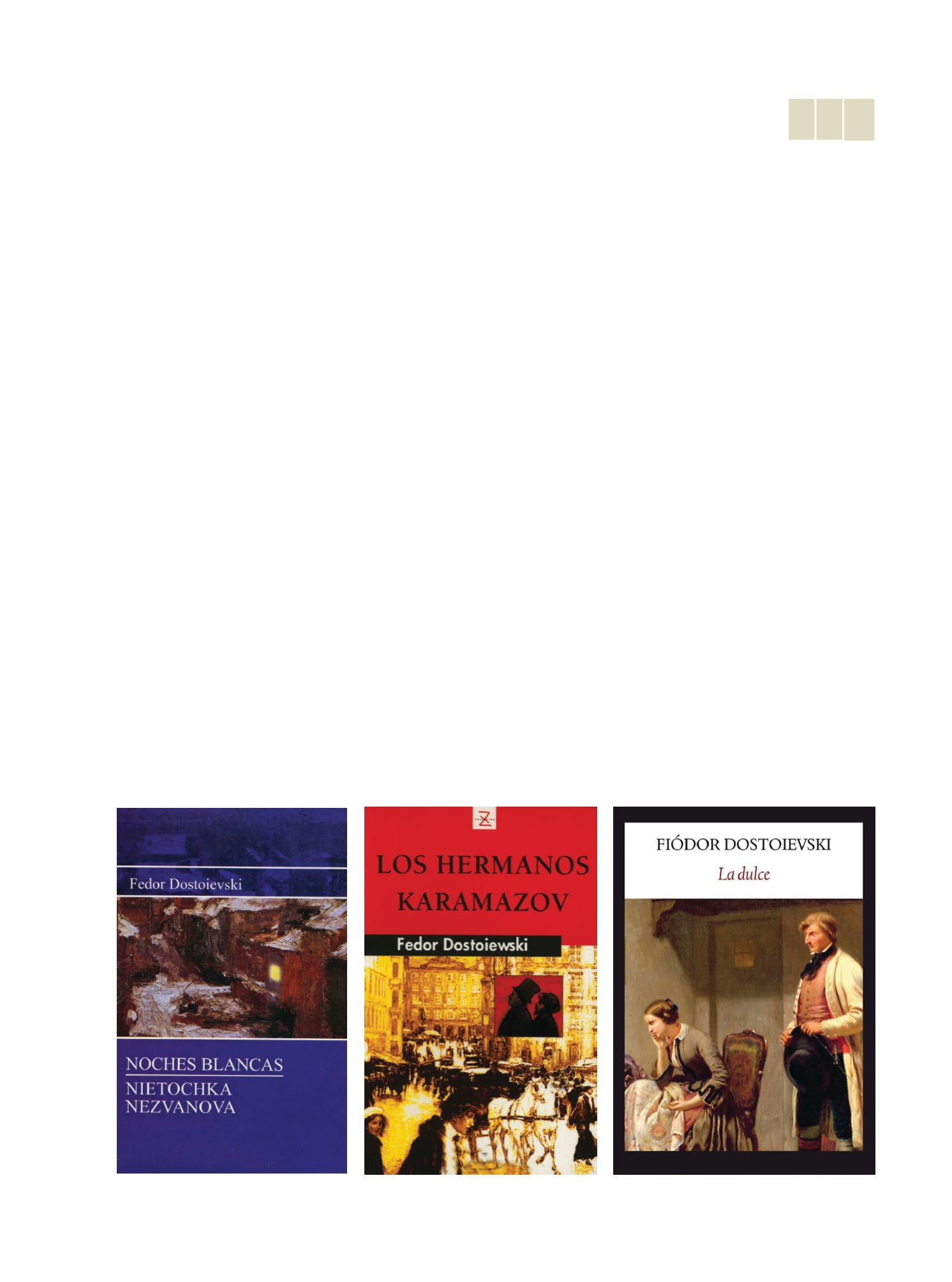
4. Noches Blancas,
publicado 1848
/
White Nights,
published in 1848
5. Los Hermanos
Karamazov,
publicado en 1880.
/
The Brothers
Karamazov,
published in 1880
6. La Dulce,
publicado en 1876.
/
La Dulce, published
in 1876
4 5 6


