·amura·
137
personajes •
characters
“Our second floor apartment consisted of six
rooms, a huge warehouse for books, an entrance
hall and a kitchen. There were seven windows
facing Kuznechny Lane, and a study, in which
my husband had a marble plaque mounted. “
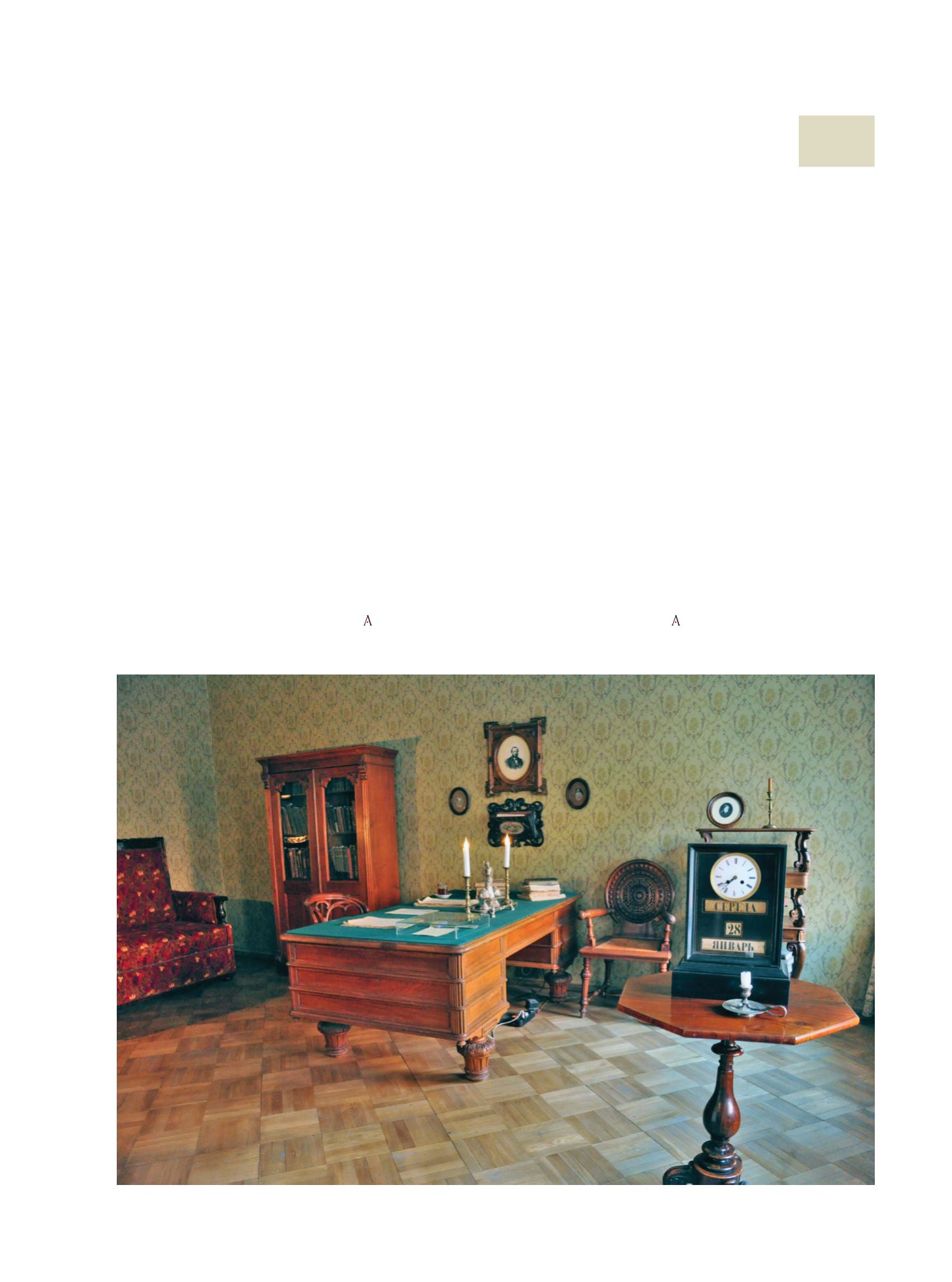
The study of the writer was reconstruct-
ed from a photograph taken by photographer
V.Taube after Dostoevsky ‘s death. Several per-
sonal items are on display: on the desk is a pen, a
box of medicines, a wallet and a holder for letters
and papers. On the wall of the right corner hangs
a religious icon with silver frame entitled “ Divine
Mother, joy of all who suffer . “ From the windows
of the study we can see the domes of the Church
of Vladimir, where Dostoevsky attended services
in the last years of his life. The old shelves con-
taining the books he had in his personal library
can also be seen. The museum collects these
based on lists compiled by the writer’s second
wife, Anna Grigoryevna. In the back of the room
there is a sofa, above which hangs a picture of the
Sistine Madonna by Raphael, Dostoevsky’s favor-
ite painting. On the table beside the windows,
a watch that stopped at the day and time of the
death of Dostoevsky can be found : January 28,
1881 , 20:36 . In Dostoevsky’s next apartment two
rooms housing a literary exhibition devoted to
his life and work are there for expectators.
St. Petersburg also serves as the final resting
place of the writer. He is buried in the cemetery of
Tikhvinskoe in Alexander Nevsky Monastery.
“Nuestro apartamento del segundo piso constaba
de seis habitaciones, un enorme almacén para libros, un
hall de entrada y una cocina. Siete ventanas que daban
a Kuznechny Lane, y el estudio de mi marido estaba en
el lugar en el que una placa de mármol está montada.”
El estudio del escritor fue reconstruido a partir de
una fotografía tomada por el fotógrafo V. Taube des-
pués de la muerte de Dostoievski. Varios objetos per-
sonales están en la exhibición: encima del escritorio
hay una pluma, una caja de medicinas, una billetera
y un soporte para cartas y papeles, en la pared de la
esquina derecha cuelga un icono religioso con marco
de plata titulada “Madre divina, gozo de todos los que
sufren”. Desde las ventanas del estudio se pueden ver
las cúpulas de la Iglesia de Vladimir, donde Dostoievs-
ki asistió a los servicios en los últimos años de su vida.
Las viejas estanterías contienen los libros que tenía
en su biblioteca personal. El museo recoge estos libros
basados en las listas compiladas por la segunda espo-
sa del escritor, Anna Grigorievna. En la parte trasera
de la habitación hay un sofá, encima del cual cuelga
una fotografía de la Madonna Sixtina de Rafael, pintu-
ra favorita de Dostoievski. Sobre la mesita, al lado de
las ventanas, encontramos un reloj que se detuvo en
el día y la hora de la muerte de Dostoievski: Enero 28,
1881, 20:36. En el apartamento adyacente al de Dos-
toievski hay dos salas que albergan una exposición
literaria dedicada a su vida y obra.
San Petersburgo también sirve como última mo-
rada del escritor. Está enterrado en el cementerio de
Tikhvinskoe, en el monasterio de Alexander Nevsky.
10. Recreación del
estudio de Fedor
Mijáilovich, en el
Museo Literario
Conmemorativo./
Recreation of Fyodor
Mikhailovich’s
studio, in the
Literary-Memorial
Museum
10


