·amura·
46
Arte Contemporáneo se ubican en el parque Forestal,
a la vera del Mapocho.
Tal como habíamos planeado, entramos a comer
en la Piojera, la picada más famosa de Chile, donde
enfrentamos la difícil tarea de elegir entre su famoso
cóctel “Terremoto”, la chicha, los perniles, arrollados,
malaya y su carne a la parrilla. La música impone un
ambiente acogedor y familiar; tal vez por eso aquí
siempre se encuentran políticos, poetas, pintores,
pensadores y escritores.
Ya satisfechos la emprendimos al Museo Nacional
de Bellas Artes para admirar la impresionante colec-
ción de esculturas y pinturas nacionales e internacio-
nales, incluso obra flamenca, italiana, francesa, de Pis-
sarro a Rodin, de Rubens a Zurbarán. Nos detuvimos
luego en el Centro Cultural Estación Mapocho, antigua
estación de tren de arquitectura afrancesada, cons-
truida al principios del siglo pasado.
Por la noche entramos al suntuoso Teatro Muni-
cipal de Santiago (1857) para ver por dentro su esti-
lo neoclásico. Nos tocó asistir a la representación de
“la Bayadera”, fantástico ballet con música de Ludvig
Minkus y coreografía de Luis Ortigoza. Al salir de ese
encanto cenamos en el famoso restaurante Canto del
Agua y exploramos su gastronomía nortina, famosa
por sus excepcionales crustáceos, pescados y carnes,
sin dejar atrás a sus postres deliciosos. Cerramos la
noche tomando las últimas copas en “Club Eve”, un
antro con baile, lounge y gente guapa y elegante.
and the Museum of Contemporary Art are located in
Forestal Park, on the banks of the Mapocho.
After seeing all this beauty, we headed to the
National Museumof Fine Arts to admire the impres-
sive collection of sculptures and national and in-
ternational works of art, including Flemish, Italian,
and French. From Pissarro to Rodin, from Rubens to
Zurbarán. We stopped also at the Mapocho Cultural
Center. It is an old train stationwith French style ar-
chitecture, built in the early last century.
Just as planned, we went to eat at the Piojera
which is themost famous “picada” in Chile. We faced
the difficult task of choosing between the famous
“Terremoto” cocktail, the chicha, the perniles, arrol-
lados or malaya and its grilled meat. The music im-
poses a cozy and familiar atmosphere. Maybe that’s
why it is here that you can always find here politi-
cians, poets, artists, philosophers and writers.
That night, we went to the magnificent Teatro
Municipal de Santiago (1857) constructed in the neo-
classical style. We attended a fantastic performance
of “La Bayadere” ballet, music of Ludwig Minkus and
choreographybyLuisOrtigoza.Leavingthisenchant-
ment, we had dinner at the famous restaurant Canto
del Agua and explored its nortina gastronomy. It is
famous for its exceptional sea food, fish and meat,
not to mention their delicious desserts. We closed
the evening with a night-cap at “Club Eve”, a dancing
lounge with elegant and beautiful people.
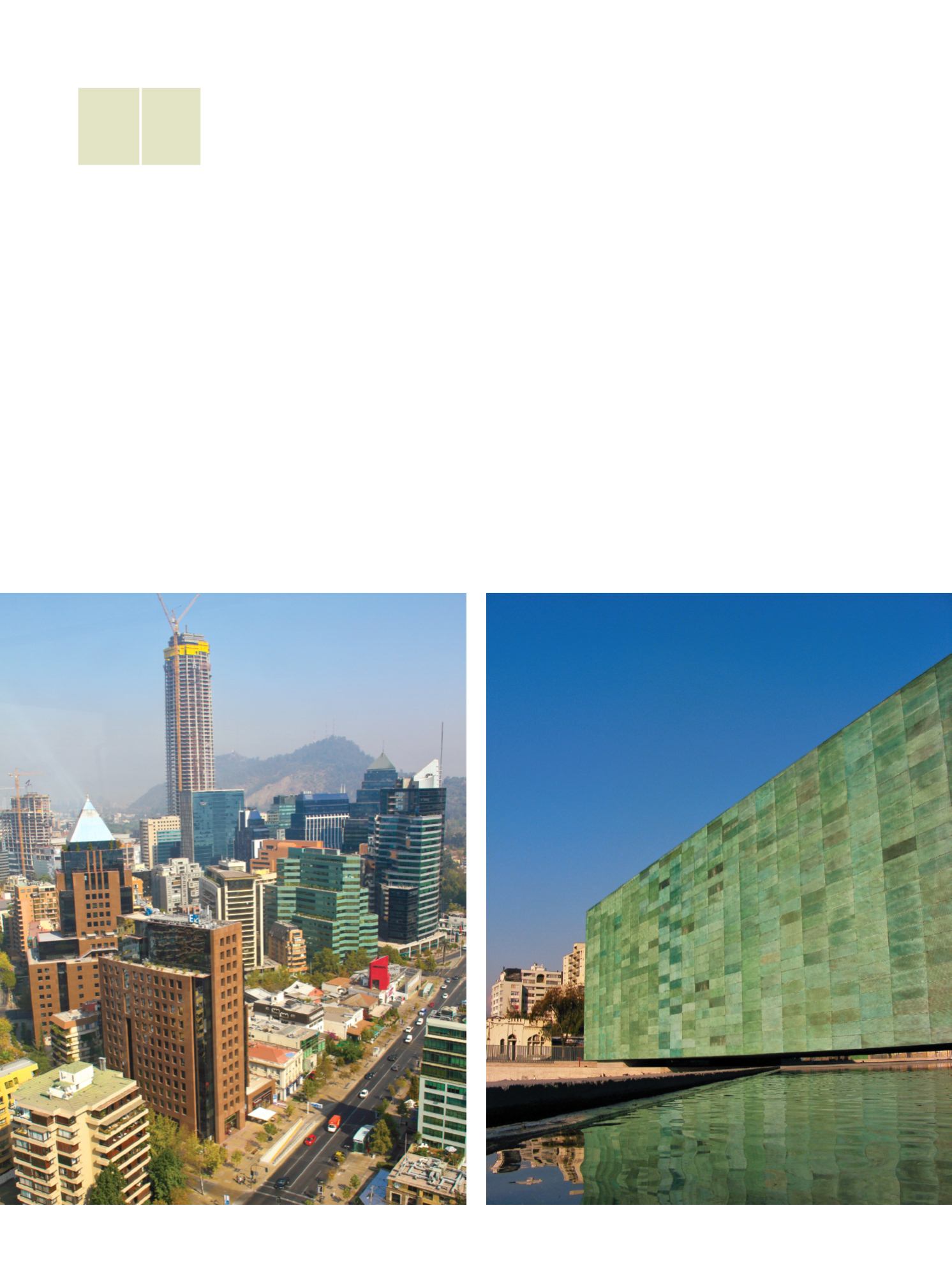
10
11
10. Actualmente
Santiago es el núcleo
urbano más impor-
tante de Chile. Al
fondo, la Gran Torre
Santiago, la más alta
del país.
Currently, Santiago
is themost impor-
tant urban core in
Chile. In the back-
ground, the Great
Tower of Santiago,
the tallest in the
country.
11. El Museo de la
Memoria y los Dere-
chos Humanos, un
espacio dedicado a
honrar a las víctimas
del Estado chileno
entre 1973 y 1990.
The Museumof
Memory and Human
Rights, a space de-
dicated to honor the
victims of the Chi-
lean state between
1973 and 1990.


